
Seat Ibiza (6F) 2017-2026 Owner's Manual: Tyre life
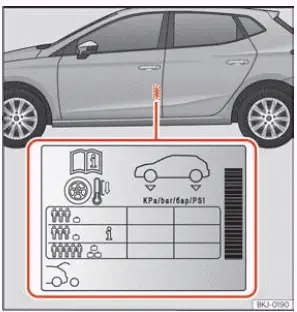
Fig. 178 Location of the tyre pressure sticker.
Maintaining the correct tyre inflation pressure and adopting a smooth, controlled driving style are two of the most effective ways to extend the service life of the tyres fitted to your Seat Ibiza. Tyre wear is influenced by several factors, including inflation pressure, vehicle load, road conditions, driving habits and wheel alignment. Regular maintenance helps the tyres wear more evenly, preserves their intended handling characteristics and reduces the likelihood of premature replacement. Properly maintained tyres also contribute to reliable braking, stable cornering and efficient vehicle operation.
- Check the inflation pressure of all tyres at least once a month and before setting off on any long journey. Tyres can gradually lose pressure during normal use, even when there is no visible puncture or other obvious damage. Regular checks make it easier to identify pressure changes before they lead to excessive wear or affect driving safety. Include all four road wheels in each inspection and check the spare wheel where one is provided.
- Always measure tyre pressure when the tyres are cold. Driving causes the tyres to warm up, increasing the pressure of the air inside them. A reading taken immediately after a journey may therefore be higher than the normal cold inflation pressure. Do not release air from warm tyres simply because the measured pressure exceeds the value shown on the vehicle's tyre pressure label. Doing so could leave the tyres underinflated once they have cooled.
- Adjust the tyre inflation pressure to suit the load being carried by the vehicle, using the values specified on the tyre pressure sticker shown in Fig. 178. The required pressure may differ depending on the number of occupants, the amount of luggage and the overall vehicle load. When the Seat Ibiza is carrying a heavier load, the tyres must be inflated to the appropriate pressure indicated for those conditions. Always use the manufacturer's specified values rather than estimating the required pressure.
- On vehicles equipped with a tyre pressure monitoring indicator, store or confirm the new reference pressures after adjusting the tyres. This allows the monitoring system to use the correctly inflated tyres as its reference condition. Follow the relevant procedure described in the vehicle's operating instructions. The tyre pressure indicator does not replace the need to check inflation pressures manually and maintain them at the specified values.
- Avoid taking corners at excessive speed and accelerating aggressively, particularly when the tyres are already subjected to heavy loads. Sudden changes in direction and rapid acceleration increase the forces acting on the tread and can accelerate wear. Smooth steering inputs and progressive acceleration help preserve the tyres and maintain more predictable vehicle handling.
- Inspect the tyre tread surfaces periodically for uneven or unusual wear patterns. Pay attention to differences between the centre and shoulders of the tread, as well as irregular wear across the width of a tyre. Such patterns may indicate incorrect inflation pressure, wheel alignment problems or other conditions requiring attention. If abnormal wear is detected, have the tyres and relevant vehicle components inspected by a qualified specialist workshop before the problem becomes more severe.
Tyre pressure
The correct tyre inflation pressures for your Seat Ibiza are specified on the information sticker located on the rear section of the front left door frame, as illustrated in Fig. 178. This label provides the manufacturer's recommended pressures for the approved tyre arrangements and vehicle loading conditions. Consult the sticker whenever checking or adjusting tyre pressures, particularly if the vehicle is carrying more passengers or luggage than usual. The values shown on the label should take precedence over general pressure recommendations that are not specific to the vehicle.
Both insufficient and excessive tyre pressure can considerably shorten tyre life and negatively affect the vehicle's handling and ride comfort. Underinflated tyres deform more than intended while rolling, which increases heat generation and can accelerate wear, particularly around the tread shoulders. Excessive inflation can reduce the tyre's ability to absorb road irregularities and may contribute to uneven tread wear. Either condition can change the way the tyres respond during braking and cornering.
Correct inflation pressure becomes especially important when driving at higher speeds. As vehicle speed increases, the tyres are subjected to repeated deformation and greater operating demands. If their pressure is incorrect, these conditions can increase the risk of overheating, irregular wear or tyre damage. Maintaining the specified cold inflation pressures helps the tyres operate within their intended conditions and supports the stability and driving characteristics of the Seat Ibiza.
The required tyre pressure must always correspond to the load carried by the vehicle. A lightly loaded Seat Ibiza may have different recommended inflation pressures from one carrying several passengers and a substantial amount of luggage. If the vehicle is going to be fully loaded, increase the tyre pressures to the values specified for maximum load on the tyre pressure sticker shown in Fig. 178. Make the necessary adjustments before starting the journey, while the tyres are cold. When the vehicle is subsequently used with a lighter load, check the pressures again and adjust them to the appropriate values indicated on the label.
Remember to include the spare wheel when checking tyre inflation pressures. A spare wheel may remain unused for a long time, but it must still be maintained in a condition suitable for emergency use. Keep a conventional spare wheel inflated to the highest pressure specified for the vehicle's normal road wheels, as instructed by the manufacturer. Checking its pressure regularly helps ensure that it is ready if a puncture or other tyre problem makes replacement necessary. A spare wheel with insufficient pressure may not be suitable for safe use when it is needed.
If the vehicle is equipped with a compact temporary spare wheel of size 125/70 R16 or 125/70 R18, its specified inflation pressure is 4.2 bar, as indicated on the tyre pressure label in Fig. 178. This value applies to the temporary spare wheel sizes identified here and must not be confused with the inflation pressures for the normal road tyres. Compact temporary spare wheels have different operating characteristics from standard wheels and are intended for restricted, temporary use. Observe the applicable instructions and limitations whenever one is fitted to the vehicle.
Depending on the equipment and tyre configuration of the Seat Ibiza, the manufacturer may provide an alternative
inflation pressure setting for medium vehicle loads that is intended to improve ride comfort. This
comfort-oriented pressure is identified by the corresponding tyre pressure symbol  on the information sticker shown in Fig. 178. Where this option is specified, the appropriate values can be used
for the loading conditions indicated on the label. The comfort setting should not be applied when the vehicle's
load requires the higher inflation pressures specified for fully loaded operation.
Driving with the comfort-oriented tyre pressure setting may result in a slight increase in fuel consumption. This is because tyre inflation pressure influences rolling resistance and the amount of energy required to keep the vehicle moving. The comfort setting represents an alternative approved pressure arrangement for the relevant loading conditions, rather than a universal recommendation for all journeys. Select the pressure that corresponds to the vehicle's actual load and the values specified by SEAT.
Driving style
The way the Seat Ibiza is driven has a significant influence on tyre wear. Taking corners at high speed, accelerating sharply and braking heavily all place increased forces on the tread surface. When these actions are severe enough to make the tyres squeal, the rubber is being subjected to particularly high friction and stress. Repeated aggressive manoeuvres can accelerate tread wear and may produce uneven wear patterns, reducing the useful life of the tyres.
A smoother driving style helps reduce these effects. Accelerate progressively, anticipate traffic conditions to avoid unnecessary hard braking and approach corners at a speed appropriate for the road. These habits reduce the mechanical demands placed on the tyres and can also contribute to improved ride comfort and more consistent vehicle control. Even when tyre pressure and wheel alignment are correct, frequent harsh driving can substantially shorten tyre service life.
Wheel balance
The wheels fitted to new vehicles are balanced before delivery to ensure that they rotate smoothly during normal driving. Wheel balancing compensates for small differences in weight distribution around the wheel and tyre assembly. When the assembly is correctly balanced, it rotates with minimal unwanted vibration, helping maintain ride comfort and reducing unnecessary stress on the tyres and associated vehicle components.
Over time, however, the balance of a wheel can change. Certain operating conditions, tyre wear or changes affecting the wheel and tyre assembly may produce an imbalance or rotational irregularity. One of the most noticeable symptoms is vibration transmitted through the steering wheel, particularly while the vehicle is moving. Depending on the nature of the imbalance, the vibration may become more apparent at certain speeds.
If the Seat Ibiza develops steering wheel vibrations that may be caused by wheel imbalance, have the wheels inspected and rebalanced by a qualified specialist workshop. Continuing to drive with unbalanced wheels can contribute to increased wear of the tyres, steering components and suspension system. The resulting vibration may also reduce driving comfort and make it more difficult to identify other problems affecting the wheels or running gear.
Wheel balancing is also necessary whenever a new tyre is fitted or an existing tyre is repaired in a way that affects the wheel and tyre assembly. Correct balancing ensures that the assembly rotates as smoothly as possible after the work has been completed. If vibrations remain after balancing, further inspection may be required to determine whether the cause is tyre damage, wheel deformation or another mechanical condition.
Incorrect wheel alignment
Incorrect wheel alignment can cause the tyres to wear excessively or unevenly and may adversely affect the safety and handling of the Seat Ibiza. Wheel alignment determines how the wheels are positioned in relation to the vehicle and the road surface. If the alignment is outside the intended settings, the tyres may not roll in the correct direction, resulting in unnecessary friction and accelerated tread wear.
Abnormal alignment can sometimes be identified by uneven tyre wear, changes in steering behaviour or a tendency for the vehicle to pull to one side. However, excessive wear may develop gradually without an obvious change in the way the vehicle drives. For this reason, tyre tread condition should be checked regularly rather than relying exclusively on steering feel to identify possible alignment problems.
If you notice unusually rapid or uneven tyre wear, have the wheel alignment checked by an authorised SEAT Service centre or another qualified specialist workshop. The technician can determine whether the running gear requires adjustment and inspect relevant components if necessary. Correcting alignment problems promptly helps prevent further tyre damage, supports stable vehicle handling and reduces the likelihood of having to replace otherwise serviceable tyres prematurely.
WARNING Incorrect handling, maintenance or inflation of wheels and tyres can result in a sudden loss of tyre pressure, separation of the tread from the tyre structure or a complete tyre blowout. Such failures may occur without sufficient warning and can cause the driver to lose control of the vehicle. Maintaining the correct inflation pressure, observing the tyre's operating limits and inspecting its condition regularly are essential precautions for safe driving.
- The driver is responsible for ensuring that every tyre fitted to the Seat Ibiza is inflated to the correct pressure for the vehicle's current loading conditions. The manufacturer's recommended inflation pressures are provided on the tyre pressure label shown in Fig. 178. These values must be followed when adjusting the tyres. Incorrect inflation can affect braking, steering response, tyre durability and overall vehicle stability, particularly during demanding driving conditions.
- Check tyre inflation pressures regularly and maintain them at the values specified on the vehicle's tyre
pressure sticker. Do not wait for a tyre to appear visibly underinflated before checking it, as pressure
loss may not be obvious from its external appearance.
Insufficient tyre pressure causes the tyre to deform excessively as it rolls, generating additional heat within its structure. If the tyre becomes severely overheated, its internal components may deteriorate, potentially leading to tread separation or a sudden burst. The risk can increase during prolonged driving or when the vehicle is travelling at higher speeds. A tyre that has been operated with dangerously low pressure may also have sustained internal damage even if it appears normal after being reinflated. Have any tyre suspected of such damage inspected professionally before further use.
- The tyres must always be inflated to the cold pressure values indicated on the manufacturer's label in Fig. 178. These pressures are specified for tyres that have not been heated significantly by driving. Because tyre pressure naturally rises as the tyre warms up, measurements taken after a journey should not be used as a reason to release air from an otherwise correctly inflated tyre. Doing so could result in insufficient pressure once the tyre cools. Always refer to the correct values for the tyre size and vehicle load.
- Check the cold inflation pressure of all road tyres at regular intervals and adjust it whenever necessary. Pressure should also be checked before long journeys and when the vehicle's loading conditions change substantially. Use a suitable tyre pressure gauge and make adjustments while the tyres are cold. If a tyre repeatedly loses pressure, have it examined for punctures, valve problems or other defects rather than simply reinflating it each time. A persistent pressure loss may indicate damage that requires professional attention.
- Inspect the tyres regularly for signs of damage, deterioration and excessive or uneven tread wear. Look for cuts, cracks, bulges, punctures and unusual changes in the tread or sidewall surfaces. Pay particular attention after striking a pothole, kerb or other obstacle, since internal tyre damage may not be immediately visible. If a tyre is damaged or its condition is uncertain, have it checked by a qualified specialist workshop. Never continue driving on a tyre that may be structurally unsafe.
- Never exceed the maximum speed rating or load capacity specified for the tyres installed on your Seat Ibiza. Every tyre is designed to operate within defined limits, and exceeding those limits can cause excessive stress, overheating or structural failure. The permitted tyre load and speed must remain appropriate for the vehicle and its operating conditions. Even when the tyres have a high speed rating, always observe legal speed limits and adapt your driving speed to road conditions, visibility, traffic and the vehicle's load.
For the sake of the environment
Driving with underinflated tyres increases rolling resistance, meaning that the engine must use more energy to keep the Seat Ibiza moving. This results in higher fuel consumption and, consequently, increased exhaust emissions. Insufficient tyre pressure can also accelerate tread wear, shortening tyre life and increasing the frequency with which tyres need to be replaced. Maintaining the manufacturer's recommended inflation pressures helps reduce unnecessary fuel consumption, limits premature tyre deterioration and makes more efficient use of the resources required to manufacture replacement tyres.
 New wheels and tyres
Wheel and tyre maintenance, replacement and installation should preferably be carried out by a qualified
specialist workshop. Professional tyre technicians have the technical knowledge, dedicated eq ...
 Tread wear indicators
Fig. 179 Tyre profile: tread wear indicators.
Fig. 180 Swapping tyres.
The original tyres fitted to the Seat Ibiza incorporate tread wear indicators that make it easier to determ ...
See also:
Honda Civic Owners Manual. Continuously variable transmission models
Change the shift position in accordance with your driving needs.
Shift lever positions
Shifting
You cannot turn the ignition switch to LOCK 0
and remove the key unless the shift lever is in P.
The vehicle may move forward very slightly even in
N while the engine is cold. ...
