



Tire pressure Nissan Kicks 2026
Tire Pressure Monitoring System (TPMS)
WARNING
Radio frequency signals may affect certain types of electronic medical equipment.
Individuals who use devices such as pacemakers should consult the manufacturer of their medical equipment before operating or traveling in a vehicle equipped with TPMS technology.
The Nissan Kicks is equipped with a Tire Pressure Monitoring System (TPMS) designed to continuously monitor the inflation pressure of all road tires, excluding the spare tire (if equipped).
When the low tire pressure warning light illuminates and the message "CHECK TIRE PRES" (on vehicles without a vehicle information display) or "Tire Pressure Low - Add Air" (on vehicles equipped with a vehicle information display) appears, one or more tires may be significantly underinflated and require immediate attention.
On properly equipped Nissan Kicks models, the system can also display individual tire pressures on the information screen. This function operates through sensors installed inside each wheel that transmit pressure data to the vehicle's monitoring system.
The TPMS becomes active when the vehicle is driven at speeds above 16 mph (25 km/h). It is important to understand that the system may not immediately recognize a sudden loss of pressure, such as a rapid puncture or tire failure that occurs while driving.
Tire inflation pressure
Check tire pressures regularly, including the spare tire (if equipped), and always inspect them before long-distance travel. Maintaining proper tire pressure is one of the most important factors in preserving tire life, ride comfort, fuel efficiency, and overall Nissan Kicks handling performance.
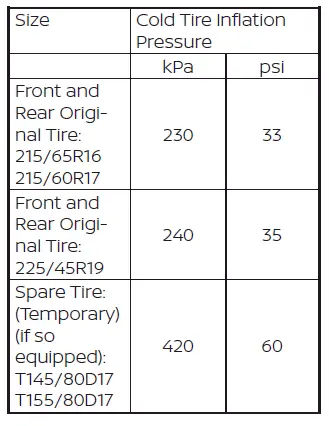
Recommended tire inflation specifications are listed on the F.M.V.S.S./C.M.V.S.S. certification label or the Tire and Loading Information label under the "Cold Tire Pressure" section. This label is located on the driver's side center pillar and provides the correct pressure values specified by the manufacturer.
Routine tire pressure checks are essential because:
- All tires naturally lose a small amount of air over time, even under normal operating conditions.
- Tire pressure can decrease suddenly after striking potholes, road debris, curbs, or other obstacles encountered during everyday driving.
The tire pressures should always be checked when the tires are cold. Tires are considered cold when the vehicle has been parked for at least three hours or driven less than 1 mile (1.6 km) at moderate speeds.
The Nissan Kicks TPMS with Easy-Fill Tire Alert provides both audible and visual assistance while inflating tires. This feature helps drivers achieve the recommended COLD tire pressure quickly and accurately without repeated trips inside the vehicle.
Incorrect tire pressure, especially underinflation, can negatively affect tire durability, fuel economy, ride quality, braking performance, and vehicle stability.
WARNING
- Tires that are improperly inflated may fail unexpectedly and increase the risk of a serious accident.
- The Gross Vehicle Weight Rating (GVWR) is shown on the F.M.V.S.S./C.M.V.S.S. certification label. Vehicle
load capacity information is provided on the Tire and Loading Information label.
Never exceed the specified load limits. Overloading the Nissan Kicks can shorten tire life, create unsafe driving conditions, increase the likelihood of tire failure, negatively affect handling characteristics, and significantly increase the risk of an accident.
Exceeding the recommended capacity may also cause damage to suspension, braking, and other vehicle components.
- Before beginning a long trip or carrying heavy cargo, use an accurate tire pressure gauge to verify that all tires are inflated to the specified pressure.
- For additional tire safety information, refer to the "Important Tire Safety Information" section (U.S.) or "Tire Safety Information" section (Canada) included with your Warranty Information Booklet.
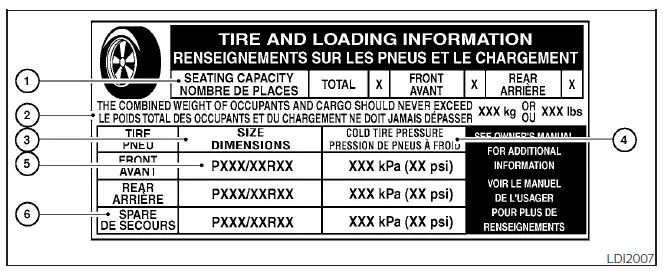
Type A (if so equipped)
Tire and Loading Information label
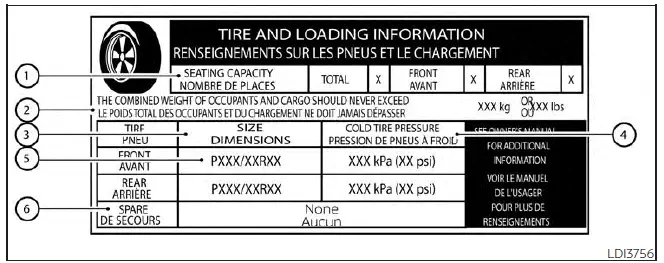
Type B (if so equipped)
- Seating capacity: Indicates the maximum number of occupants that may safely ride in the Nissan Kicks.
- Vehicle load limit: Displays the maximum allowable combined weight of passengers and cargo. Refer to the vehicle loading information section for additional details.
- Original tire size: Identifies the tire dimensions installed on the vehicle at the factory.
- Cold tire pressure: Specifies the recommended inflation pressure when tires are cold. This value has been carefully selected by the manufacturer to provide an optimal balance of tire wear, ride comfort, handling characteristics, road noise control, and vehicle performance up to the maximum GVWR.
- Tire size: Additional information regarding tire markings and sizing can be found in the tire labeling section.
- Spare tire size: Indicates the designated spare tire specification, if equipped.
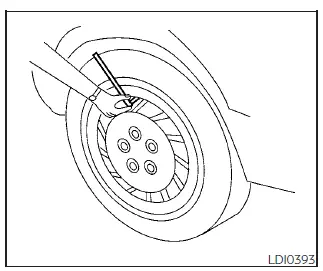
Checking tire pressure
1. Remove the valve stem cap from the tire and place it in a clean location to prevent contamination.
2. Firmly press the tire pressure gauge straight onto the valve stem. Avoid pressing excessively hard or applying sideways force, as this can allow air to escape and produce an inaccurate reading.
If you hear a hissing sound while measuring pressure, reposition the gauge until the leakage stops and a proper reading is obtained.
3. Remove the gauge from the valve stem.
4. Read the pressure indicated on the gauge and compare it with the specification listed on the Nissan Kicks Tire and Loading Information label.
5. Add air as necessary to reach the recommended pressure. If the tire becomes overinflated, briefly press the center valve core using the gauge tip to release air. Recheck the pressure and adjust again if required.
6. Reinstall the valve stem cap securely to help protect the valve from dirt, moisture, and contamination.
7. Repeat the procedure for all remaining tires, including the spare tire if your Nissan Kicks is equipped with one.
Tire labeling Nissan Kicks
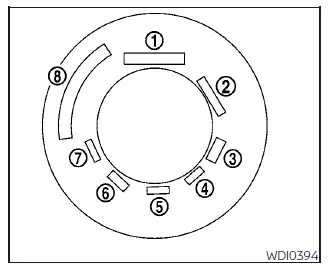
Example
Federal regulations require tire manufacturers to place standardized information on the sidewall of every tire. This labeling helps drivers understand important tire specifications and provides critical identification data used for safety, maintenance, and replacement purposes.
The information molded into the tire sidewall describes the tire's primary characteristics, dimensions, load capacity, and performance ratings. It also includes the Tire Identification Number (TIN), which can be used to identify a specific tire in the event of a safety recall or service campaign involving the Nissan Kicks or any other vehicle equipped with that tire.
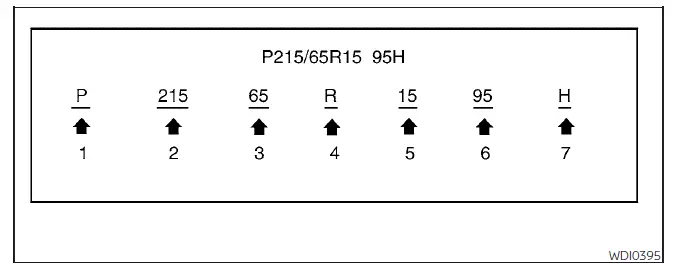
Example
- Tire size (example: P215/65R15 95H)
1. P: The letter "P" identifies the tire as a passenger vehicle tire. Some tire models may not display this designation depending on their classification.
2. Three-digit number (215): This value represents the tire width in millimeters, measured from one sidewall to the other.
3. Two-digit number (65): Known as the aspect ratio, this figure indicates the relationship between the tire's sidewall height and its width.
4. R: The letter "R" signifies that the tire uses radial construction, which is the most common tire design used on modern vehicles, including the Nissan Kicks.
5. Two-digit number (15): This number specifies the wheel or rim diameter in inches on which the tire is designed to be mounted.
6. Two- or three-digit number (95): This is the tire load index. It identifies the maximum load-carrying capability assigned to the tire.
7. H: This character represents the tire speed rating. The vehicle should never be operated beyond the speed capability specified by the tire manufacturer.
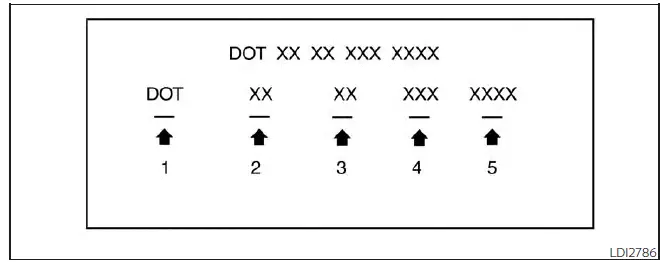
Example (Type A) (if so equipped)
- TIN (Tire Identification Number) for a new tire (example: DOT XX XX XXX XXXX)
1. DOT: Abbreviation for the U.S. Department of Transportation. This marking may appear above, below, to the left, or to the right of the Tire Identification Number.
2. Two-digit code: Manufacturer identification code assigned to the tire producer.
3. Two-digit code: Tire size code used for identification purposes.
4. Three-digit code: Optional tire type designation used by the manufacturer.
5. Four-digit date code: These numbers identify the week and year the tire was manufactured.
For example, the code 3103 indicates that the tire was produced during the 31st week of 2003.
If the manufacturing date is not visible on one sidewall, inspect the opposite side of the tire where the complete TIN may be molded.
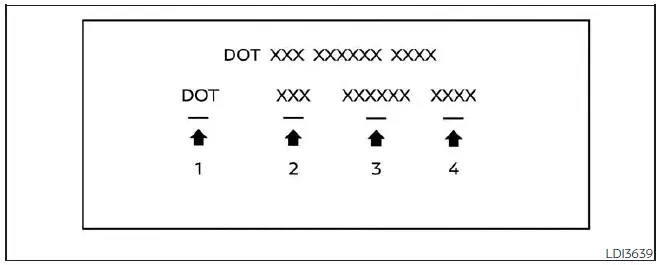
Example (Type B) (if so equipped)
- TIN (Tire Identification Number) for a new tire (example: DOT XXX XXXXXX XXXX)
1. DOT: Abbreviation for the Department of Transportation. The marking may appear above, below, or adjacent to the Tire Identification Number.
2. Three-digit code: Manufacturer identification mark assigned to the tire producer.
3. Six-digit code: Descriptive code used to identify important design and construction characteristics of the tire.
4. Four-digit date code: Indicates the production week and year.
For example, the code 3103 signifies that the tire was manufactured during the 31st week of 2003.
- Tire ply composition and material
The tire sidewall identifies the number of plies used in the tire's construction. Manufacturers must also disclose the materials used, which may include steel, polyester, nylon, and other reinforcing components that contribute to tire strength and durability. - Maximum permissible inflation pressure
This value indicates the highest air pressure the tire is designed to safely contain. Tire pressure should never exceed this specified limit. - Maximum load rating
This marking shows the maximum load capacity that the tire can support, expressed in both kilograms and pounds. When replacing tires on a Nissan Kicks, always select tires with load ratings equal to or greater than those originally installed by the manufacturer. - Term of "tubeless" or "tube type"
This designation indicates whether the tire is designed to operate without an inner tube ("tubeless") or requires one ("tube type"). - The word "radial"
This marking confirms that the tire utilizes radial construction, which provides improved ride comfort, handling, and tread life. - Manufacturer or brand name
The tire manufacturer's name or brand designation is molded into the sidewall for identification and product reference purposes.
Other Tire-related Terminology
In addition to the definitions provided throughout this section, you may encounter the term Intended Outboard Sidewall. This refers to either: (1) the sidewall containing whitewall styling, raised white lettering, or manufacturer, brand, or model markings that are more prominent than those on the opposite sidewall; or (2) the outward-facing sidewall of an asymmetrical tire specifically designed to face away from the vehicle when mounted.
Understanding tire sidewall markings can help Nissan Kicks owners make informed decisions when inspecting, replacing, or maintaining their tires. Correct interpretation of tire labeling also assists in selecting appropriate replacement tires that match the vehicle's original specifications and safety requirements.
Types of tires Nissan Kicks P16
WARNING
- When replacing tires on your Nissan Kicks, always ensure that all four tires are of the same category, such as Summer, All-Season, or Snow tires, and that they share the same basic construction. A NISSAN dealer can provide guidance regarding the correct tire specifications, including size, speed rating, load capacity, and availability.
- Replacement tires may carry a lower speed rating than the tires originally installed at the factory. If this occurs, the maximum safe operating speed of the vehicle may be reduced. Never drive faster than the speed rating indicated on the tire sidewall.
- Installing tires that differ from those specified for the Nissan Kicks may interfere with the proper operation of the Tire Pressure Monitoring System (TPMS) and other vehicle control systems.
- Always use tires that match in type, size, brand, construction, and tread pattern on all four wheels. Differences between front and rear tire circumferences can negatively affect Vehicle Dynamic Control (VDC) operation, accelerate tire wear, place additional stress on drivetrain components, and may lead to transmission or differential damage. In severe situations, vehicle stability could be compromised, increasing the risk of injury.
- For additional tire-related safety information, refer to the "Important Tire Safety Information" section (U.S.) or "Tire Safety Information" section (Canada) included in the Warranty Information Booklet supplied with your Nissan Kicks.
All-Wheel Drive (AWD) models
WARNING
For Nissan Kicks AWD models, the TEMPORARY USE ONLY spare tire (if equipped) must be installed on a rear wheel only. If a front tire becomes damaged, move the original rear tire to the front position and then install the temporary spare tire on the rear axle. Failure to follow this procedure may place excessive stress on the AWD system and could result in overheating or drivetrain damage.
CAUTION
- Use only spare tires specifically approved for the AWD version of the Nissan Kicks. Using an incorrect spare tire may affect vehicle handling and damage drivetrain components.
If excessive or uneven tire wear is discovered, all four tires should generally be replaced together using tires of identical size, brand, construction, and tread design. Tire inflation pressures and wheel alignment should also be inspected and corrected if necessary. For optimal results and vehicle safety, it is recommended that the Nissan Kicks be inspected by a NISSAN dealer or qualified tire specialist.
All season tires
Some Nissan Kicks models are factory-equipped with All-Season tires. These tires are designed to provide balanced year-round performance in a variety of weather conditions, including light snow, rain, and dry pavement.
All-Season tires can typically be identified by the markings ALL SEASON and/or M&S (Mud and Snow) molded into the tire sidewall.
While All-Season tires offer versatility, dedicated winter tires generally provide superior traction, braking, and control in severe snow and ice conditions. Drivers who frequently encounter harsh winter weather may benefit from using snow tires during the cold season.
Summer tires
Certain Nissan Kicks configurations may be equipped with summer tires to maximize handling precision, cornering performance, and traction on dry and wet roads during warmer temperatures.
Summer tires are not intended for use in snow or icy conditions. Their performance can decrease significantly when temperatures drop, and they do not carry the M&S tire designation found on many all-season or winter tires.
If you expect to drive your Nissan Kicks in areas where snow, ice, or prolonged freezing temperatures are common, NISSAN recommends replacing summer tires with either dedicated snow tires or suitable all-season tires on all four wheels.
Snow tires
If winter driving conditions require the use of snow tires, choose tires that match the original equipment specifications in both size and load rating. Installing incorrect tire sizes or ratings can adversely affect vehicle handling, braking performance, ride quality, and overall safety.
Snow tires often have lower speed ratings than the original factory-installed tires. Always observe the maximum speed rating marked on the tire and never exceed it, regardless of vehicle capability.
For best performance and predictable handling, all four wheels on the Nissan Kicks should be fitted with snow tires of the same size, brand, construction type, and tread pattern.
For additional traction on icy roads, studded snow tires may be available. However, regulations regarding studded tires vary by state, province, and local jurisdiction. Always verify local laws before installing them.
Keep in mind that while studded tires can improve traction on ice-covered surfaces, they may provide reduced grip, increased noise, and different handling characteristics on dry or wet pavement compared to non-studded winter tires. Choosing the correct tire type for your driving environment will help maintain the safety, stability, and performance of your Nissan Kicks throughout the winter season.
Tire chains Nissan Kicks 2026
WARNING
If tire chains are used on the Nissan Kicks, they must provide adequate clearance between the tires and nearby suspension, brake, steering, and body components. Using incorrect chains or installing them improperly may damage critical vehicle systems and could lead to a loss of control, increasing the risk of a serious accident, injury, or death.
Tire chain use may be restricted or prohibited in certain regions. Always verify local regulations before installing tire chains. When chains are required, make sure they are the correct size for the tires installed on your Nissan Kicks and follow all installation instructions supplied by the chain manufacturer.
Use only SAE Class "S" tire chains. These chains are specifically designed for vehicles with limited clearance between the tire and surrounding vehicle components.
Vehicles approved for Class "S" chains are engineered to provide the minimum clearance necessary for winter traction devices such as chains or tire cables while minimizing the risk of interference with suspension and body parts.
The specified clearances are based on the factory-installed tire sizes used on the Nissan Kicks. Installing chains that do not meet these requirements may result in vehicle damage. When recommended by the chain manufacturer, use chain tensioners to help maintain a secure and consistent fit.
Any loose chain ends should be properly secured or removed to prevent them from striking the fenders, wheel wells, underbody panels, or other components while driving. Whenever possible, avoid carrying maximum loads when operating the vehicle with tire chains installed.
Drive cautiously and reduce vehicle speed when using tire chains. Excessive speed may damage the chains, tires, or vehicle components and can negatively affect handling, ride quality, and overall driving stability.
Tire chains must be installed only on the front wheels and never on the rear wheels.
Never install tire chains on a TEMPORARY USE ONLY spare tire (if equipped).
Avoid using tire chains on dry pavement. Driving on dry roads with chains installed can place excessive stress on the tires, drivetrain, suspension components, and road surface, potentially causing premature wear or damage.
Changing wheels and tires
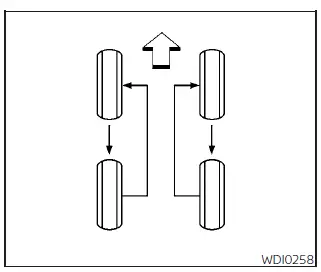
Tire rotation
NISSAN recommends rotating the tires on your Nissan Kicks every 5,000 miles (8,000 km) to promote even tread wear and help maximize tire service life.
As soon as possible after rotation or wheel installation, tighten the wheel nuts to the specified torque using an accurate torque wrench.
Wheel nut tightening torque: 83 ft-lb (113 N·m)
Wheel nuts must always remain tightened to the specified torque values.
It is recommended that wheel nut torque be checked and verified at every tire rotation interval to help ensure safe vehicle operation.
WARNING
- After rotating the tires, inspect and adjust all tire pressures to the recommended specifications shown on the Tire and Loading Information label.
- Retighten the wheel nuts after driving approximately 600 miles (1,000 km), including after a tire repair or wheel replacement following a flat tire.
- Do not include the spare tire (if equipped) as part of the normal tire rotation schedule.
- For additional tire safety guidance, refer to "Important Tire Safety Information" (U.S.) or "Tire Safety Information" (Canada) in the Warranty Information Booklet.
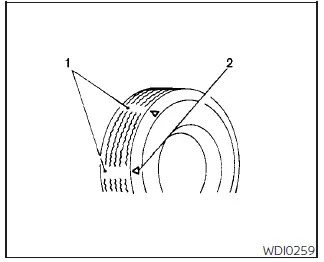
Tire wear and damage
- Wear indicator
- Location mark
WARNING
- Tires should be inspected regularly for signs of uneven wear, cracks, bulges, embedded objects, punctures, or other damage. If excessive wear, deep cuts, sidewall damage, or visible deterioration are found, the affected tire or tires should be replaced immediately.
- The original tires supplied with the Nissan Kicks are equipped with built-in tread wear indicators. When these indicators become visible across the tread surface, the tires have reached their service limit and must be replaced.
- Tires naturally deteriorate with age, even if tread depth remains acceptable. Any tire, including a spare tire (if equipped), that is more than six years old should be inspected by a qualified technician. Certain forms of aging-related damage may not be visible during a routine visual inspection.
Replace worn or damaged tires promptly to help prevent tire failure, maintain safe handling characteristics, and reduce the risk of personal injury or vehicle damage while operating your Nissan Kicks.
Replacing wheels and tires
When replacing tires on your Nissan Kicks, always select tires that match the original equipment specifications, including size, load-carrying capacity, speed rating, and tread design. Using the correct replacement tires helps preserve ride quality, handling performance, braking effectiveness, and overall vehicle safety.
WARNING
- Using tires other than those recommended for the Nissan Kicks, or mixing tires of different brands, constructions (bias, bias-belted, or radial), tread patterns, or specifications, can negatively affect ride comfort, braking performance, steering response, Vehicle Dynamic Control (VDC) operation, ground clearance, tire chain clearance, speedometer accuracy, headlamp alignment, and bumper height. These changes may compromise vehicle stability and could contribute to an accident resulting in serious injury.
- If your Nissan Kicks was originally equipped with four matching tires and only two tires are being replaced, install the new tires on the rear axle. Mounting new tires on the front axle while leaving worn tires on the rear may increase the likelihood of vehicle instability in certain road or weather conditions and could lead to loss of control.
- If the wheels are replaced for any reason, always use wheels with the same offset specification as the
original equipment.
Wheels with an incorrect offset can accelerate tire wear, negatively affect handling characteristics, interfere with proper VDC system operation, and potentially contact brake components. Such interference may reduce braking efficiency and contribute to premature brake pad wear or other mechanical issues.
- When a wheel without a Tire Pressure Monitoring System (TPMS) sensor is installed, such as a spare wheel (if equipped), the TPMS will not operate normally. In this situation, the low tire pressure warning light will flash for approximately one minute and then remain illuminated. Have the proper tire installed and the TPMS inspected or reset as soon as possible. It is recommended that you visit a NISSAN dealer for this service.
- Installing tires that differ from those originally specified by NISSAN may affect the accuracy and operation of the TPMS and other vehicle systems.
- TPMS sensors are precision electronic components and may be damaged if handled improperly during tire service. Exercise care whenever wheels or tires are removed and installed.
- When replacing a TPMS sensor, sensor ID registration may be required before the system can function correctly. It is recommended that this procedure be performed by a NISSAN dealer.
- Do not install valve stem caps that are not specified or approved by NISSAN. Incorrect caps may become seized on the valve stem and create service difficulties.
- Always ensure that valve stem caps are properly installed after checking tire pressure. Missing or improperly fitted caps can allow dirt, moisture, or debris to enter the valve stem, potentially causing pressure loss or valve malfunction.
- Never install a wheel or tire that is damaged, bent, cracked, deformed, or structurally compromised, even if it has been repaired. Hidden structural damage may cause sudden failure without warning.
- The use of retreaded tires is not recommended for the Nissan Kicks, as their performance characteristics may differ from original equipment tire specifications.
- For additional information regarding tire maintenance, tire replacement, and tire safety practices, refer to "Important Tire Safety Information" (U.S.) or "Tire Safety Information" (Canada) in the Warranty Information Booklet.
Wheel balance
Proper wheel balance is essential for maintaining smooth driving characteristics, maximizing tire life, and preserving the overall ride quality of your Nissan Kicks. Even during normal day-to-day driving, wheels can gradually lose their balance due to tire wear, road impacts, and other operating conditions. For this reason, wheel balancing should be performed whenever vibration, uneven tire wear, or handling concerns are noticed.
Wheel balancing should always be carried out with the wheels removed from the vehicle.
Attempting to spin-balance wheels while they remain installed on the Nissan Kicks may result in unnecessary mechanical stress or damage to drivetrain and suspension components.
Care of wheels
- Wash the wheels regularly whenever the vehicle is cleaned to help maintain their appearance and remove brake dust, road grime, and other contaminants.
- Clean the inner surfaces of the wheels whenever a wheel is removed or when the underside of the Nissan Kicks is being washed, as dirt and road salt can accumulate in these areas.
- Do not use abrasive cleaning compounds, harsh brushes, or aggressive polishing materials when cleaning the wheels, as they may damage the finish.
- Inspect wheel rims periodically for dents, cracks, corrosion, or other damage. Such defects can affect tire sealing, contribute to air loss, and compromise driving safety.
- NISSAN recommends applying a suitable wax coating to alloy wheels to provide additional protection against road salt and winter-related corrosion in regions where de-icing chemicals are commonly used.
Spare tire (TEMPORARY USE ONLY spare tire) (if so equipped)
When a wheel that is not equipped with a Tire Pressure Monitoring System (TPMS) sensor is installed, such as the temporary spare tire, the TPMS will not operate normally on the Nissan Kicks.
Observe the following precautions whenever the TEMPORARY USE ONLY spare tire must be installed. Failure to follow these guidelines may result in vehicle damage, reduced handling performance, or an increased risk of an accident.
WARNING
- The spare tire is intended strictly for emergency situations. Replace it with the standard road tire at the earliest opportunity to help prevent possible tire, drivetrain, or differential damage.
- Drive cautiously whenever the TEMPORARY USE ONLY spare tire is installed. Avoid sudden steering inputs, aggressive acceleration, and hard braking maneuvers.
- Check the inflation pressure of the spare tire regularly. The TEMPORARY USE ONLY spare tire should always be maintained at 60 psi (420 kPa, 4.2 bar).
- Do not operate the Nissan Kicks at speeds exceeding 50 mph (80 km/h) while the TEMPORARY USE ONLY spare tire is fitted.
- When driving on snow-covered or icy roads, the TEMPORARY USE ONLY spare tire should be installed on the rear axle, while an original tire should be moved to the front drive-wheel position.
- The tread of the TEMPORARY USE ONLY spare tire typically wears faster than a standard tire. Replace the spare tire once the tread wear indicators become visible.
- Do not install the spare tire on another vehicle, even if the wheel size appears similar.
- Never operate the vehicle with more than one spare tire installed at the same time.
- Do not tow a trailer while the TEMPORARY USE ONLY spare tire is mounted on the vehicle.
CAUTION
- Do not install tire chains on a TEMPORARY USE ONLY spare tire. Chains are not designed to fit properly on the spare tire and may damage the tire, wheel, suspension, or body components of the Nissan Kicks.
- Because the TEMPORARY USE ONLY spare tire has a smaller overall diameter than the original tire, vehicle ground clearance is reduced. Use extra caution when driving over speed bumps, curbs, potholes, or other obstacles. Avoid automatic car washes, as the spare tire may become caught in the equipment and cause vehicle damage.