
Seat Ibiza (6F) 2017-2026 Owner's Manual: Special driving situations
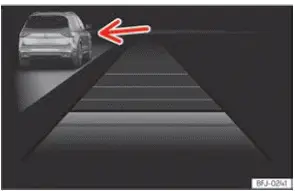
Fig. 105 On the instrument cluster display:
ACC active, vehicle detected on the left.
Adaptive Cruise Control (ACC) provides additional assistance in certain driving situations, including overtaking, travelling alongside slower traffic and stopping behind another vehicle. However, these functions operate within specific limits and cannot respond correctly to every possible road or traffic condition. Before using them, familiarise yourself with the operating restrictions and safety warnings described in the Introduction at the beginning of this chapter. The driver must continue monitoring the surrounding traffic and remain prepared to accelerate, brake or take control whenever necessary.
Avoid undertaking on the right
When ACC detects a vehicle travelling in the lane to the left at a speed lower than the cruising speed selected by the driver, it can reduce the Seat Ibiza's speed to help prevent passing that vehicle on the right. As illustrated in Fig. 105, the system recognises the slower vehicle in the adjacent lane and adjusts speed within its normal comfort limits. This intervention is intended to support appropriate driving behaviour on roads where overtaking is generally carried out on the left. The amount of deceleration depends on the detected traffic situation and the system's available regulating capability.
The driver can override this speed adjustment at any time by pressing the accelerator pedal. Doing so temporarily interrupts the corresponding ACC regulation and allows the vehicle to accelerate according to the driver's input. Before overriding the system, check the surrounding traffic and make sure that the intended manoeuvre is safe and permitted by the applicable traffic regulations. ACC does not determine whether passing another vehicle on the right is legally or practically appropriate in every situation.
This function operates at speeds above approximately 80 km/h (50 mph). It may not be available in certain countries, depending on the vehicle's specification and the applicable market requirements. Below the stated operating speed, or when the function is unavailable, the driver must manage the vehicle's speed and position independently without relying on this particular ACC intervention.
Overtaking
When the driver activates the turn signal to indicate an overtaking manoeuvre, ACC can adjust its distance regulation to assist with the intended movement. In this situation, the system reduces the programmed following distance to the vehicle ahead, allowing the Seat Ibiza to approach more closely in preparation for overtaking. This adjustment is intended to make the manoeuvre smoother while the driver remains responsible for checking the adjacent lane, assessing the available space and deciding when it is safe to overtake.
The vehicle will not accelerate beyond the cruising speed previously selected in ACC. Although the following-distance regulation may change temporarily, the programmed speed remains the upper target for normal ACC operation. If a higher speed is required, the driver must intervene using the appropriate controls or accelerator pedal, while observing the applicable speed limits and traffic conditions.
The overtaking assistance function is available at speeds above approximately 80 km/h (50 mph). Its availability may vary between countries and vehicle specifications. The driver should not assume that activating the turn signal will always produce an ACC response, particularly when the system's operating requirements are not satisfied or the function is unavailable in the relevant market.
Stop&Go function
Valid for vehicles with an automatic gearbox
In Seat Ibiza models equipped with an automatic gearbox, Adaptive Cruise Control includes a Stop&Go function that can bring the vehicle to a complete standstill when a detected vehicle ahead stops. ACC progressively reduces speed in response to the vehicle in front and, within its operating limits, can slow the Seat Ibiza to 0 km/h. This function is particularly useful in traffic where vehicles repeatedly slow down and stop, although the driver must remain attentive and ready to apply the brakes whenever necessary.
After the vehicle has stopped, ACC remains active for a short period, and the message ACC ready to start appears on the instrument cluster display. During the few seconds in which this status is maintained, the Seat Ibiza can move off automatically if the vehicle ahead begins moving again. The system responds to the movement of the detected vehicle in front, allowing driving to resume without the driver having to initiate acceleration manually during this limited period. The driver must nevertheless check that the road ahead is clear before the vehicle moves.
If the vehicle ahead remains stationary, the driver can press the brake pedal to keep the Seat Ibiza at a standstill while the ACC ready to start status is displayed. Applying the brakes allows the driver to maintain direct control of the stationary vehicle instead of relying solely on the temporary holding capability of ACC. This is especially important when traffic remains stopped for longer than the system's short automatic stopping period.
ACC can hold the vehicle stationary for only a few seconds. Once this period has elapsed, the instrument cluster displays the warning Brake, accompanied by an audible warning signal. The driver must immediately press the brake pedal to keep the vehicle securely stopped. If the brake pedal is not applied, the Seat Ibiza may begin moving forwards unintentionally, creating a risk of collision with another vehicle, a pedestrian or an obstacle. Never assume that ACC will continue holding the vehicle stationary indefinitely.
When the vehicle is stationary, ACC is automatically deactivated under certain conditions. These interruptions prevent the system from continuing its normal operation when the circumstances no longer satisfy the requirements for automatic speed and distance regulation. ACC is deactivated in the following situations:
- The vehicle remains stopped for several minutes. If the Seat Ibiza stays stationary for an extended period, ACC ends its active regulation. The driver must take responsibility for keeping the vehicle stopped and should not rely on the Stop&Go function to maintain its position after the system has been deactivated.
- A vehicle door is opened. Opening a door while the vehicle is stopped causes ACC to deactivate. The driver must ensure that the vehicle remains stationary and properly controlled, as automatic ACC regulation is no longer available under these conditions.
WARNING When the message ACC ready to start is displayed on the instrument cluster, the Seat Ibiza may move off automatically as soon as the vehicle ahead begins moving. This automatic response can occur without the driver pressing the accelerator pedal. However, the radar sensor and ACC system may fail to detect certain obstacles, objects or other hazards located in the vehicle's path. The fact that the vehicle ahead has started moving does not guarantee that the road immediately in front of your vehicle is clear or safe.
Unintended movement towards an undetected obstacle can result in a collision, serious injuries or other dangerous consequences. The driver remains fully responsible for ensuring that the vehicle can move off safely, even when ACC is controlling the initial acceleration. Never rely exclusively on the movement of the vehicle ahead or on the system's automatic response when deciding whether it is safe to proceed.
- Always check the road and the area immediately in front of the Seat Ibiza before allowing the vehicle to move off. Pay attention to pedestrians, cyclists, stationary objects and any other hazards that may not be recognised by ACC. If the path is obstructed, the traffic situation is uncertain or automatic movement would be unsafe, apply the brake pedal immediately and keep the vehicle stationary until it is safe to continue.
ACC system limitations
Adaptive Cruise Control is subject to technical and operational limitations that make it unsuitable for certain driving situations. Although ACC can assist with maintaining a selected speed, adjusting the distance to vehicles ahead and responding to some changes in traffic flow, it cannot recognise every hazard or react appropriately under all circumstances. Its performance depends on the information detected by the vehicle's sensors, the prevailing road and weather conditions, and the type and movement of surrounding traffic. The driver must therefore assess whether ACC is appropriate for the current journey and take over speed and distance control whenever the system's capabilities are insufficient. In the Seat Ibiza, as in any vehicle equipped with adaptive cruise control, safe driving always takes priority over automatic assistance.
SEAT advises against using Adaptive Cruise Control (ACC) in the following situations because road conditions, environmental factors or the characteristics of the surrounding area may interfere with reliable vehicle detection and speed regulation. Under these circumstances, the system may respond too late, incorrectly interpret the traffic situation or fail to recognise a potential hazard. The driver should control the Seat Ibiza's speed and following distance manually whenever the conditions are unsuitable for ACC operation:
- Heavy rain, snow or fog. Severe weather can reduce visibility and interfere with the radar sensor's ability to detect vehicles reliably. Rain, snowfall and dense fog may also make it more difficult to judge distances and can increase the time required to stop safely. Do not rely on ACC when weather conditions prevent a clear assessment of the road ahead.
- Driving through tunnels. The confined surroundings and particular conditions encountered inside tunnels may affect the system's ability to interpret the driving environment correctly. Maintain direct control of the vehicle's speed and distance from other traffic when passing through these areas.
- Road sections affected by construction work. Temporary lane markings, narrowed carriageways, barriers and changes to the normal traffic layout can create situations that ACC is not designed to handle reliably. When approaching or passing through roadworks, reduce speed as necessary and follow the temporary traffic signs and instructions.
- Roads with numerous bends, including mountain routes. Sharp or successive curves can make it difficult for the radar sensor to maintain consistent detection of vehicles travelling ahead. The system may temporarily lose sight of a vehicle in the same lane or detect traffic travelling in an adjacent lane. The driver must adjust speed to the road layout and available visibility.
- Off-road routes. ACC is not intended for use on uneven or unpaved terrain where surface conditions, gradients and obstacles can change unexpectedly. Driving off-road requires the driver to manage acceleration and braking directly according to the available traction and the condition of the route.
- Covered car parks. Enclosed parking areas often contain tight bends, structural columns, parked vehicles and other stationary obstacles. ACC cannot be relied upon to recognise or respond appropriately to these hazards. Drive at a suitable low speed and remain in full control of the Seat Ibiza.
- Roads containing embedded metal objects, such as railway or tram tracks. Metal structures incorporated into the road surface may interfere with radar-based detection or complicate the interpretation of the surrounding environment. Exercise particular caution when crossing tracks or travelling along roads where such objects are present.
- Roads covered with loose gravel. Loose stones and unstable surfaces can reduce tyre grip and affect braking performance. Even if ACC detects a vehicle ahead correctly, the available traction may be insufficient for the expected deceleration. Adjust speed manually and allow additional space for braking when driving on loose gravel.
Even in conditions where Adaptive Cruise Control can normally be used, certain traffic situations require particular attention because the radar sensor cannot identify every vehicle or obstacle with equal reliability. The driver must remain prepared to intervene immediately if the Seat Ibiza does not respond as expected. The following examples illustrate circumstances in which ACC detection or distance regulation may be limited.
On curves
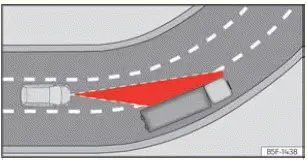
Fig. 106 Vehicle on a bend.
When driving around a bend, ACC may temporarily fail to detect a vehicle travelling directly ahead because the vehicle moves outside the radar sensor's effective detection area. Conversely, the sensor may identify a vehicle travelling in a neighbouring lane and incorrectly take it into account when regulating the following distance, as illustrated in Fig. 106. These situations can result in unexpected acceleration, unnecessary deceleration or an inadequate response to traffic in the Seat Ibiza's own lane. The risk is particularly relevant on roads with tight bends or rapidly changing curvature. Always observe the traffic ahead and adjust the vehicle's speed manually if ACC does not respond appropriately to the road layout.
Vehicles outside the sensor zone
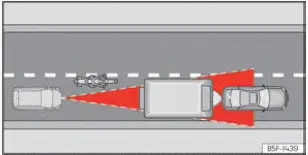
Fig. 107 Motorcyclist ahead out of range of the
radar sensor.
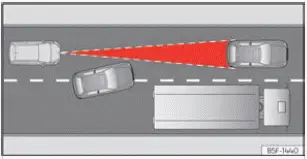
Fig. 108 Vehicle changing lanes.
The front radar sensor has a limited detection area, and its ability to recognise another vehicle depends partly on that vehicle's position, movement and dimensions. Some vehicles may not be detected until they are directly within the sensor's effective field of view. In the following situations, ACC may fail to react, respond later than necessary or regulate speed and distance in a way that does not correspond to the actual traffic conditions:
- Vehicles travelling outside the normal detection area or not aligned with the lane. Narrow vehicles, particularly motorcycles, may travel towards one side of the lane rather than directly in front of the Seat Ibiza. As shown in Fig. 107, their position can place them outside the radar sensor's effective detection zone. ACC may therefore fail to recognise the vehicle or may detect it too late to adjust speed appropriately. The driver must maintain a safe distance and be prepared to brake independently.
- Vehicles entering the lane immediately ahead. If another driver changes lanes and moves into the Seat Ibiza's path at a short distance, ACC may not have sufficient time to recognise the new vehicle and adjust the following distance, as illustrated in Fig. 108. This can be particularly dangerous when the vehicle entering the lane is travelling more slowly. Observe surrounding traffic carefully and brake promptly if another vehicle moves into the available space ahead.
- Vehicles carrying protruding loads or accessories. Loads extending beyond the sides, rear or roof of another vehicle may not be recognised accurately by the radar sensor. ACC may detect the vehicle itself without correctly accounting for the full dimensions of the protruding equipment or cargo. Maintain sufficient clearance from vehicles carrying oversized or projecting loads, and do not rely on the system to assess the additional space required.
Objects that are not detected
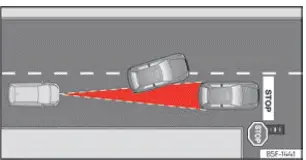
Fig. 109 A vehicle turning and another
stationary.
Adaptive Cruise Control is designed primarily to detect and respond to vehicles travelling in the same direction as the Seat Ibiza. Its radar-based detection and speed regulation are not intended to identify every type of road user or obstacle. Consequently, the driver must not expect ACC to provide an appropriate response to the following:
- People. ACC is not designed to detect pedestrians or regulate the vehicle's speed in response to people standing, walking or crossing the road. The driver must remain attentive to pedestrians and apply the brakes whenever necessary.
- Animals. Animals on or near the carriageway are not reliably recognised by ACC. Their movements may be unpredictable, and the system cannot be relied upon to slow or stop the vehicle when an animal enters its path.
- Vehicles approaching from the opposite direction or crossing the road. ACC is not designed to respond to oncoming traffic or vehicles moving across the Seat Ibiza's direction of travel. This limitation is especially important at junctions, intersections and other locations where vehicles may cross the intended route.
- Other stationary obstacles. Objects that are not moving, including obstructions in the roadway, may not trigger a response from ACC. The driver must identify these hazards independently and take appropriate action to avoid a collision.
ACC does not react to stationary vehicles. A vehicle that is stopped in the Seat Ibiza's path may therefore remain undetected for the purposes of automatic speed and distance regulation, even when it is clearly visible to the driver. Never assume that ACC will reduce speed or bring the vehicle to a standstill when approaching stationary traffic or an unexpected obstruction.
For example, ACC may initially detect and follow a moving vehicle ahead. If that vehicle then turns off the road or changes its position, it may reveal another vehicle that is stationary directly in front of the Seat Ibiza. As illustrated in Fig. 109, ACC may not react to this newly exposed stationary vehicle, despite having previously regulated the distance to the moving vehicle. The driver must recognise the hazard and apply the brakes in sufficient time to prevent a collision. This situation demonstrates why continuous observation of the road ahead is essential, even when Adaptive Cruise Control appears to be operating normally.
WARNING Using Adaptive Cruise Control in the situations described above can result in serious accidents and injuries. The system may fail to detect vehicles or obstacles, respond too slowly to changing traffic conditions or regulate speed inappropriately because of its inherent technical limitations. Relying on ACC where its use is unsuitable may also lead to violations of applicable traffic regulations. The driver must always remain attentive, maintain a safe speed and following distance, and take immediate control of braking or acceleration whenever necessary. Do not use ACC when road conditions, traffic circumstances or the system's detection limitations make safe operation uncertain.
 ACC operation
Fig. 103 On the instrument cluster display:
ACC active.
Fig. 104 On the multifunction steering wheel:
buttons for operating the ACC.
Vehicle detected ahead. This indication ...
 Troubleshooting
ACC not available
If the Adaptive Cruise Control (ACC) warning indicator illuminates yellow in the Seat Ibiza instrument cluster,
the system is currently unavailable or unable to operate corre ...
See also:
Honda Civic Service Manual. Battery Removal and Installation
Removal
1.
Battery Terminal - Disconnection
1.
Make sure the ignition switch is in LOCK (0).
2.
Disconnect and isolate the negative cable and battery ...
