
Seat Ibiza (6F) 2017-2026 Owner's Manual: Securing a child seat with the ISOFIX or i-Size system
The identification and marking of ISOFIX and i-Size anchorage points may vary depending on the equipment fitted to the Seat Ibiza and the country in which the vehicle is supplied. These anchorages are designed to provide secure attachment points for compatible child restraint systems, allowing the child seat to be connected directly to the vehicle structure. Before installing a restraint, locate the designated anchorages and confirm that the child seat is approved for the intended seating position. The presence of ISOFIX mounting points does not automatically mean that every ISOFIX or i-Size child seat can be installed there.
To determine which ISOFIX or i-Size child restraint systems are compatible with the Seat Ibiza, refer to the following table of approved vehicle seating positions. The information identifies the suitability of each position according to the restraint's size class, approval category and applicable weight or height range. Compare these details with the markings and instructions supplied by the child seat manufacturer. If the restraint has a restricted, semi-universal or vehicle-specific approval, its compatibility with the exact vehicle model and seating position must also be confirmed before installation.
Vehicle ISOFIX/i-Size positions
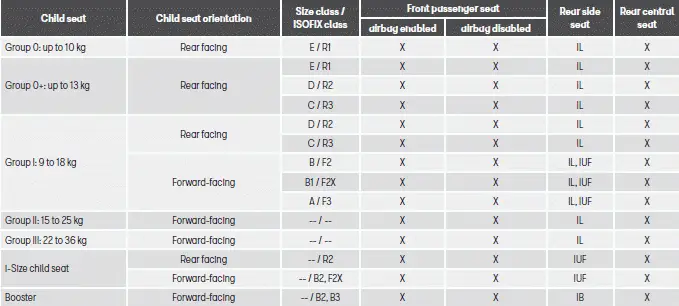
- Size class: The size-class designation identifies the category assigned to a child restraint under the relevant approval system and is associated with the approved child seat configuration and occupant weight group. For child seats with universal or semi-universal approval, the applicable size class is indicated on the ECE approval label attached to the restraint. This designation helps determine whether the child seat can be installed in a particular vehicle seating position. Always check the size-class marking on the actual child seat and compare it with the corresponding information in the vehicle compatibility table. A restraint must not be considered suitable merely because it uses ISOFIX connectors; its size class and approval conditions must also be compatible with the selected position.
- IUF: This designation identifies a seating position suitable for ISOFIX child restraint systems with universal approval that are authorised for the specified weight group. Where the compatibility table includes ISOFIX or i-Size information, the restraint must also meet the applicable approval and installation requirements. A universal ISOFIX child seat may require an additional Top Tether attachment, depending on its approved configuration. Follow the child seat manufacturer's instructions and ensure that every required securing component is correctly installed before the seat is used.
- IL: This designation indicates that the seating position is suitable for certain ISOFIX child restraint systems belonging to vehicle-specific, restricted or semi-universal approval categories. It does not mean that all ISOFIX child seats within the corresponding weight group can be installed. Compatibility depends on the particular restraint model and the vehicles for which its manufacturer has approved it. Consult the child seat manufacturer's vehicle application list and verify that the Seat Ibiza, including the intended seating position, is covered by the approval. Any additional installation conditions specified for the restraint must also be observed.
- IB: This designation identifies a seating position suitable for installing an ISOFIX forward-facing booster seat in groups 2 and 3, as well as an approved forward-facing i-Size child restraint intended for children between 100 and 150 cm tall. The child restraint must be suitable for the child's height and must be installed using the attachment arrangement specified by its manufacturer. Where the vehicle's three-point seat belt is used to restrain the child, make sure the belt follows the designated guides and is positioned correctly across the child's body. The ISOFIX connectors and any other required components must be secured in accordance with the restraint's instructions.
- X: This marking indicates that the seating position is not suitable for an ISOFIX or i-Size child restraint in the specified weight group or size class. A child seat must not be installed in a position marked X for its particular category, even if its connectors appear to fit the available anchorages. Select another seating position that is approved for the restraint, or choose a different compatible child seat. Never attempt to overcome an incompatibility by modifying the child seat, its attachment points or the vehicle's seating components.
Securing the child seat with the ISOFIX or i-Size system
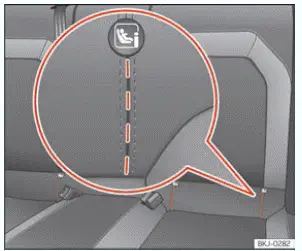
Fig. 35 Rear seat: pre-punched slots to access
the ISOFIX/iSize securing rings.
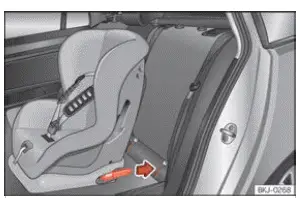
Fig. 36 Rear seats: fitting a child seat with the
ISOFIX system
Always follow the installation and operating instructions supplied by the child seat manufacturer when securing a restraint with the ISOFIX or i-Size system. Although the anchorage arrangement is standardised, the procedure for extending, engaging and checking the child seat connectors may differ between restraint models. Before beginning installation, confirm that the child seat is compatible with the selected rear seating position and identify any additional securing components, such as a Top Tether strap, that are required for the approved installation. Do not place a child in the restraint until all attachment points have been correctly engaged and checked.
The ISOFIX or i-Size anchorage positions in the Seat Ibiza are identified by the corresponding symbols near the junction between the rear seat cushion and backrest, as shown in Fig. 35. Depending on the vehicle's construction and equipment, the metal anchorage rings may be attached to the seat frame or secured to the rear floor structure. These rings provide the designated connection points for the child restraint's rigid connectors. Locate both anchorage points before fitting the seat, and make sure that the surrounding upholstery does not prevent the connectors from engaging correctly. The anchorage symbols indicate where the mounting points can be accessed; they do not replace the need to check the child restraint's compatibility.
- Open the access points for the anchorages. Using your hands, carefully open the pre-cut sections behind the marked grooves in the rear seat upholstery, as illustrated in Fig. 35. These openings provide access to the ISOFIX or i-Size securing rings located between the seat cushion and backrest. Open the sections sufficiently to expose the mounting points without unnecessarily pulling or damaging the surrounding upholstery. Identify both rings and make sure that they are accessible before positioning the child seat. Do not use sharp tools or attempt to create additional openings in the seat covering.
- Attach the child seat to the securing rings. Position the restraint on the approved rear
seating position and align its ISOFIX or i-Size connectors with the corresponding anchorage rings. Push the
child seat towards the anchorages until the connectors engage securely, as shown in Fig. 36. The locking
mechanism should produce an audible engagement sound when the connectors are correctly attached. Follow the
child seat manufacturer's instructions for checking the locked position, including any locking indicators
fitted to the restraint.
If the child seat is equipped with a Top Tether strap and its approved installation requires this additional attachment, connect the strap to the designated Top Tether anchorage point. Use only the anchorage specified for this purpose, and route and tighten the strap according to the child seat manufacturer's instructions. The Top Tether must not be attached to an ordinary luggage securing point or another fitting that is not approved for child restraint installation. Where the restraint uses a different additional securing arrangement, follow the requirements specified for that particular model.
- Check that the child seat is securely attached. After installation, grasp the child restraint on both sides and pull it firmly to verify that both ISOFIX or i-Size connectors are correctly engaged with the anchorage rings. The seat must remain securely attached and must not detach from either mounting point. Check any locking indicators provided by the child seat manufacturer and confirm that the required additional attachment has been installed correctly. If either connector is not fully engaged, release and refit the restraint according to its instructions before using it. Repeat the installation check whenever the child seat has been removed and refitted.
Child restraint systems equipped with ISOFIX or i-Size connectors and a Top Tether attachment can be obtained through SEAT technical services and other suppliers of approved child safety equipment. When purchasing a child seat for the Seat Ibiza, provide the vehicle details and confirm that the restraint is suitable for the intended rear seating position. The supplier or child seat manufacturer can provide information about approved models, installation arrangements and any additional components required. Choose a restraint that meets the child's current height and weight requirements and retain its installation instructions for future reference.
WARNING The ISOFIX, i-Size and Top Tether anchorage points are specifically designed for securing compatible child restraint systems. They must only be used for the attachment arrangements for which they have been approved. Using these mounting points to secure unsuitable equipment or other objects can compromise occupant safety and may result in serious or fatal injuries during an accident. Always use the designated anchorages correctly and verify that the child seat is securely installed before travelling.
- Never attach a child restraint that is not equipped with the appropriate ISOFIX, i-Size or Top Tether securing system to these anchorage rings. Do not use the rings to fasten ordinary seat belts, luggage straps, loose objects or any other equipment that is not intended to be connected to them. The anchorages are designed for specific child restraint loads and attachment arrangements, and incorrect use may prevent the restraint from providing its intended protection during a collision. A child seat must be installed only with the securing method approved by its manufacturer and supported by the selected seating position in the Seat Ibiza. Failure to observe these restrictions can result in potentially fatal injuries.
- Always make sure that the child restraint is correctly and securely attached to both ISOFIX or i-Size anchorage rings. If the approved installation requires a Top Tether strap, confirm that it is connected to the designated anchorage point and adjusted according to the manufacturer's instructions. Do not rely solely on the sound of the connectors engaging; check that the locking mechanisms are fully secured and that the child seat remains firmly attached when pulled from both sides. An incorrectly engaged connector or unsecured Top Tether strap can allow excessive movement of the child restraint during an accident, substantially increasing the risk of injury. Never use the child seat until the complete installation has been verified.
 Attachment systems
Several attachment systems are available for securing child restraint seats in a vehicle, and the systems
commonly used may differ depending on the country and applicable safety regulations. In the ...
 Top Tether securing belts
Fig. 37 Rear part of the rear seats: securing
rings for the Top Tether belt.
Child restraint systems equipped with Top Tether have an additional securing strap designed to connect the child ...
See also:
Honda Civic Owners Manual. Airbag System Components
The front, front side, and side curtain
airbags are deployed according to the
direction and severity of impact. Both side
curtain airbags are deployed in a rollover.
The airbag system includes:
Two SRS (Supplemental Restraint System)
front airbags. The driver's airbag is stored
in ...
