
Seat Ibiza (6F) 2017-2026 Owner's Manual: Introduction
The Seat Ibiza equipped with a DSG automatic transmission uses an electronically controlled gearbox based on a dual-clutch design. Unlike a conventional automatic transmission, which typically transfers engine torque through a torque converter, the DSG gearbox uses two independent clutches to manage the connection between the engine and transmission. This arrangement allows the gearbox to change between gear ratios efficiently while maintaining a smooth delivery of power to the drive wheels. As a result, the vehicle can accelerate with minimal interruption to the transmission of engine torque, providing the convenience of automatic gear selection together with the direct driving characteristics of a manual gearbox.
The DSG transmission also incorporates the Tiptronic function, which allows the driver to select gears manually when greater control over the transmission is desirable. Rather than relying entirely on automatic gear selection, the driver can choose an appropriate gear for the prevailing road and driving conditions. This can be particularly useful when travelling on winding roads, negotiating gradients or adjusting the vehicle's response to changes in speed. The procedure for selecting gears manually is described in the section on changing gears in Tiptronic mode.
Gear selector positions
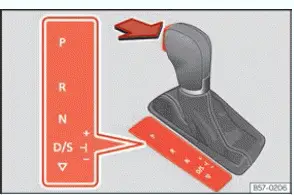
Fig. 87 Selector lever lock.
The position selected on the DSG gearbox is indicated by the corresponding illuminated symbol. This allows the driver to identify the current transmission setting without relying solely on the physical position of the selector lever. When the selector is operating in the forward driving positions M, D or S, the instrument cluster also displays the gear currently engaged. The displayed information helps the driver monitor the transmission's operation, particularly when switching between normal automatic driving, Sport mode and manual gear selection.
 - Parking
lock
Position P engages the transmission's parking lock, mechanically preventing the drive wheels from rotating through the gearbox. This position is intended to secure the vehicle when it has been parked and must only be selected after the Seat Ibiza has come to a complete standstill. Attempting to engage the parking lock while the vehicle is moving can place excessive stress on the transmission's locking mechanism and may cause serious mechanical damage. Always stop the vehicle fully before moving the selector lever into P.
To move the selector lever into position P or release it from this position, press and hold the selector lever locking button while simultaneously depressing the brake pedal. Both actions are required to operate the selector safely and prevent an unintended change of transmission position. Keep the brake pedal pressed until the intended position has been selected and the vehicle is ready for the next operation.
 - Reverse gear
Position R engages reverse gear and allows the Seat Ibiza to move backwards. Reverse must only be selected when the vehicle is completely stationary and the engine is running at idle speed. Changing into reverse while the vehicle is still moving forwards can subject the gearbox to unnecessary mechanical stress and may damage transmission components. Before selecting R, bring the vehicle to a full stop and maintain control using the brake pedal.
To move the selector lever into position R, press and hold the locking button while keeping the brake pedal depressed. Once reverse gear has been selected, the transmission is prepared for backwards movement. With the ignition switched on and the selector lever in position R, the reversing lights illuminate automatically, making other road users aware that the vehicle is in reverse gear. Check the surroundings carefully before releasing the brake and beginning the reversing manoeuvre.
 - Neutral
When the selector lever is in position N, the transmission is in neutral and no driving gear is engaged. In this position, the gearbox does not transmit engine torque to the drive wheels for forward or reverse propulsion. The vehicle is not secured against rolling simply because neutral has been selected, so the appropriate braking system must be used whenever necessary to keep it stationary.
To move the selector lever from N into the forward driving position D/S while the Seat Ibiza is stationary or travelling at a speed below 3 km/h (2 mph), depress the brake pedal before changing the selector position. This requirement helps prevent the vehicle from moving unexpectedly when a driving gear is engaged. Keep the brake applied until the intended gear range has been selected and you are ready to move off.
 -
Permanent forward drive
position
The D/S selector position provides two automatic forward driving programmes: normal mode D and Sport mode S. With the selector lever in D/S, the driver can switch between these programmes without selecting individual gears manually. To activate Sport mode, briefly move the selector lever backwards. Moving it backwards again returns the transmission to normal driving mode D. The currently selected programme is indicated on the instrument cluster display, allowing the driver to confirm whether the gearbox is operating in D or S.
In normal driving mode D, the DSG transmission automatically selects the gear ratio considered most suitable for the current driving conditions. Gear selection depends on factors including engine load, vehicle speed and the Dynamic Regulation Programme (DRP). By evaluating these operating conditions, the gearbox adapts its shifting behaviour to the demands placed on the vehicle. During ordinary driving, the transmission selects gears automatically to provide an appropriate balance between engine response, smooth operation and efficient use of the available power.
Sport mode S is intended for situations where the driver prefers a more responsive and dynamic driving style. In this programme, the gearbox uses a shifting strategy that makes greater use of the engine's available performance, allowing stronger acceleration when required. The transmission's behaviour differs from normal mode, and individual gear changes may be more noticeable during acceleration. Sport mode can be selected when a more immediate response to accelerator input is desirable, although the driver must continue to adapt speed and driving style to the road conditions.
In certain driving situations, such as travelling along mountain roads or negotiating a series of steep gradients and bends, using Tiptronic mode may offer advantages over fully automatic gear selection. Manual control allows the driver to select a gear that better suits the road layout, the vehicle's speed and the desired engine response. This can make it easier to maintain an appropriate gear when climbing or descending hills, or when preparing for changes in road conditions that the automatic transmission may not anticipate in the same way as the driver.
Selector lever lock
The DSG selector lever incorporates a locking mechanism designed to prevent certain gear positions from being engaged unintentionally. When the selector lever is in position P or N, this mechanism helps prevent an accidental selection of a driving gear that could cause the Seat Ibiza to move unexpectedly. The lock is an important safeguard, particularly when the vehicle is stationary with the engine running and the driver is preparing to select a forward or reverse gear.
To release the selector lever lock, switch on the ignition and press the brake pedal firmly, keeping it depressed throughout the operation. At the same time, press the locking button on the selector lever in the direction indicated by the arrow in Fig. 87. Once the locking mechanism has been released, move the selector lever carefully into the required position. Do not force the lever if it remains locked; first make sure that the brake pedal and locking button are being operated correctly.
When the selector lever is in position P or N, the instrument cluster may display a reminder indicating the action required before a driving gear can be selected. This message draws the driver's attention to the selector lever locking mechanism and the need to operate the brake pedal when releasing the lock. The following indication appears on the display:
When the vehicle is stationary, keep the foot brake firmly applied while selecting a gear.
The selector lever locking mechanism does not engage when the lever is moved quickly through position N (Neutral), for example when changing directly from R (Reverse) to D (Drive). This allows the driver to alternate between forward and reverse gears without the selector lock interrupting the movement. Such operation can be useful when attempting to free a Seat Ibiza that has become stuck, as the vehicle can be gently rocked backwards and forwards by alternating between the appropriate driving positions.
However, if the selector lever remains in position N for more than approximately one second, the locking mechanism engages automatically when the vehicle is travelling at less than 5 km/h (3 mph) and the brake pedal is not depressed. This prevents a driving gear from being selected unintentionally after the lever has remained in neutral. To release the lock, the driver must operate the brake pedal as required by the transmission's selector locking system.
Ignition key removal lock
On Seat Ibiza models equipped with an ignition key and DSG automatic transmission, the key can only be removed after the ignition has been switched off and the selector lever has been placed in position P (Park). This interlock helps ensure that the transmission's parking lock is engaged before the driver leaves the vehicle. If the selector lever is in another position, the ignition key cannot be removed through the normal procedure.
Once the key has been removed from the ignition lock, the selector lever remains mechanically locked in position P. This prevents the transmission from being shifted out of Park while the key is absent, reducing the possibility of the vehicle being moved unintentionally through operation of the gear selector.
WARNING
- Be particularly careful not to press the accelerator pedal unintentionally while the Seat Ibiza is stationary with a driving gear selected. The vehicle may begin moving immediately when engine power is applied, even if the driver does not intend to move off. Under certain conditions, this can happen despite the parking brake being engaged. Unexpected vehicle movement can result in a collision, serious injuries or damage to surrounding objects. Keep your foot on the brake pedal and avoid operating the accelerator until you are ready to drive.
- Never move the selector lever into position R (Reverse) or P (Park) while the vehicle is in motion.
Selecting either of these positions before the Seat Ibiza has come to a complete stop can cause serious mechanical damage to the automatic transmission and may affect the driver's ability to control the vehicle. An inappropriate gear selection while driving can lead to an accident or transmission failure. Always bring the vehicle to a full standstill before selecting Reverse or Park.
- Whenever the engine is running and the selector lever is in any position other than P, keep the foot brake depressed as necessary to prevent the vehicle from moving. A DSG automatic transmission can transmit driving force even when the engine is operating at idle speed. As a result, the vehicle may begin to creep forwards or backwards when a driving gear is engaged and the brake pedal is released. Never assume that the vehicle will remain stationary simply because the accelerator is not being pressed.
- Do not press the accelerator pedal while selecting a gear with the vehicle stationary and the engine
running. Applying engine power during gear selection may cause the vehicle to move suddenly as the
transmission engages the selected gear.
This unexpected movement can make the Seat Ibiza difficult to control, especially when parking, manoeuvring in confined spaces or operating near pedestrians and obstacles. Keep the brake pedal firmly depressed throughout the selection process and accelerate only after the required gear has been engaged and you are ready to move.
- Never leave the driver's seat or exit the vehicle while the engine is running and a driving gear remains engaged. Before leaving the Seat Ibiza, bring it to a complete stop, apply the parking brake and move the selector lever into position P to engage the transmission's parking lock. These precautions help secure the vehicle against unintended movement and reduce the risk of an accident while it is unattended.
Note
- If the selector lever is accidentally moved into position N while the Seat Ibiza is being driven, release the accelerator pedal immediately and allow the engine speed to decrease to idle before selecting D or S again. This prevents the transmission from being re-engaged while the engine is running at an unnecessarily high speed. Wait until the engine has returned to idle before restoring the normal forward driving range.
- If the electrical power supply to the selector lever is interrupted while the transmission is in position P, the lever may remain locked and cannot be moved using the normal selection procedure. In this situation, the manual selector lever release mechanism can be used to release the lock. This provision allows the selector to be unlocked when the electrical locking system is unable to operate normally.
Note
- If the selector lever lock does not engage correctly, a malfunction has occurred in the locking system.
The transmission of driving power is interrupted as a precaution to prevent the Seat Ibiza from moving
unexpectedly. This protective response means that the vehicle may not respond normally when a driving
position is selected.
To restore the selector lever locking function, follow the procedure corresponding to the DSG gearbox fitted to the vehicle:
- Vehicles with a 6-speed DSG gearbox: Depress the brake pedal fully and then release it. This action allows the system to attempt to restore the normal operation of the selector lever lock. Check that the locking mechanism responds correctly before attempting to move the vehicle.
- Vehicles with a 7-speed DSG gearbox: Depress the brake pedal and move the selector lever into position P or N. Then select the required driving gear again. This sequence allows the transmission control system to attempt to re-establish the correct selector position and locking operation.
- If a driving gear has been selected but the Seat Ibiza does not move either forwards or backwards as
expected, the transmission may not have engaged the requested gear correctly. Do not repeatedly
accelerate in an attempt to force the vehicle to move. Instead, check the selected gear position and
proceed as follows:
- If the vehicle does not move in the intended direction, the transmission control system may not have engaged the selected gear ratio properly. Depress the brake pedal, keep the vehicle stationary and select the required gear range again. This gives the gearbox another opportunity to engage the appropriate driving position.
- If the vehicle still fails to move in the required direction after the gear range has been
selected again, a malfunction of the transmission system may be present.
Do not continue attempting to move the vehicle by repeatedly changing gears or applying additional accelerator pressure. Obtain assistance from a qualified specialist and have the DSG transmission and its control system inspected to determine the cause of the problem.

 Changing gear in Tiptronic mode
Fig. 88 Lever in the Tiptronic position
Fig. 89 Steering wheel: automatic gearbox
levers
The Tiptronic function allows the driver of a Seat Ibiza equipped with a DSG automatic transmiss ...
See also:
Honda Civic Owners Manual. Synchronized Mode
You can set the temperature synchronously for the driver’s side and the
passenger’s
side in synchronized mode.
1. Press the SYNC button.
The system switches to synchronized mode.
2. Adjust the temperature using the driver’s side temperature control dial.
Press the SYNC button ...
