
Seat Ibiza (6F) 2017-2026 Owner's Manual: Correct position on the seat
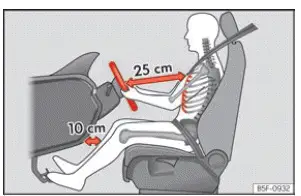
Fig. 15 The correct distance between the
driver and the steering wheel must be at least
25 cm (10 inches).
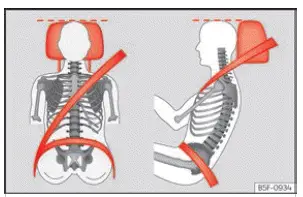
Fig. 16 Correct belt web and headrest
positions
Maintaining the correct sitting position is essential for the safety of everyone travelling in the Seat Ibiza. The driver and passengers should sit upright, with their backs properly supported, their head restraints correctly adjusted and their seat belts securely fastened. The illustrations above show the recommended seating arrangement and the appropriate positioning of the steering wheel, seat belt and head restraint. These adjustments help the vehicle's restraint systems provide effective protection during sudden braking, evasive manoeuvres or a collision.
If a physical condition, restricted mobility or another individual circumstance prevents you from adopting the recommended sitting position, consult a qualified specialist workshop about suitable adaptations or additional equipment. The protective effectiveness of seat belts and airbags depends significantly on the occupant's position relative to these systems. Sitting too close to an airbag, leaning away from the backrest or wearing a seat belt incorrectly can reduce the protection available in an accident. SEAT recommends having any necessary vehicle adaptations assessed and carried out by a qualified technical service provider.
For maximum possible protection and to minimise the risk of injury during an accident, emergency braking or a sudden change of direction, SEAT recommends the seating positions and adjustments described below. Make all necessary adjustments before beginning the journey and maintain the correct position while the vehicle is moving. The driver should also ensure that passengers understand how to adjust their seats and restraint systems correctly.
Valid for all vehicle occupants:
- Adjust the head restraint so that its upper edge is approximately level with the top of your head, or as close to this position as the adjustment range allows. The restraint should be positioned at approximately eye level or higher, with the back of your head and neck as close to it as practicable, as illustrated in Fig. 16. Correct positioning helps limit excessive rearward movement of the head during certain collisions and can reduce the risk of neck injuries. Avoid leaving the head restraint unnecessarily low or positioned too far behind the head.
- Shorter occupants should lower the head restraint completely if necessary to obtain the most suitable position. This applies even when the top of the occupant's head remains below the upper edge of the fully lowered restraint. The aim is to position the restraint as effectively as possible within its available adjustment range while maintaining a comfortable, upright seating position.
- Taller occupants should raise the head restraint to its highest position when required by their height. This provides the greatest available support for occupants whose heads extend above the normal adjustment range. Do not leave the restraint in a low position simply because the seat remains comfortable; correct head support is an important part of occupant protection.
- Keep both feet in the designated footwell throughout the journey. Never place your feet on the dashboard, seat cushion, window area or another part of the passenger compartment. An unsuitable leg position can increase the likelihood of injury during sudden braking or a collision and may prevent the seat belt and other restraint systems from protecting the occupant correctly.
- Adjust the seat belt to fit your body and fasten it securely before the vehicle begins moving. Make sure the belt lies flat without twists and follows the correct path across the shoulder, chest and pelvis, as illustrated in Fig. 16. The belt must remain correctly positioned throughout the journey. Avoid placing the shoulder section behind your back or under your arm, and never share a seat belt between occupants.
The following also applies to the driver:
- Adjust the driver's seat backrest to an almost upright position, ensuring that your entire back rests firmly against it. This position provides stable support and helps maintain the correct relationship between your body, the seat belt and the steering wheel airbag. Avoid driving with the backrest excessively reclined, as this can reduce the effectiveness of the restraint systems and make it more difficult to operate the vehicle's controls safely.
- Position the steering wheel so that the distance between its centre and your sternum is at least 25 cm (10 inches), as shown in Fig. 15. At the same time, you should be able to hold the outer sides of the steering wheel comfortably with both hands and your elbows slightly bent. This arrangement allows you to steer without stretching your arms fully and maintains the minimum recommended clearance from the steering wheel airbag. If necessary, adjust the seat and steering column together to achieve the correct position.
- Ensure that the steering wheel is directed towards your chest rather than your face. The steering wheel airbag is designed to provide protection when the driver is seated correctly in relation to it. A steering wheel positioned too high or directed towards the head can increase the risk of injury if the airbag deploys. Check the wheel's angle after adjusting the seat height or longitudinal position, and make sure that you can still see the instrument cluster clearly.
- Move the driver's seat forwards or backwards until you can fully depress the accelerator, brake and clutch pedals, where fitted, without stretching your legs completely. Your knees should remain slightly bent when the pedals are fully pressed. There must also be a clearance of at least 10 cm (4 inches) between the knee area and the dashboard, as indicated in Fig. 16. This position helps maintain effective pedal control while providing suitable space between your legs and the instrument panel. Avoid sitting so far forwards that your knees are pressed against the dashboard or so far backwards that you cannot operate the pedals through their full travel.
- Adjust the seat height so that you can comfortably reach the upper part of the steering wheel while maintaining the correct distance from the airbag and keeping your back supported by the backrest. The seating height should also provide a clear view of the road ahead and the vehicle's instruments. Make sure that adjusting the seat vertically does not compromise your ability to operate the pedals or maintain the recommended steering wheel position.
- Keep both feet in the driver's footwell so that you can operate the pedals correctly and maintain control of the Seat Ibiza at all times. Your feet should remain positioned where they can respond promptly to changing traffic conditions. Do not allow loose objects or unsuitable floor coverings to interfere with pedal movement, and avoid driving in a posture that prevents you from applying the brakes quickly and effectively.
For the passenger, the following applies:
- Adjust the front passenger seat backrest to an almost upright position so that your back remains fully supported by the seat. This helps the seat belt follow the correct path across the body and allows the restraint systems to function as intended. Avoid reclining the backrest excessively or leaning forwards while the vehicle is moving, since these positions can increase the risk of injury during emergency braking or an accident.
- Move the front passenger seat as far backwards as possible while maintaining a suitable seating position. A minimum distance of 25 cm (10 inches) must be maintained between the passenger's chest and the instrument panel. This clearance is particularly important because the front passenger airbag deploys from the dashboard area. If the occupant sits closer than 25 cm, the airbag may not be able to provide its intended protection and could increase the risk of injury during deployment. Before setting off, check that the seat is positioned correctly, the backrest is almost upright and the seat belt is securely fastened.

 Number of seats
The Seat Ibiza has five seating positions: two in the front and three in the rear. Each seat is equipped with its
own seat belt, designed to restrain the occupant and help reduce the risk of injury ...
See also:
Honda Civic Owners Manual. How to Select a Play Mode
You can select shuffle and repeat modes when playing a file.
Select a play mode.
To turn off a play mode
Select the mode you want to turn off.
How to Select a Play Mode
Play Mode Menu Items
Shuffle All Songs: Plays all available files in a
selected list (playlists, artists, albums, song ...
