
Honda Civic Owners Manual: Checking Tires. Tire and Loading Information Label
Checking Tires
To safely operate your vehicle, your tires must be of the proper type and size, in good condition with adequate tread, and properly inflated.
Inflation guidelines
Properly inflated tires provide the best combination of handling, tread life, and comfort. Refer to the driver's doorjamb label or specification's page for the specified pressure.
►nderinflated tires wear unevenly, adversely affect handling and fuel economy, and are more likely to fail from overheating.
Overinflated tires make your vehicle ride harshly, are more prone to road hazards, and wear unevenly.
Every day before you drive, look at each of the tires. If one looks lower than the others, check the pressure with a tire gauge.
At least once a month or before long trips, use a gauge to measure the pressure in all tires, including the spare. Even tires in good condition can lose 1-2 psi (10-20 kPa, 0.1-0.2 kgf/cm2) per month.
Inspection guidelines
Every time you check inflation, also examine the tires and valve stems. Look for:
- Bumps or bulges on the side or in the tread. Replace the tire if you find any cuts, splits, or cracks in the side of the tire. Replace it if you see fabric or cord.
- Remove any foreign objects and inspect for air leaks.
- Uneven tread wear. Have a dealer check the wheel alignment.
- Excessive tread wear.
- Cracks or other damage around valve stem.
|
Checking Tires WARNING
Using tires that are excessively worn or
improperly inflated can cause a crash in
which you can be seriously hurt or killed.
Follow all instructions in this owner's
manual regarding tire inflation and
maintenance. Measure the air pressure when tires are cold. This means the vehicle has been parked for at least three hours, or driven less than 1 mile (1.6 km). If necessary, add or release air until the specified pressure is reached. If checked when hot, tire pressure can be as much as 4-6 psi (30-40 kPa, 0.3-0.4 kgf/cm2) higher than if checked when cold. U.S. models Whenever tire pressure is adjusted, you must calibrate the TPMS. Have a dealer check the tires if you feel a consistent vibration while driving. New tires and any that have been removed and reinstalled should be properly balanced. Check the spare tire pressure once a month or before long trips. |
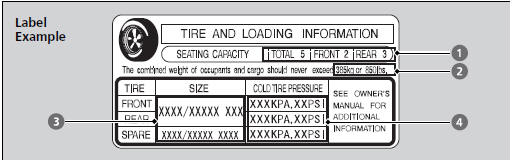
Tire and Loading Information Label
The label attached to the driver's doorjamb provides necessary tire and loading information.
|
Tire and Loading Information Label The tire and loading information label attached to the driver's doorjamb contains:
|

 Tire Labeling
The tires that came on your vehicle have a
number of markings. Those you should be
aware of are described below.
Tire Sizes
Whenever tires are replaced, they should be replaced with tires of the ...
See also:
. Maintaining the Bumpers and Other Resin Coated Parts
If you get gasoline, oil, engine coolant, or battery fluid on resin coated
parts, they
may be stained or the coating may peel. Promptly wipe it away using a soft cloth
and
clean water.
Maintaining the Bumpers and Other Resin Coated
Parts
Ask a dealer about the correct coatin ...
