



Front-door pockets Nissan Kicks crossover
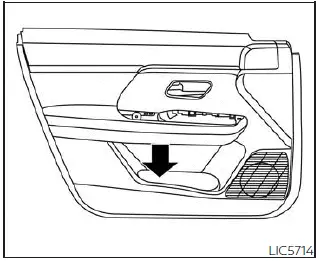
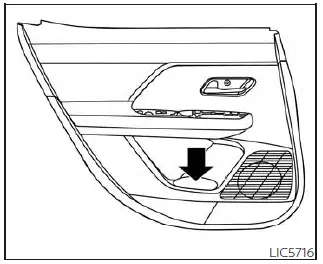
Rear-door pockets
Seatback pockets (if so equipped)
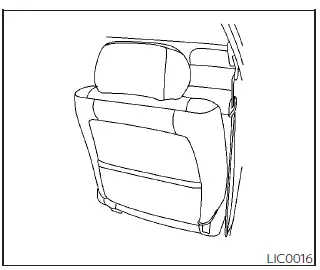
The seatback pockets in the Nissan Kicks are positioned on the rear side of the driver's seat and front passenger's seat, depending on vehicle equipment.
These pockets are intended for lightweight, flat items such as maps, small documents, travel papers, or other thin accessories that need to remain within easy reach for rear-seat passengers.
WARNING
To help ensure correct operation of the driver's and/or front passenger's NISSAN Advanced Air Bag System, if equipped, always observe the following safety precautions:
- Do not allow a rear-seat passenger to push, pull, lean heavily against, or place force on the seatback pocket, seatback, head restraint, or headrest.
- Do not place loads heavier than 9.1 lbs. (4 kg) on the seatback, head restraint/headrest, or inside the seatback pocket. Excessive weight may affect seat operation and safety system performance.
Storage trays
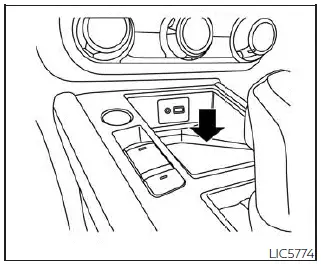
Storage compartment (if so equipped)
The Nissan Kicks may include convenient storage trays for small everyday items. These areas are useful for temporary placement of lightweight objects, but they should not be used for loose items that could move around while driving.
WARNING
Do not place sharp, fragile, or hard objects in the trays. During a sudden stop, sharp turn, or collision, such items could move and cause injury.
Glove box
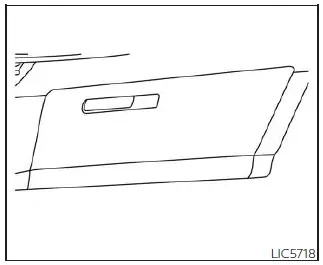
To open the glove box in the Nissan Kicks, pull the handle gently and lower the lid.
The glove box is suitable for storing vehicle documents, the owner's manual, registration papers, and other small items that should remain protected and out of sight.
WARNING
Keep the glove box lid securely closed while driving. An open glove box may increase the risk of injury during an accident, hard braking, or a sudden stop.
Console box (if so equipped)
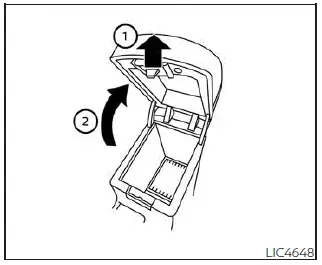
To open the console box, pull lever 1 and raise lid 2.
To close the console box, lower the lid and press it down until the latch locks securely into place.
The console box in the Nissan Kicks provides a practical storage area for small personal items such as charging cables, sunglasses, receipts, or compact accessories.
Cup holders Nissan Kicks
CAUTION
- Avoid sudden acceleration, sharp cornering, and abrupt braking when a cup holder is being used. Spilled liquid may distract the driver, damage interior surfaces, or cause burns if the beverage is hot.
- Use only soft cups or suitable beverage containers in the cup holder.
Hard objects can become dangerous during a collision or sudden stop and may cause injury.
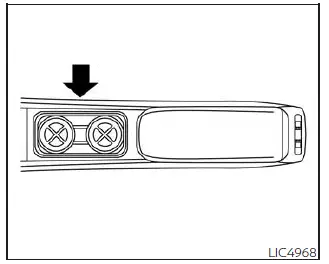
Center console with armrest
The front cup holders in the Nissan Kicks are designed to hold compatible drink containers securely during normal driving. Always make sure the container fits properly before driving.
CAUTION
- Do not use the bottle holder for objects other than suitable bottles. Loose items may be thrown around inside the vehicle during sudden braking or an accident and may injure occupants.
- Do not place open liquid containers in the bottle holder. Spilled liquid may damage the Nissan Kicks interior or electrical components.
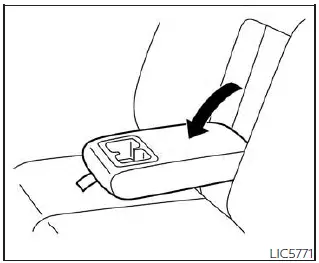
Rear (if so equipped)
CAUTION
- Do not recline the rear seatback while using the cup holders on the rear armrest. This may cause beverages to spill, and hot drinks may scald rear passengers.
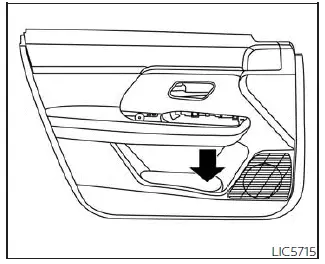
Bottle holder - front
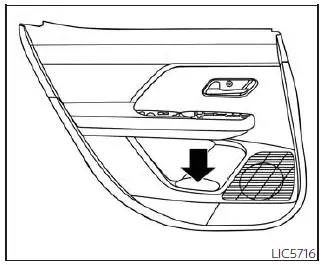
Bottle holder - rear
The Nissan Kicks bottle holders are convenient for closed beverage bottles that fit securely. Always use capped containers to reduce the chance of spills while driving.
Cargo area storage bin
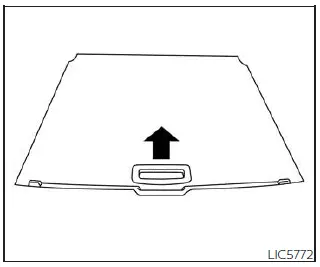
To access the floor storage area, pull up on the handle and lift the luggage board.
This hidden cargo area in the Nissan Kicks is useful for storing smaller items below the main luggage floor, helping keep the cargo compartment more organized and less cluttered.
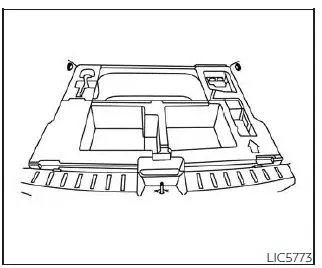
Luggage hooks
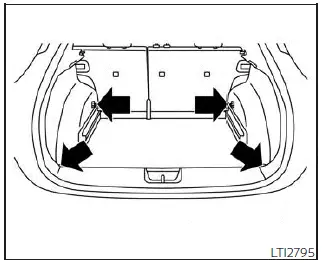
The luggage hooks located on the cargo floor of the Nissan Kicks are designed for securing cargo. Each single hook should carry a load of less than 110 lbs. (490 N).
The luggage hooks may be used with suitable ropes, straps, or cargo tie-downs to help keep items from moving while the vehicle is in motion.
WARNING
- Secure all cargo properly with ropes or straps to help prevent it from sliding, shifting, or being thrown forward. Do not stack cargo higher than the seatbacks. In a sudden stop or collision, unsecured cargo may cause serious personal injury.
- Use appropriate ropes, straps, and hooks that are suitable for the weight and shape of the cargo being carried.
- Never allow anyone to ride in the luggage area. Riding in a cargo compartment inside any vehicle is
extremely dangerous.
In a collision, people riding in these areas are much more likely to be seriously injured or killed.
- Do not allow passengers to ride in any area of the Nissan Kicks that is not equipped with seats and seat belts.
- The child restraint top tether strap may be damaged if it contacts unsecured items in the cargo area. Always secure cargo properly. A damaged top tether strap may reduce child restraint protection and could result in serious injury or death during a collision.
- Make sure every occupant is seated correctly and wearing a seat belt properly before driving.
Grocery hooks
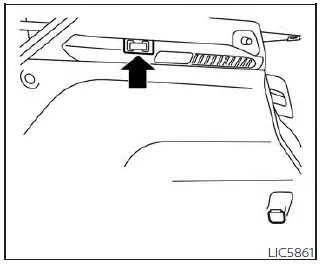
Left side shown (right similar)
The grocery hooks are located in the cargo area of the Nissan Kicks and are intended to hold standard-size plastic grocery bags side by side. They help reduce bag movement and keep light items more organized during short trips.
CAUTION
Do not apply a total load of more than 6.6 lbs. (3 kg) to a single grocery hook.
Cargo cover (if so equipped)
WARNING
- Never place any object on the cargo cover, regardless of size. Even a small item may become a projectile and cause injury during an accident or sudden stop.
- Do not place objects heavier than 44 lbs. (20 kg) on the cargo cover for extended periods.
- Do not leave the cargo cover inside the Nissan Kicks if it is disengaged from its holders.
- Secure all cargo properly with ropes or straps to help prevent sliding or shifting. Do not load cargo higher than the seatbacks. Unsecured cargo may cause personal injury during a sudden stop or collision.
- Secure cargo carefully and do not allow it to contact the child restraint top tether strap when the strap is attached to the top tether anchor. Improperly secured cargo, or cargo that touches the top tether strap, may damage the strap during a collision. If the cargo cover contacts the top tether strap while it is attached, remove the cargo cover from the vehicle or secure it on the cargo floor below its normal attachment point. Failure to do so may damage the child restraint top tether strap, increasing the risk of serious injury or death to a child in a collision.
The cargo cover helps hide items stored in the luggage compartment from outside view, giving the Nissan Kicks cargo area a cleaner and more private appearance.
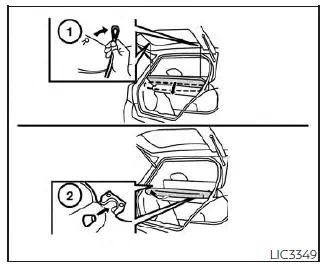
To remove the cargo cover:
- Detach the straps from the rear hatch.
- Lift and remove the cargo cover from the holders on the rear pillar.
Practical storage tip: For everyday use, keep heavy items low on the cargo floor and secure them before driving. This helps the Nissan Kicks remain stable and keeps the passenger area safer during sudden maneuvers.
Roof rack Nissan Kicks 2025
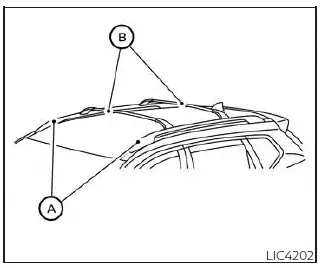
The roof rack system on the Nissan Kicks can provide additional cargo-carrying flexibility when it is used correctly with proper crossbars and approved attachments. Because roof-mounted cargo changes the vehicle’s center of gravity and wind resistance, every load must be positioned carefully, secured firmly, and kept within the specified weight limits.
WARNING
- Always install the crossbars onto the roof side rails before carrying any type of cargo. Placing cargo directly on the roof side rails or directly on the roof panel of the Nissan Kicks may damage the vehicle.
- Roof rack crossbars must be positioned and distributed evenly to support the load correctly.
- Do not exceed the maximum load capacity of the roof rack crossbars. Always spread the load uniformly across the crossbars.
- Heavy loading on the crossbars can affect Nissan Kicks stability, steering response, braking feel, and handling during sudden or unusual driving maneuvers.
- Secure all cargo properly with suitable ropes, straps, or approved tie-downs to help prevent movement. During a sudden stop or collision, unsecured cargo may slide, shift, fall, or cause personal injury.
- Drive with extra care when the Nissan Kicks is loaded near its cargo-carrying capacity, especially when a significant portion of the weight is carried on the roof crossbars.
CAUTION
- Use care when placing items onto the roof rack or removing them. If you cannot lift the item safely and comfortably from the ground, use a stable ladder or step stool and avoid leaning hard against the vehicle body.
Do not apply any load directly to the roof side rails A. Crossbars B must be installed before placing any load, cargo, luggage, carrier, or accessory on the roof of the Nissan Kicks.
Genuine NISSAN accessory crossbars may be available through an authorized NISSAN dealer. It is recommended that you contact a NISSAN dealer for proper part selection, installation guidance, and additional roof rack information for the Nissan Kicks.
The service load capacity for the roof side rails is 110 lbs. (50 kg). However, this does not mean the crossbars can carry more than their own rated capacity. Always follow the lower applicable load limit.
Be careful not to exceed the Gross Vehicle Weight Rating (GVWR) or the Gross Axle Weight Rating (GAWR front and rear) of the Nissan Kicks. Roof cargo, passengers, accessories, and luggage all contribute to the total vehicle load.
For additional information regarding GVWR and GAWR, refer to:
- F.M.V.S.S. or C.M.V.S.S. certification label located on the driver's door pillar.
Before driving with roof-mounted cargo, check that the load is centered, secure, and does not interfere with the liftgate, antenna, or any roof-mounted equipment.
Installing Crossbars (if so equipped)
WARNING
- It is recommended that roof rack crossbars be installed by a NISSAN dealer to help ensure correct fitment and safe operation.
- Protect the painted roof area under the crossbars by placing a clean cloth under the crossbar contact points during installation to help prevent scratches.
- Make sure the moonroof, if equipped, is fully closed before beginning the crossbar installation process.
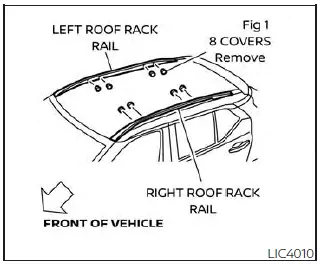
1. Carefully remove all 8 protective caps from the roof rack rails by hand. See Fig. 1.
NOTE:
Store these protective covers in the glove box so they are available for reinstallation if the crossbars are removed later.
CAUTION
The covers should be re-installed whenever the crossbar is removed to help protect the roof rack mounting points.
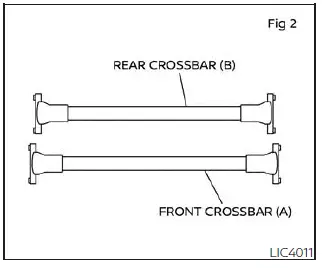
2. Identify the FRONT (A) and REAR (B) crossbar assemblies included in the kit.
NOTE:
The REAR crossbar is shorter than the FRONT crossbar. Do not interchange their positions during installation.
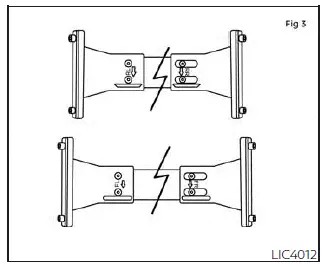
3. Locate the markings on the bottom side of each crossbar end support.
NOTE:
- FL identifies the FRONT crossbar, driver side.
- FR identifies the FRONT crossbar, passenger side.
- RL identifies the REAR crossbar, driver side.
- RR identifies the REAR crossbar, passenger side.
When installed correctly, the arrow on the bottom side of each crossbar end support must always point toward the front of the Nissan Kicks.
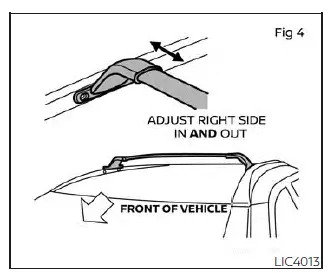
4. Position the FRONT crossbar onto the left and right roof rack rails. Adjust the right support inward or outward until the crossbar fits securely into the correct mounting position.
See Fig. 4.
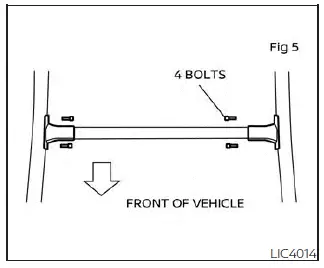
5. Confirm that the FRONT crossbar is aligned correctly with the roof rack rail attachment points. Using the supplied T-30 TORX screwdriver, loosely install all 4 bolts on the FRONT crossbar.
See Fig. 5.
NOTE:
Begin with the driver side front bolt. At this stage, the bolts should only be partially tightened so the crossbar can settle into its proper position.
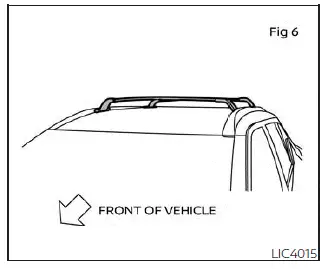
6. Tighten all 4 bolts to 8-9 N-m using a T-30 TORX torque wrench.
NOTE:
- Start with the driver side front bolt.
- A T-30 TORX torque wrench is not included with the kit and must be obtained separately.
7. Repeat steps 4 through 6 to install the REAR crossbar.
8. After installation, gently move the crossbars by hand to check for looseness. If any loose fit is noticed, remove the crossbars and repeat steps 4 through 7 until both crossbars are properly secured.
WARNING
- Locate and read the maximum load label on the crossbar end support before carrying cargo.
- Do not load more than 100 lbs. (45 kg) on the crossbars.
- Make sure the Nissan Kicks does not exceed its Gross Vehicle Weight Rating (GVWR) or Gross Axle Weight Rating (GAWR front and rear). The GVWR and GAWR information is shown on the Safety Compliance Certification Label.
- Always distribute luggage evenly and use appropriate roof rack attachments on the crossbars.
Practical roof rack tip: After driving a short distance with cargo on the roof, stop in a safe place and recheck the straps, bolts, and load position. This helps maintain safe handling and protects the Nissan Kicks roof rack system from unnecessary stress.