



WARNING
Failure to follow the warnings and instructions for proper use of the AEB with Pedestrian Detection system could result in serious injury or death.
- The AEB with Pedestrian Detection system is intended as an additional driver-assistance feature for the
Nissan Kicks. It is not a substitute for attentive driving, sound judgment, or the driver's
responsibility to monitor traffic conditions and operate the vehicle safely at all times.
This technology cannot prevent every accident and should never be relied upon as the sole means of avoiding a collision caused by distraction, delayed reactions, or unsafe driving behavior.
- The AEB with Pedestrian Detection system does not function in every traffic, weather, road, or driving condition. System performance may vary depending on visibility, vehicle speed, road layout, and surrounding circumstances.
The AEB with Pedestrian Detection system in the Nissan Kicks is designed to assist the driver when there is a potential risk of a forward collision involving:
- a vehicle traveling ahead in the same lane
- a pedestrian detected in the vehicle's path of travel
Intersection Assist (if equipped) can provide additional support when a potential collision risk exists:
- While turning left or right across the path of an approaching vehicle.
- While turning left or right when a pedestrian is detected ahead and is expected to cross into the vehicle's intended path.
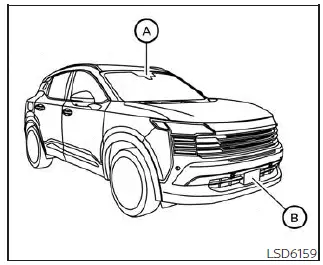
The AEB with Pedestrian Detection system uses a radar sensor located at the front of the vehicle B to monitor traffic ahead and calculate the distance to vehicles traveling in the same direction.
For pedestrian recognition, the Nissan Kicks combines information from the radar sensor with a forward-facing camera A mounted behind the windshield, allowing the system to monitor both vehicles and pedestrians ahead.
- AEB with Pedestrian Detection system operation
- Turning the AEB with Pedestrian Detection system on/off
- AEB with Pedestrian Detection system limitations
- System temporarily unavailable
AEB with Pedestrian Detection system operation Nissan Kicks 2026
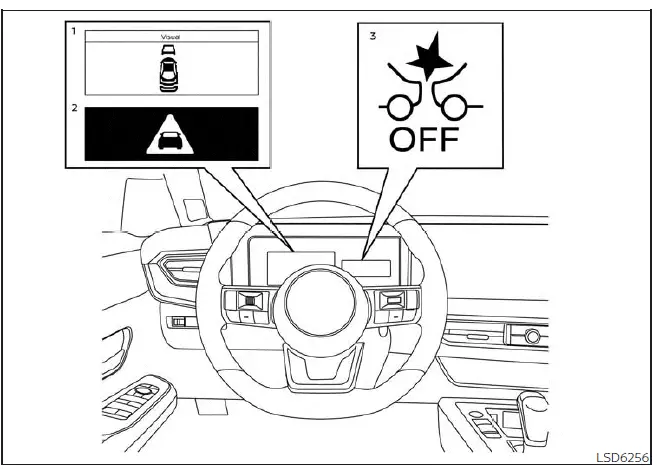
For vehicles with the 7 inch (18 cm) display
- Vehicle ahead detection indicator
- AEB with Pedestrian Detection emergency warning indicator
- AEB with Pedestrian Detection system warning light (if so equipped) and AEB with Pedestrian Detection system warning indicator (if so equipped)
The AEB with Pedestrian Detection system becomes operational when the Nissan Kicks is traveling at speeds above approximately 3 mph (5 km/h).
For pedestrian detection functionality, the system is designed to operate at vehicle speeds between approximately 6 and 37 mph (10 to 60 km/h).
If the system determines that a frontal collision risk exists, it first alerts the driver by flashing the vehicle-ahead detection indicator in yellow on the vehicle information display while simultaneously sounding an audible warning. At this stage, partial braking assistance may also be applied.
If the driver reacts by pressing the brake pedal quickly and firmly, but the AEB with Pedestrian Detection system still determines that a collision remains possible, it can automatically increase braking force to help reduce impact severity.
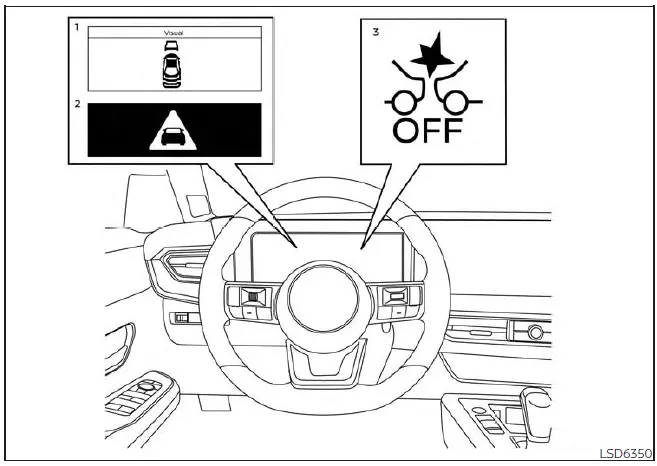
For vehicles with the 12.3 inch (31.2 cm) display
If the driver does not respond to the initial warning, the AEB with Pedestrian Detection system issues a second visual warning using flashing red and white indicators together with an audible alert. The system may then apply additional braking intervention.
When the possibility of a collision becomes imminent, the Nissan Kicks can automatically apply stronger braking force in an effort to help avoid the impact or lessen its consequences.
While the AEB with Pedestrian Detection system is operating, brake-related sounds may be heard. This is a normal characteristic of system operation and does not indicate a malfunction.
NOTE:
The vehicle's stop lights illuminate whenever braking is applied by the AEB with Pedestrian Detection system.
Intersection Assist (if equipped) is designed to operate at vehicle speeds between approximately 6 and 16 mph (10 to 25 km/h).
The corresponding turn signal must be activated for Intersection Assist to recognize an approaching vehicle during a turn. However, pedestrian detection within the intersection-assist function may operate even when a turn signal is not being used.
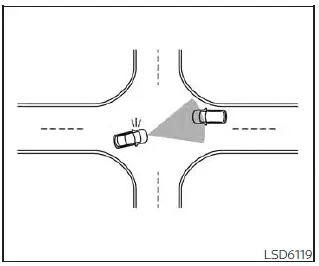
Intersection assist for approaching
vehicle
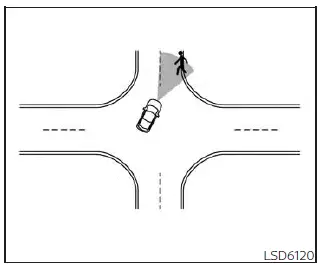
Intersection assist for pedestrian
NOTE:
- The vehicle's stop lights illuminate whenever braking is performed by the Intersection Assist function.
- When the AEB with Pedestrian Detection system identifies an obstacle ahead and displays a warning, a brief sound may be heard from the front of the Nissan Kicks as the braking system prepares itself for a faster response.
Depending on vehicle speed, the distance to a detected vehicle or pedestrian, road conditions, and surrounding traffic, the system may help the driver avoid a collision or reduce the severity of an unavoidable impact.
If the driver is actively steering, accelerating, or braking, the AEB with Pedestrian Detection system may respond later or may not intervene, depending on the specific driving situation.
Automatic braking assistance will cease under the following conditions:
- When the steering wheel is turned sufficiently to avoid the detected hazard.
- When the accelerator pedal is depressed.
- When a vehicle or pedestrian is no longer detected ahead.
If the AEB with Pedestrian Detection system brings the Nissan Kicks to a complete stop, the vehicle will generally remain stationary for approximately two seconds before brake pressure is released.
When the brake pedal is pressed while braking assistance is being applied by the system, the driver may notice a change in pedal feel along with sounds or slight vibration. These characteristics are normal and do not indicate a problem with the vehicle.
Additional braking force can be achieved by applying greater pressure to the brake pedal whenever stronger deceleration is required.
Turning the AEB with Pedestrian Detection system on/off Nissan Kicks
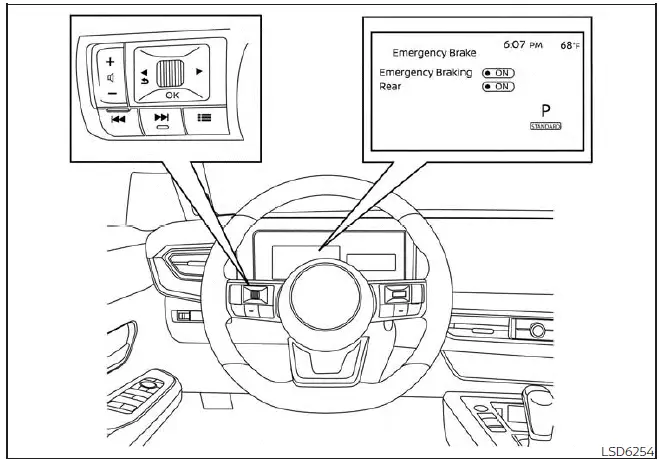
For vehicles with the 7 inch (18 cm) display
Follow the steps below to enable or disable the AEB with Pedestrian Detection system in your Nissan Kicks. This allows the driver to customize how the vehicle's forward collision assistance features operate through the vehicle information display.
1. Press the
 button repeatedly until the "Settings" menu appears in the vehicle information display.
Use the
 button to highlight "Driver Assistance," then press the OK button to enter the menu.
2. Select "Emergency Brake" or "Emergency Assist," depending on the display configuration of your Nissan Kicks, and then press the OK button.
3. Select "Emergency Braking" and press the OK button again to switch the system on or off as desired.
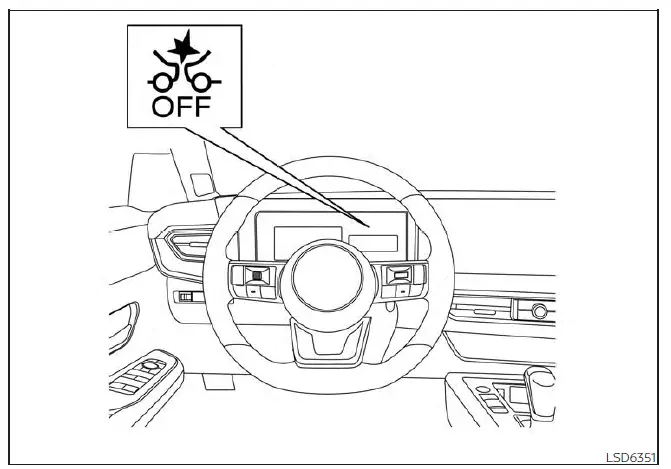
When the AEB with Pedestrian Detection system is disabled, the corresponding warning light will illuminate in the instrument display to inform the driver that the feature is currently inactive.
NOTE:
- The AEB with Pedestrian Detection system is automatically re-enabled each time the engine is restarted. This ensures that the safety feature returns to its default operating state whenever the Nissan Kicks is started again.
- The Intelligent Forward Collision Warning (I-FCW) system is integrated with the AEB with Pedestrian
Detection system.
Because of this integration, there is no separate menu option for the I-FCW system within the vehicle information display. When the AEB with Pedestrian Detection system is switched off, the I-FCW function is also disabled at the same time.
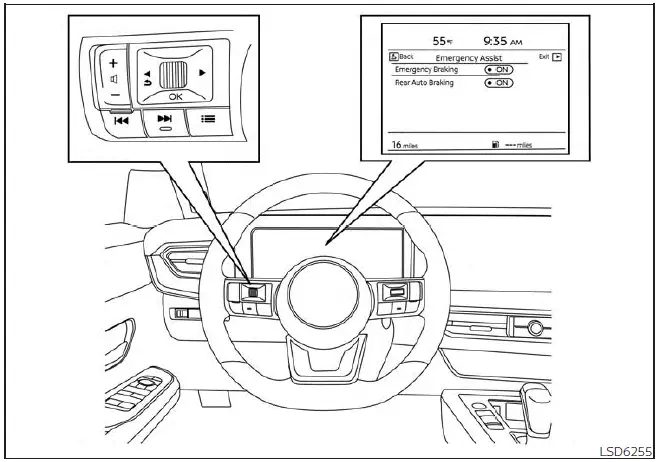
For vehicles with the 12.3 inch (31.2 cm) display
AEB with Pedestrian Detection system limitations Nissan Kicks Owner's Manual
WARNING
The following limitations apply to the AEB with Pedestrian Detection system. Failure to understand and follow these limitations when operating your Nissan Kicks could increase the risk of an accident resulting in serious injury or death.
- The AEB with Pedestrian Detection system cannot identify every vehicle or pedestrian in every possible driving situation.
- The AEB with Pedestrian Detection system is not capable of detecting the following:
- Pedestrians who are small in stature (such as children), seated, riding toys or skateboards, using scooters or wheelchairs, or who are not in a normal standing or walking position.
- Animals of any size.
- Roadway obstacles such as cargo, debris, or other objects located on or near the road surface.
- Vehicles crossing the path of your Nissan Kicks from another direction.
- Vehicles whose tires are difficult to see or whose rear profile is partially hidden, unclear, or obstructed.
- Parked vehicles.
- The AEB with Pedestrian Detection system has inherent performance limitations.
- If a stationary vehicle is directly ahead, the system may not function when your Nissan Kicks approaches it at speeds above approximately 50 mph (80 km/h).
- Pedestrian detection is designed to operate only when vehicle speed is approximately between 6 mph (10 km/h) and 37 mph (60 km/h). Outside this range, pedestrian recognition may not be available.
WARNING
- For pedestrian-related situations, the AEB with Pedestrian Detection system does not provide the initial warning stage that is available for some vehicle-detection scenarios.
- The AEB with Pedestrian Detection system may not detect a vehicle or pedestrian ahead, or may not
function correctly, under the following conditions:
- During poor visibility caused by rain, snow, fog, dust storms, sandstorms, smoke, or spray generated by other vehicles.
- When dirt, ice, snow, condensation, fog, or other materials cover the radar sensor area or the windshield area in front of the camera.
- When strong light sources, such as direct sunlight or oncoming high beams, enter the front camera, or when there is a sudden change in brightness, such as when entering or exiting a tunnel.
- In low-light or dark conditions, including nighttime driving, tunnels, situations where headlights are not sufficiently illuminated, or when the vehicle ahead has poor rear lighting visibility.
- When the camera alignment is incorrect.
- While driving on steep downhill grades, rough surfaces, dirt roads, or roads with sharp curves.
- When interference from external radar sources is present.
- When the position or movement of your Nissan Kicks changes suddenly, such as during abrupt steering inputs, rapid lane changes, quick acceleration, or sudden braking.
- When either your vehicle or the vehicle/pedestrian ahead moves in a way that prevents the system from detecting and responding in time, including sudden cut-ins, rapid direction changes, or pedestrians entering the vehicle's path at close range.
- When the detected vehicle or pedestrian is outside the primary forward travel path.
- When the speed difference between vehicles is minimal.
- When a pedestrian's appearance is partially obscured or difficult to identify because of luggage, strollers, bulky clothing, loose garments, accessories, or unusual body positions.
- When there is insufficient contrast between a pedestrian and the surrounding background due to similar colors or patterns.
- For approximately 15 seconds after the engine has been started.
- When the vehicle ahead has an unusual shape, extremely high or low ground clearance, uncommon cargo loading, or a narrow profile such as a motorcycle.
- When the vehicle or pedestrian is located near traffic signs, reflective surfaces, standing water, bright reflections, or deep shadows.
- When multiple pedestrians are grouped closely together.
- When a pedestrian is partially hidden behind another vehicle or object.
- System performance may be reduced under the following circumstances:
- When driving on slippery road surfaces.
- When driving on steep inclines or declines.
- When excessive cargo or heavy luggage is loaded in the rear seating area or cargo compartment of the Nissan Kicks.
- The system continuously performs automatic checks of the radar and camera sensors within the limits of its design. However, some obstructions such as snow, ice, stickers, or other contaminants may not always be detected. Regularly inspect and clean the sensor areas to help maintain proper system performance and reliable warnings.
- Under certain road or traffic conditions, the AEB with Pedestrian Detection system may apply partial braking unexpectedly. If acceleration is required, press the accelerator pedal to override the system.
- The system may activate when it detects patterns, shadows, lights, reflections, or objects that resemble the shape, size, or lighting signature of vehicles, motorcycles, or pedestrians.
- The system may continue operating while a vehicle ahead is turning left or right and has not completely exited the detection area.
- The system may activate while your Nissan Kicks is approaching and overtaking another vehicle.
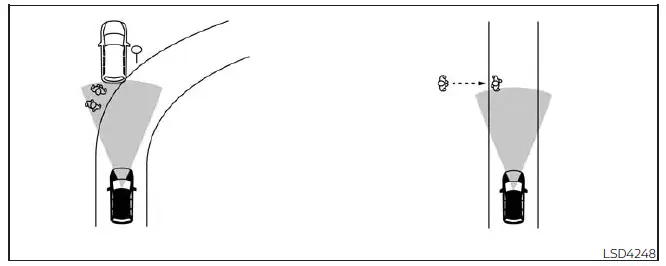
- Depending on road geometry, including curved roads, winding routes, construction zones, lane shifts, or the entrance and exit of bends, the system may temporarily respond to an oncoming vehicle located ahead of your vehicle.
WARNING
The following limitations apply to the AEB with Pedestrian Detection system. Failure to operate the Nissan Kicks with a full understanding of these limitations could increase the risk of a collision resulting in serious injury or death.
- The AEB with Pedestrian Detection system may react to objects, vehicles, or pedestrians that are not
directly in the intended path of the vehicle, including the following situations:
- Roadside objects such as traffic signs, guardrails, pedestrians, motorcycles, parked vehicles, or similar structures.
- Pedestrians encountered while driving through narrow streets, alleys, or confined roadways.
- Pedestrians who briefly step into or move toward the travel lane while attempting to avoid obstacles located on the shoulder of the road.
- Objects positioned above the roadway, including low bridges, overhead signs, and similar structures.
- Road-surface features such as railroad tracks, drainage grates, metal plates, or comparable objects.
- Parking garage structures including support beams, pillars, walls, and overhead components.
- Pedestrians or motorcycles approaching the travel lane from the side.
- Vehicles, motorcycles, pedestrians, or other objects located in adjacent lanes or traveling very close to the Nissan Kicks.
- Pedestrians approaching from the opposite direction.
- Roadside objects such as trees or similar vertical structures.
- Braking distance increases on slippery road surfaces. Wet pavement, snow, ice, or other low-traction conditions can reduce the effectiveness of braking performance even when the AEB with Pedestrian Detection system is operating.
- Excessive surrounding noise may interfere with the audible warning chime, making it difficult for the driver to hear system alerts when they occur.
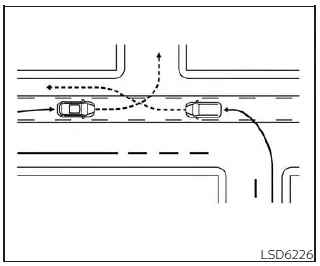
WARNING
Intersection Assist (if equipped) does not apply braking for approaching vehicles that are traveling toward the front of your vehicle in every situation. Drivers of the Nissan Kicks must remain attentive and be prepared to brake or steer whenever necessary.
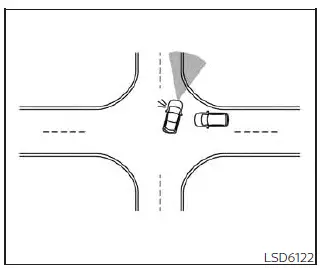
(In the intersection) After turning left
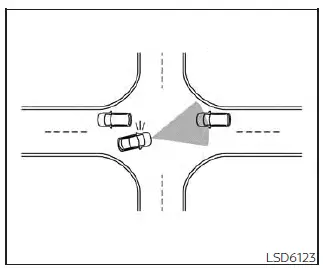
(In the intersection) Approaching
vehicles in a row
WARNING
In addition to the general operating limitations that apply to the AEB with Pedestrian Detection system, the following restrictions should be considered when the AEB with Pedestrian Detection and Intersection Assist feature (if equipped) is active on the Nissan Kicks. Understanding these conditions can help drivers better recognize situations where the system's performance may be reduced and where increased driver attention is required.
- Intersection Assist (if equipped) may not recognize an approaching vehicle or pedestrian under the
following circumstances:
- When making a right or left turn across traffic that is separated by more than two lanes from the approaching vehicles, reducing the system's ability to accurately evaluate crossing traffic.
- When the Nissan Kicks is not traveling directly toward an approaching vehicle during a right or left turn, making it more difficult for the sensors to determine a potential collision path.
- Intersection Assist may not identify an approaching vehicle after the turn maneuver has already begun, particularly if the vehicle enters the detection area late.
- When turning sharply or negotiating an unusually wide curve, the system's field of detection may be affected.
- When the road center line cannot be properly recognized due to faded markings, poor visibility, road damage, or other environmental conditions.
- When multiple approaching vehicles are traveling closely together in a sequence, making it more difficult for the system to distinguish individual vehicle movements.
- When the roadway is significantly wider or narrower than standard lane dimensions, which may influence the system's interpretation of the driving environment.
- When the center line is positioned very close to road markers, construction markings, or other lane indicators that may affect recognition accuracy.
- While making a right or left turn, Intersection Assist may activate the brakes even when the calculated collision risk appears minimal. This precautionary behavior is intended to enhance safety but may occasionally feel unexpected to the driver.
- Intersection Assist may also apply braking if the movement of an approaching vehicle becomes difficult to predict, such as when that vehicle suddenly changes direction, turns unexpectedly, or rapidly slows down while approaching the intersection.
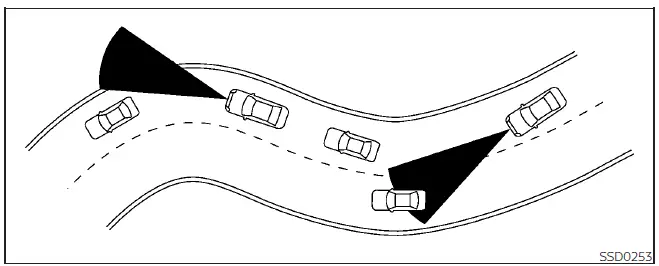
When driving the Nissan Kicks on certain road types, including winding roads, steep hills, narrow lanes, curved routes, construction zones, or roads with significant inclines or declines, the forward-facing sensor may occasionally detect vehicles traveling in adjacent lanes or temporarily lose track of a vehicle directly ahead. Under these conditions, the system may not operate exactly as expected because the surrounding road geometry can affect sensor performance and object recognition.
The ability of the Nissan Kicks to detect vehicles may also be influenced by driving inputs and vehicle positioning. Factors such as steering movements, lane placement, cornering angles, and overall vehicle dynamics can impact how the system interprets surrounding traffic. In some situations, the system indicator may flash and a warning chime may sound even though no immediate hazard is present. If this occurs, the driver should remain attentive, maintain a safe following distance, and be prepared to manually control vehicle speed and braking. As with all driver-assistance technologies, AEB with Pedestrian Detection and Intersection Assist are designed to support the driver, not replace safe and attentive driving practices.
System temporarily unavailable Nissan Kicks Owner's Manual
For vehicles with the 7 inch (18 cm) display
Condition A:
Under certain operating conditions, the Nissan Kicks AEB with Pedestrian Detection system may temporarily suspend operation. When this occurs, the system warning light will flash and the feature will automatically deactivate until normal operating conditions are restored.
- The radar sensor is receiving interference from another radar source or electronic signal nearby.
- The windshield area in front of the camera becomes fogged, frosted, or partially frozen, reducing visibility for the camera.
- Intense light is shining directly toward the front of the vehicle, affecting the camera's ability to detect objects accurately.
- The cabin temperature exceeds approximately 104°F (40°C) while the vehicle is exposed to strong direct sunlight.
- The camera viewing area on the windshield remains covered by dirt, dust, debris, moisture, or other contaminants for an extended period.
Action to take:
Once the conditions listed above have cleared, the AEB with Pedestrian Detection system on your Nissan Kicks will automatically return to normal operation without requiring additional driver input.
NOTE:
If the camera viewing area on the inside surface of the windshield is fogged or frozen, it may take some time for the air conditioning system to completely clear the glass after it has been activated. If contamination or residue remains on the camera area, it is recommended that the windshield be inspected and cleaned professionally. Nissan recommends contacting an authorized NISSAN dealer if the condition persists.
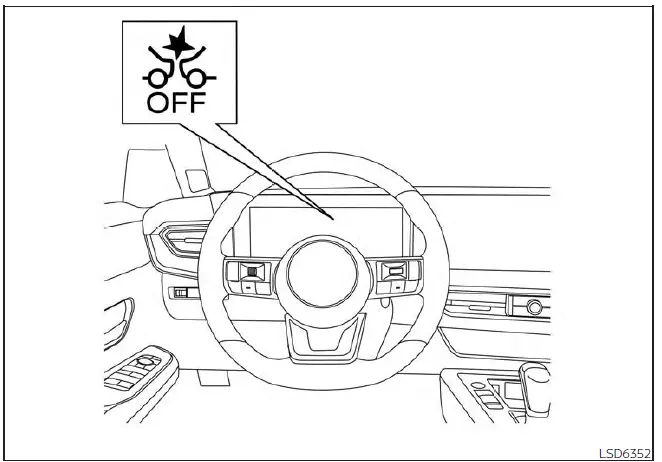
For vehicles with the 12.3 inch (31.2 cm) display
Condition B:
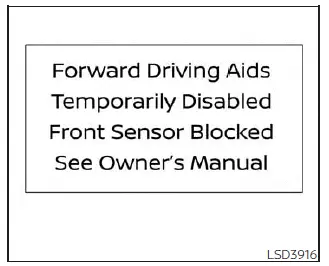
Severe weather conditions such as heavy rain, dense fog, blowing snow, or similar environmental factors may block the front radar sensor. When this happens, the AEB with Pedestrian Detection system on the Nissan Kicks will be canceled temporarily. A warning chime will sound and the message "Forward Driving Aids Temporarily Disabled Front Sensor Blocked See Owner's Manual" will appear in the vehicle information display.
Action to take:
After weather conditions improve and the radar sensor is no longer obstructed, the warning message should disappear automatically from the vehicle information display. If the message remains visible after conditions have returned to normal, the system should be inspected. It is recommended that you visit a NISSAN dealer for diagnosis and service.
Condition C:
If the radar sensor located behind the front bumper or emblem becomes covered with mud, dirt, slush, snow, ice, or any other obstruction, the Nissan Kicks AEB with Pedestrian Detection system will automatically deactivate. A warning chime will sound and the message "Forward Driving Aids Temporarily Disabled Front Sensor Blocked See Owner's Manual" will be displayed.
Action to take:
If this warning appears, stop the vehicle in a safe location, move the shift selector to the P (Park) position, and switch the engine off. Carefully inspect and clean the radar sensor area on the front bumper or emblem, then restart the engine. In many cases, normal system operation will resume once the obstruction has been removed.
If the "Forward Driving Aids Temporarily Disabled Front Sensor Blocked See Owner's Manual" message continues to appear after cleaning the sensor area, the system should be checked by a qualified technician.
It is recommended that you visit a NISSAN dealer for inspection and service.
Condition D
While driving on roads with very limited roadside structures or unique surroundings, such as long bridges, open desert areas, large snow-covered fields, or roads running alongside extended walls, the Nissan Kicks may temporarily display the system warning light together with the message "Forward Driving Aids Temporarily Disabled Front Sensor Blocked See Owner's Manual". In these situations, surrounding conditions can affect how the radar sensor interprets the driving environment.
Action to take:
Once normal road conditions are encountered again, reactivate the system if necessary and continue driving. The warning should no longer be displayed when the unusual environmental conditions are no longer present.
NOTE:
If the AEB with Pedestrian Detection system becomes unavailable, the Intelligent Forward Collision Warning (I-FCW) system will also be unavailable because both systems share related detection functions.
System malfunction
If a malfunction is detected within the Nissan Kicks AEB with Pedestrian Detection system, the feature will automatically switch off. A warning chime will sound and the orange AEB warning indicator will illuminate in the vehicle information display to notify the driver that system operation has been suspended.
Action to take:
If the orange warning indicator illuminates, stop the vehicle in a safe location whenever conditions permit. Turn the engine off, wait briefly, and restart the vehicle. If the warning light remains illuminated after restarting, the AEB with Pedestrian Detection system should be inspected. It is recommended that you visit a NISSAN dealer for professional diagnosis and repair.
System maintenance
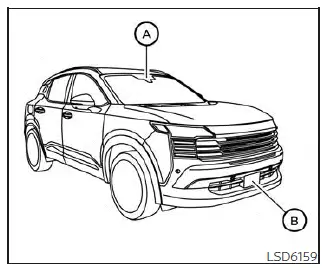
The radar sensor is positioned at the front of the vehicle B, while the camera unit is mounted near the upper portion of the windshield A. These components work together to support the Nissan Kicks AEB with Pedestrian Detection system and related driver-assistance features.
To help ensure reliable operation of the system, follow these maintenance guidelines:
- Keep the sensor areas on the front bumper, emblem, and windshield clean at all times.
- Avoid striking, scratching, or otherwise damaging the areas surrounding the radar sensor and camera.
- Do not place stickers, films, accessories, or other objects near the sensors, as they may block signals or interfere with proper operation.
- Do not install metallic accessories near the radar sensor, including brush guards or similar equipment, because they may negatively affect sensor performance.
- Avoid placing reflective objects such as mirrors, glossy paper, or highly reflective materials on the instrument panel. Reflected sunlight may reduce the camera's ability to detect objects accurately.
- Do not modify, repaint, remove, or alter the front bumper. If bumper repairs, restoration work, or customization are required, Nissan recommends consulting a NISSAN dealer to help maintain proper sensor alignment and operation.
Radio frequency statement
For USA
This device complies with Part 15 of the FCC Rules. Operation is subject to the following two conditions:
1. This device may not cause harmful interference, and
2. This device must accept any interference received, including interference that may cause undesired operation.
FCC Warning
Any changes or modifications not expressly approved by the party responsible for compliance may void the user's authority to operate this equipment.
For Canada
This device complies with Part 15 of the FCC Rules and with Industry Canada licence-exempt RSS standard(s). Operation is subject to the following two conditions:
1. This device may not cause interference, and
2. This device must accept any interference received, including interference that may result in undesired operation of the device.
Le présent appareil est conforme aux CNR d'Industrie Canada applicables aux appareils radio exempts de licence. L'exploitation est autorisée aux deux conditions suivantes:
1. L'appareil ne doit pas produire de brouillage, et
2. L'utilisateur de l'appareil doit accepter tout brouillage radioélectrique subi, même si le brouillage est susceptible d'en compromettre le fonctionnement.
Radio frequency radiation exposure information:
This equipment complies with FCC and IC radiation exposure limits established for an uncontrolled environment.
This equipment should be installed and operated with a minimum distance of 30 cm between the radiator and the user's body.
This transmitter must not be co-located with, or operated together with, any other antenna or transmitter.
Cet équipement est conforme aux limites d'exposition aux rayonnements IC établies pour un environnement non contrôlé.
Cet équipement doit être installé et utilisé avec un minimum de 30 cm de distance entre la source de rayonnement et votre corps.
FCC Notice
Changes or modifications not expressly approved by the party responsible for compliance could void the user's authority to operate the equipment.