



WARNING
- Riding in a cargo area inside a vehicle is extremely dangerous.
In the event of a collision, occupants traveling in cargo areas face a significantly higher risk of serious injury or death because these locations are not designed to provide proper occupant protection.
- Never allow passengers to ride in any area of the vehicle that is not equipped with approved seating and seat belts.
- Always ensure that every occupant of your Nissan Kicks is seated properly and wearing a correctly fastened seat belt before the vehicle is driven.
Terms
Before loading your Nissan Kicks with passengers, luggage, or other cargo, it is important to understand the following weight-related terms. Familiarity with these definitions will help you load the vehicle safely and remain within its designed operating limits.
- Curb Weight (actual vehicle weight) - the weight of the vehicle as manufactured, including standard and optional equipment, operating fluids, emergency tools, and the spare tire assembly. This value does not include passengers or cargo.
- GVW (Gross Vehicle Weight) - the combined weight of the vehicle, all occupants, and all cargo currently being carried.
- GVWR (Gross Vehicle Weight Rating) - the maximum allowable combined weight of the unloaded vehicle,
passengers, cargo, trailer tongue load, hitch equipment, and any installed accessories or optional
equipment.
This information is displayed on the F.M.V.S.S. certification label and should never be exceeded.
- GAWR (Gross Axle Weight Rating) - the maximum allowable load that may be carried by either the front axle or
rear axle.
This information can be found on the F.M.V.S.S./C.M.V.S.S. certification label and is important when distributing cargo throughout the vehicle.
- GCWR (Gross Combined Weight Rating) - the maximum allowable combined weight of the vehicle, occupants, cargo, and trailer when towing.
- Vehicle Capacity Weight, Load Limit, Total Load Capacity - the maximum permitted combined weight of
passengers and cargo that may be carried by the vehicle.
If the Nissan Kicks is used for towing, the trailer tongue weight must be included as part of the total cargo load. The load limit information is shown on the Tire and Loading Information label.
- Cargo Capacity - the allowable cargo weight remaining after the weight of all occupants has been subtracted from the vehicle's total load limit.
Vehicle load capacity
Before operating a fully loaded Nissan Kicks, verify that neither the Gross Vehicle Weight Rating (GVWR) nor the Gross Axle Weight Rating (GAWR) will be exceeded. These ratings are provided by the manufacturer and are listed on the F.M.V.S.S./C.M.V.S.S. certification label.
Remaining within these limits helps maintain safe handling characteristics, braking performance, tire durability, and overall vehicle stability.
For additional information, refer to the section titled "Measurement of weights".
Never exceed the load limit identified on the Tire and Loading Information label as "The combined weight of occupants and cargo."
Likewise, do not exceed the maximum seating capacity listed on the Tire and Loading Information label. Both passenger weight and cargo weight must be considered when calculating the total vehicle load.
To determine "the combined weight of occupants and cargo," first calculate the total weight of all vehicle occupants and then add the weight of all luggage, equipment, and cargo being transported. The following example illustrates this process.
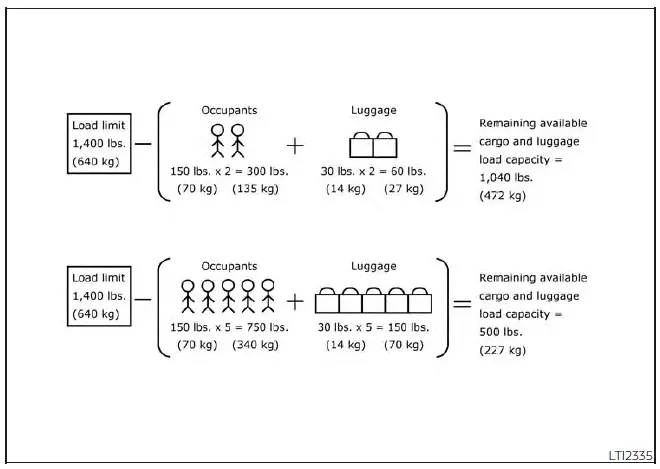
Example
Steps For Determining Correct Load Limit
1. Locate the statement "The combined weight of occupants and cargo should never exceed XXX kg or XXX lbs." on the vehicle placard or Tire and Loading Information label.
2. Calculate the total combined weight of the driver and all passengers who will be traveling in the Nissan Kicks.
3. Subtract the combined passenger weight from the maximum value shown as XXX kg or XXX lbs.
4. The remaining value represents the available cargo and luggage carrying capacity. For example, if the listed limit is 1,400 lbs. and five occupants weighing 150 lbs. each are riding in the vehicle, the available cargo capacity would be 650 lbs. (1,400 − 750 = 650 lbs.).
5. Determine the total weight of all luggage, equipment, and cargo that will be loaded into the vehicle. This combined cargo weight must not exceed the available capacity calculated in Step 4.
6. If your vehicle is used to pull a trailer, a portion of the trailer's weight will be transferred to the vehicle through the hitch connection. This additional load must be included when calculating the available cargo and luggage carrying capacity. Refer to the appropriate sections of this manual to understand how trailer tongue weight affects overall vehicle loading limits.
Using a vehicle for towing when it has not been designed or approved for trailer towing can significantly increase the risk of accidents, vehicle damage, loss of control, and serious injury.
WARNING
Do not tow a trailer with your vehicle.
Towing a trailer with the Nissan Kicks may result in an accident involving serious injury or death.
Before operating a fully loaded Nissan Kicks, always verify that neither the Gross Vehicle Weight Rating (GVWR) nor the Gross Axle Weight Rating (GAWR) is exceeded.
In addition, check all tires to ensure they are inflated to the recommended pressures shown on the Tire and Loading Information label.
Securing the load
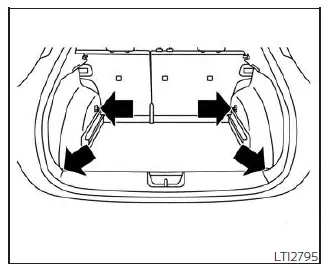
Cargo area luggage hooks
The Nissan Kicks is equipped with luggage hooks in the cargo compartment as illustrated. These hooks are designed to help secure luggage, equipment, and other items using ropes, straps, or similar tie-down devices to minimize movement during driving.
Properly securing cargo helps maintain vehicle stability and reduces the possibility of objects shifting unexpectedly during acceleration, braking, or cornering.
When securing cargo to the luggage hooks, do not apply a load greater than 110 lbs. (490 N) to any individual hook.
WARNING
- Always secure cargo properly using suitable ropes, straps, or tie-down devices to help prevent movement during vehicle operation. Cargo should never be stacked above the height of the seatbacks. In a sudden stop or collision, unsecured items can become dangerous projectiles and may cause serious personal injury.
- Items carried in the cargo area may come into contact with a child restraint top tether strap. Secure all cargo appropriately to avoid damaging the tether. A damaged tether strap may reduce child restraint effectiveness and could result in serious injury or death during a collision.
- Never load the Nissan Kicks beyond its GVWR or the specified front and rear GAWR limits. Exceeding these ratings can cause component failure, tire damage, altered handling characteristics, and increased risk of losing control of the vehicle.
Loading tips
- The Gross Vehicle Weight (GVW) must never exceed the GVWR or the individual GAWR ratings specified on the F.M.V.S.S./C.M.V.S.S. certification label.
- Do not load either axle to its maximum GAWR while simultaneously carrying additional load elsewhere in the vehicle. Doing so may cause the total vehicle weight to exceed the GVWR.
WARNING
- Secure all cargo carefully using appropriate straps or tie-down equipment. Avoid placing cargo above the seatback height. During emergency maneuvers or collisions, unsecured cargo may move suddenly and cause injury to vehicle occupants.
- Do not exceed the Gross Vehicle Weight Rating (GVWR) or the maximum Gross Axle Weight Ratings (GAWR) for
either axle. Overloading may damage vehicle components, increase tire stress, and adversely affect the
handling characteristics of your Nissan Kicks.
This can lead to reduced vehicle control and increase the likelihood of an accident resulting in personal injury.
- Improper loading practices and vehicle overloading can shorten the service life of both the vehicle and
its tires. They may also result in reduced braking performance, unstable handling, and increased
stopping distances.
Excessive loading can contribute to premature tire failure and significantly increase the risk of a serious accident. Damage caused by overloading is not covered under the vehicle warranty.
Measurement of weights
Secure all loose cargo before measuring vehicle weight to prevent weight shifts that could affect balance and measurement accuracy.
When the Nissan Kicks is fully loaded, drive the vehicle onto a certified scale and weigh the front and rear axles separately. This procedure allows you to determine the actual load being carried by each axle.
The measured axle loads must not exceed the applicable Gross Axle Weight Ratings (GAWR). In addition, the combined total of both axle loads must remain below the Gross Vehicle Weight Rating (GVWR).
These ratings are listed on the vehicle certification label and represent the maximum allowable operating weights established by the manufacturer.
If any measured weight exceeds the specified limits, redistribute, reduce, or remove cargo as necessary until all axle loads and total vehicle weight are within the approved ratings.
Towing a trailer
Do not tow a trailer with your vehicle.
The Nissan Kicks is not designed or intended for trailer towing. Attempting to tow a trailer may negatively affect braking performance, vehicle stability, handling, and component durability, creating an increased risk of accidents and vehicle damage.