



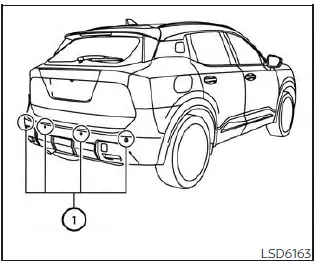
WARNING
Failure to follow the warnings and operating instructions for the Rear Automatic Braking (RAB) system could result in serious injury or death.
-
The RAB system is designed as a supplemental driver-assistance feature and should never be considered a
substitute for attentive driving practices.
Always check the area behind your Nissan Kicks using the rearview and side mirrors, and physically turn to look in the direction of travel before and while reversing. The RAB system is intended to assist the driver, not replace visual confirmation of surrounding conditions.
The driver remains fully responsible for maintaining awareness, operating the vehicle safely, and controlling the Nissan Kicks at all times.
- Like all driver-assistance technologies, the RAB system has operational limitations and may not perform effectively in every driving environment or situation.
- Severe weather conditions or external ultrasonic sources, such as automatic vehicle wash equipment, truck air brake systems, pneumatic tools, or similar equipment, may influence system operation. In some cases this may reduce detection performance or result in unintended system activation.
The Rear Automatic Braking system in the Nissan Kicks is designed to assist the driver when reversing and approaching objects located directly behind the vehicle.
2. Select "Emergency Brake" and press the OK button.
3. Select "Rear" or "Rear Auto Braking" and press the OK button to enable or disable the system according to your preference.
NOTE:
The Rear Automatic Braking (RAB) system in the Nissan Kicks is automatically reactivated every time the engine is restarted, even if it was previously turned off through the settings menu.
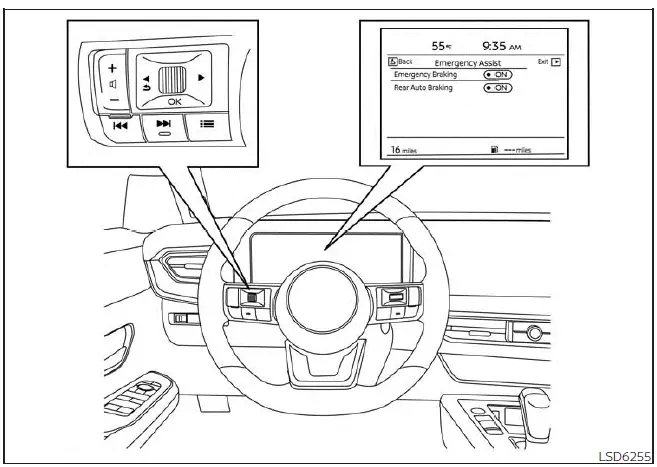
For vehicles with the 12.3 inch (31.2 cm) display
RAB system limitations
WARNING
Listed below are important operating limitations of the Rear Automatic Braking system. Failure to understand and follow these warnings could result in serious injury or death.
- When the vehicle approaches an obstacle while the accelerator pedal or brake pedal is being pressed, system operation may be delayed or may not occur at all. The RAB system's performance can be affected by vehicle condition, traffic situations, weather, road surface conditions, and other environmental factors. Never wait for the system to react. Apply the brakes yourself whenever necessary to maintain safe vehicle control.
- If it becomes necessary to override an active RAB intervention, firmly depress the accelerator pedal.
- Always check the area around and behind
your Nissan Kicks before and while
reversing. The RAB system is designed to
detect certain stationary objects behind
the vehicle, but it cannot identify every
type of obstacle. The system does not
detect the following:
- Moving objects
- Very low objects that may fall outside the sensor detection area
- Narrow obstacles
- Wedge-shaped objects
- Objects located very close to the rear bumper (less than approximately 1 ft [30 cm])
- Objects that suddenly enter the detection zone
- Thin items such as ropes, cables, chains, wires, or similar materials
- The RAB system may also be unable to
respond appropriately to the following
obstacles:
- Objects positioned high above the ground
- Objects located significantly off-center relative to the rear of the vehicle
- Objects made of soft materials, such as snowbanks or sponge-like surfaces, that absorb ultrasonic signals
- The RAB system may not function correctly
under the following conditions:
- Rain, snow, ice, mud, dirt, or other foreign material is covering the sonar sensors
- Loud noises are present near the vehicle
- The surface of the detected object is angled sharply relative to the rear of the Nissan Kicks
- Under certain circumstances, the RAB
system may activate even though no
collision risk exists. Examples include:
- Tall grass or dense vegetation near the vehicle
- Structures located close to the side of the vehicle, such as walls, toll booth equipment, parking gates, or narrow tunnels
- Road surface irregularities including bumps, raised pavement sections, protrusions, or manhole covers
- Driving through hanging flags, fabric barriers, curtains, or similar materials
- Accumulated snow or ice behind the vehicle
- Nearby ultrasonic sources, including parking sensors from other vehicles
- Once automatic braking has been activated for a specific obstacle, the system will not immediately activate again for that same obstacle during the same maneuver.
- The automatic braking function operates for only a limited period of time. The driver must remain attentive and be prepared to apply the brakes whenever necessary.
Therefore, the driver must always be prepared to apply the brake pedal manually whenever necessary. The Rear Automatic Braking system in the Nissan Kicks is designed as an assistance feature and should never be considered a substitute for attentive vehicle operation.
- When the Nissan Kicks is being driven in adverse weather conditions such as rain, fog, snow, sleet, or heavy road spray.
- When driving on steep inclines or declines that may affect sensor detection and vehicle attitude.
- When the vehicle's posture changes significantly, such as while passing over bumps, dips, uneven pavement, or speed humps.
- When driving on slippery surfaces where tire traction is reduced.
- When the steering wheel is turned sharply to its limit, causing rapid changes in vehicle direction.
- When snow chains are installed on the vehicle.
- When wheels or tires other than those recommended by NISSAN are fitted.
- When the braking system is cold due to low ambient temperatures or immediately after the vehicle begins moving.
- When braking performance is temporarily reduced because the brakes are wet after driving through standing water or after washing the vehicle.
- When the vehicle is being towed.
- When the Nissan Kicks is being transported on a flatbed truck.
- When the vehicle is being tested on a chassis dynamometer.
- When driving over severely uneven or irregular road surfaces.
- When suspension components other than Genuine NISSAN parts have been installed. Changes to vehicle height or body angle may affect obstacle detection accuracy.
- When accessories such as bicycle carriers, cargo carriers, or similar equipment obstruct the rear sensors.
System malfunction
If the Rear Automatic Braking (RAB) system detects a malfunction, it will automatically deactivate itself and the RAB warning light will illuminate in the vehicle information display.
Action to take:
If the warning indicator comes on, safely park the Nissan Kicks, switch the engine off, and then restart it. If the warning light remains illuminated after restarting the vehicle, the system should be inspected as soon as possible. It is recommended that you visit a NISSAN dealer for diagnosis and service.
NOTE:
If the RAB system becomes temporarily unavailable due to operating conditions, the RAB warning light may blink. This does not necessarily indicate a permanent malfunction.
System maintenance
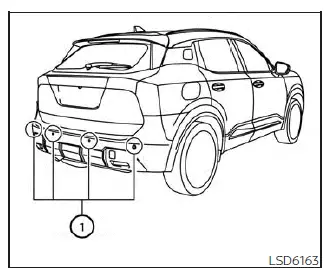
To help ensure reliable operation of the Rear Automatic Braking system in the Nissan Kicks, observe the following maintenance recommendations:
- Always keep the parking sensors 1 clean and free of dirt, mud, snow, ice, wax buildup, or other contaminants that could interfere with detection performance.
- If the parking sensors become dirty, carefully clean them using a soft cloth. Avoid using abrasive materials or excessive force that could scratch or damage the sensor surfaces.
- Do not subject the areas surrounding the parking sensors 1 to strong impacts. Do not remove, modify, or disassemble the sensors. If the rear bumper, sensors, or surrounding components are damaged or deformed in a collision, have the system inspected. It is recommended that you visit a NISSAN dealer for this service.
- Do not place stickers, films, decals, or accessories—including transparent materials—on or near the parking sensors 1. Such items may interfere with sensor operation and could result in improper system performance or malfunction.