



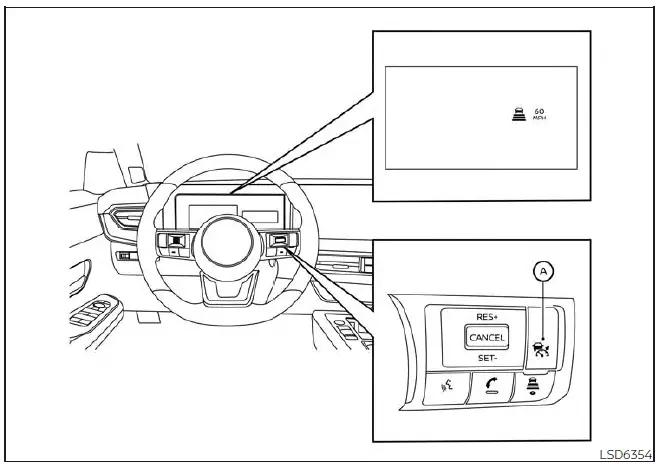
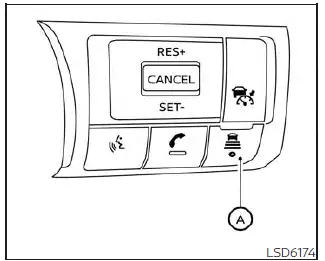
- ICC switch
WARNING
Failure to follow the warnings and operating instructions for the Intelligent Cruise Control system may result in serious injury or death.
- The ICC system in the Nissan Kicks is a driving assistance feature only. It is not a collision warning system, an emergency braking system, or a substitute for attentive driving. The driver must remain alert, watch the road, and keep full control of the vehicle at all times.
- Always obey posted speed limits and never set the cruise speed higher than the legal or safe speed for current road conditions.
- Always drive carefully and remain attentive when using the ICC system.
Read and understand the Owner's Manual before operating Intelligent Cruise Control. To help avoid serious injury or death, do not rely on the system to prevent accidents, react to every traffic situation, or control the Nissan Kicks in emergency conditions.
Use the ICC system only when road, weather, visibility, and traffic conditions are suitable.
- In conventional fixed-speed cruise control mode, the system does not provide a warning chime if your vehicle becomes too close to the vehicle ahead. Always monitor the distance between the Nissan Kicks and surrounding traffic, or a collision could occur.
The Intelligent Cruise Control system helps the Nissan Kicks maintain a selected following distance from the vehicle ahead within a speed range of 0 to 90 mph (0 to 144 km/h), up to the speed set by the driver. The driver can select a set speed between 20 and 90 mph (32 and 144 km/h).
When the lane ahead is clear, the Nissan Kicks travels at the selected set speed.
The ICC system can operate in one of two cruise control modes:
- Vehicle-to-vehicle distance control mode: Helps maintain a selected distance between the Nissan Kicks and the vehicle ahead, up to the preset speed selected by the driver.
- Conventional fixed-speed cruise control mode: Allows the vehicle to cruise at a preset speed without automatic distance control.
Push the ICC switch A to choose between vehicle-to-vehicle distance control mode and conventional fixed-speed cruise control mode.
Once one cruise control mode is activated, it cannot be changed directly to the other mode. To change modes, push the ICC switch A once to turn the system off. Then push the ICC switch A again to turn the system back on and select the desired cruise control mode.
Always confirm the selected mode and setting in the Nissan Kicks ICC system display before relying on the system during driving.
How to select the cruise control mode
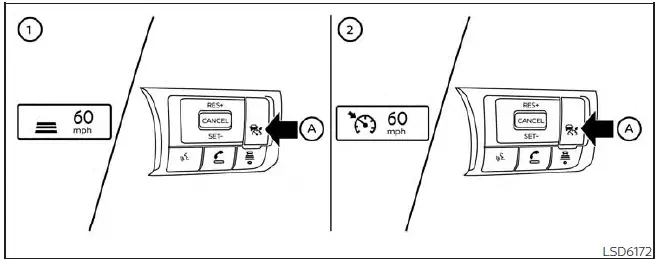
Selecting vehicle-to-vehicle distance control mode: To choose vehicle-to-vehicle distance control mode 1, quickly push and release the ICC switch A.
Selecting conventional fixed-speed cruise control mode: To choose conventional fixed-speed cruise control mode 2, push and hold the ICC switch A for longer than approximately 1.5 seconds.
Before using Intelligent Cruise Control in the Nissan Kicks, make sure the selected mode matches the driving situation. Vehicle-to-vehicle distance control is intended for steady traffic flow, while fixed-speed cruise control is best suited for clear roads where the driver can safely manage following distance manually.
- Vehicle-to-vehicle distance control mode
- Vehicle-to-vehicle distance control mode switches
- Vehicle-to-vehicle distance control mode limitations
- System maintenance
Vehicle-to-vehicle distance control mode Nissan Kicks crossover
In vehicle-to-vehicle distance control mode, the Nissan Kicks Intelligent Cruise Control (ICC) system is designed to automatically maintain a driver-selected following distance from the vehicle traveling ahead. Depending on traffic conditions, the system can adjust the Nissan Kicks speed to match the movement of the preceding vehicle while maintaining the chosen gap whenever possible.
When the roadway ahead is clear and no vehicle is detected within the monitoring range, the Nissan Kicks continues traveling at the speed selected by the driver.
The Intelligent Cruise Control system is intended to improve driving comfort during highway and long-distance travel by assisting the driver when following vehicles traveling in the same lane and direction.
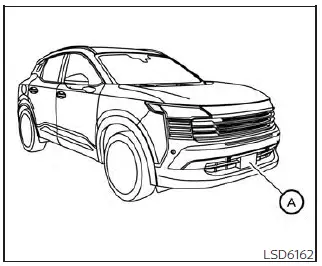
If the radar sensor A detects a slower-moving vehicle ahead, the Nissan Kicks ICC system automatically reduces vehicle speed to help maintain the selected following distance.
The system can manage engine output and apply braking force when necessary. Under normal operating conditions, the ICC system can apply braking effort of up to approximately 40% of the vehicle's available braking capability.
The forward radar sensor can monitor traffic conditions at a distance of up to approximately 650 ft (200 m) ahead of the Nissan Kicks, allowing the system to detect and react to changing traffic flow.
Vehicle-to-vehicle distance control mode operation
The vehicle-to-vehicle distance control mode is designed to continuously monitor the distance between the Nissan Kicks and the vehicle ahead. When traffic slows, the system can automatically reduce speed to help maintain the selected following interval.
If the vehicle ahead slows significantly, the Nissan Kicks Intelligent Cruise Control system will progressively decelerate the vehicle. If the detected vehicle comes to a complete stop, the system can bring the Nissan Kicks to a standstill within the operating limitations of the system.
Although the ICC system can automatically apply the brakes, its braking capability is limited to approximately 40% of total braking force. Drivers must remain attentive and be prepared to apply the brakes immediately whenever traffic conditions require stronger or faster deceleration.
This Nissan Kicks feature is most effective when traffic flow remains relatively steady or when speed changes occur gradually. Sudden traffic events may exceed the response capability of the system.
For example, if another vehicle quickly moves into your lane or if the vehicle ahead brakes sharply, the distance between vehicles may decrease rapidly because the Intelligent Cruise Control system cannot always reduce speed quickly enough to maintain the selected gap.
When additional driver intervention is required, the system will sound an audible warning chime and flash information in the display to alert the driver to take corrective action.
The ICC system will automatically cancel operation and a warning chime will sound if vehicle speed drops below approximately 15 mph (24 km/h) and no vehicle is detected ahead. The system may also disengage if operating conditions exceed the allowable control range or when the vehicle travels above the maximum set speed.
The following functions are performed while operating in vehicle-to-vehicle distance control mode:
- When no vehicle is detected ahead, the Nissan Kicks maintains the speed selected by the driver. The available set speed range is approximately 20 to 90 mph (32 to 144 km/h).
- When a vehicle is detected ahead, the Intelligent Cruise Control system automatically adjusts vehicle speed to maintain the driver-selected following distance. If the preceding vehicle slows down, the Nissan Kicks will decelerate accordingly. If the vehicle ahead comes to a complete stop, the Nissan Kicks can also slow to a standstill within the limits of system operation.
For optimal performance, ensure that the radar sensor area remains clean and unobstructed. Proper use of Intelligent Cruise Control can help reduce driver workload during extended highway travel, but the driver must always remain fully responsible for safe vehicle operation.
The Nissan Kicks ICC system will cancel the vehicle-to-vehicle distance control operation once it determines that the vehicle has come to a standstill, and a warning chime will sound to alert the driver.
The Intelligent Cruise Control system in the Nissan Kicks does not control vehicle speed or provide a warning when you are approaching stationary or very slow-moving vehicles. For this reason, the driver must always watch the road carefully and maintain a proper following distance, especially when approaching toll gates, heavy traffic, traffic congestion, or vehicles stopped ahead.
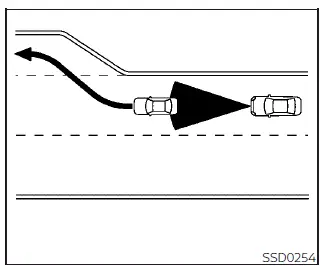
When the Nissan Kicks is being driven on a freeway at a selected set speed and the vehicle approaches a slower vehicle ahead, the ICC system adjusts vehicle speed to help maintain the following distance chosen by the driver. If the vehicle ahead changes lanes, exits the freeway, or is no longer detected in the same lane of travel, the ICC system may accelerate the Nissan Kicks and maintain speed up to the set speed. The driver must continue to pay close attention and remain ready to steer, brake, or accelerate as needed while the vehicle returns to the selected cruising speed.
The Nissan Kicks may not always be able to maintain the set speed on winding roads, steep grades, rolling hills, sharp curves, or roads where vehicle detection becomes difficult. If this happens, the driver must manually control the vehicle speed and drive according to the actual road and traffic conditions.
During normal vehicle-to-vehicle distance control, the ICC system automatically accelerates or decelerates the Nissan Kicks according to the speed of the vehicle detected ahead. This feature is designed to support comfortable highway driving, but it is not a substitute for attentive driving or safe judgment.
Press the accelerator pedal when additional acceleration is required, such as when changing lanes or merging into faster traffic. Press the brake pedal whenever stronger deceleration is needed to maintain a safe distance, especially if the vehicle ahead brakes suddenly or another vehicle cuts into your lane. Always stay alert when using the Nissan Kicks ICC system, keep both hands ready for control, and remember that the driver remains fully responsible for safe vehicle operation.
Vehicle-to-vehicle distance control mode switches Nissan Kicks P16
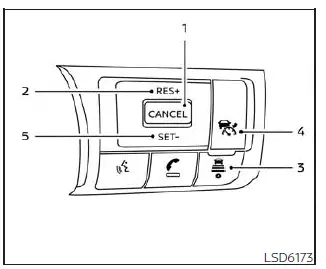
The Nissan Kicks vehicle-to-vehicle distance control mode is operated by the ICC switch together with four control switches, all conveniently positioned on the steering wheel so the driver can manage cruise control functions without taking attention away from the road.
1. CANCEL switch:
This switch deactivates the Nissan Kicks ICC system without deleting the previously set cruising speed.
2. RES+ switch:
This switch resumes the stored set speed or increases the cruising speed in small increments when adjustment is needed.
3. DISTANCE
 switch:
This switch changes the following distance that the Nissan Kicks maintains from the vehicle ahead:
- Long
- Middle
- Short
4. ICC Switch:
This is the master switch used to activate the Intelligent Cruise Control system in the Nissan Kicks.
5. SET- switch:
This switch sets the desired cruise speed or reduces the selected speed in small increments.
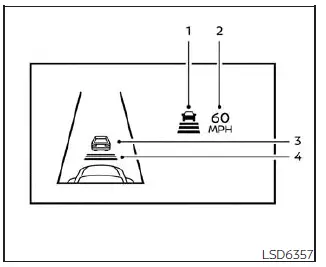
Vehicle-to-vehicle distance control mode display and indicators
The ICC display for the Nissan Kicks is located between the speedometer and the tachometer, allowing the driver to check system status, set speed, distance selection, and vehicle detection information at a glance.
1. This indicator shows the current ICC system status according to its color:
- ICC system ON indicator (gray): Indicates that the Nissan Kicks ICC system is switched on and ready.
- ICC system SET indicator (green): Indicates that the cruising speed has been set and the system is actively controlling speed.
- ICC system warning (yellow): Indicates that a malfunction or system-related issue has been detected in the ICC system.
2. Set vehicle speed indicator:
This area displays the cruising speed selected by the driver.
For Canadian Nissan Kicks models, the speed is displayed in km/h.
3. Vehicle ahead detection indicator:
This indicator shows whether the ICC system detects a vehicle traveling ahead in the same lane.
4. Set distance indicator:
This display shows the following distance selected with the distance switch, helping the driver confirm whether Long, Middle, or Short distance has been chosen.
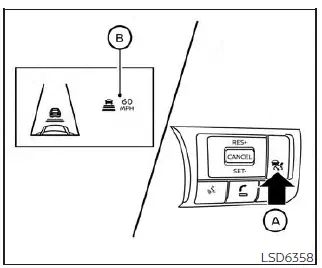
Operating vehicle-to-vehicle distance control mode
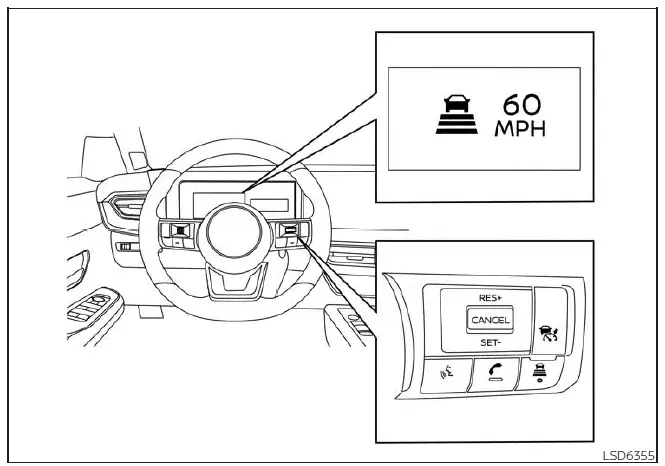
To turn on cruise control in the Nissan Kicks, quickly push and release the ICC switch A. The ICC system ON indicator in gray, the set distance indicator, and the set vehicle speed indicator B will illuminate, placing the system in standby mode and preparing it for speed setting.
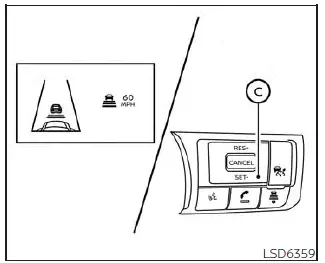
To set the cruising speed, accelerate the Nissan Kicks to the desired speed, then push and release the SET- switch C. The ICC system SET indicator in green, the vehicle ahead detection indicator, the set distance indicator, and the set vehicle speed indicator B will illuminate.
After setting the speed, remove your foot from the accelerator pedal.
The Nissan Kicks will then maintain the selected speed, as long as road, traffic, and system operating conditions allow.
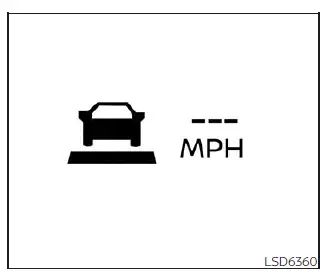
When the SET- switch is pushed under the following conditions, the Nissan Kicks ICC system cannot be set, and the ICC indicators will blink for approximately 2 seconds:
- When the vehicle is traveling below 20 mph (32 km/h) and no vehicle ahead is detected
- When the shift lever is not in the D (Drive) position
- When the parking brake is applied
- When the driver is pressing or operating the brake pedal
When the SET- switch is pushed under the following conditions, the ICC system in the Nissan Kicks also cannot be set.
A warning chime will sound, and a message will appear on the display to alert the driver:
- When the VDC system is off. To use the ICC system, turn the VDC system on. Push the ICC switch to turn off the ICC system, then reset it by pushing the ICC switch again.
- When the VDC system is currently operating
- When a wheel is slipping. To use the Nissan Kicks ICC system, make sure the wheels are no longer slipping and that traction has returned to normal.
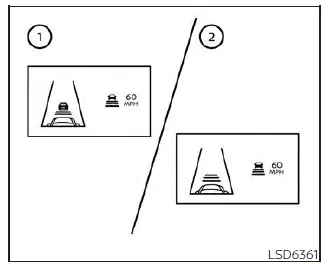
- System set display with vehicle ahead
- System set display without vehicle ahead
The driver selects the desired vehicle speed according to current road, traffic, and weather conditions. In the Nissan Kicks, the ICC system maintains this selected speed in a manner similar to conventional cruise control when no vehicle is detected in the lane ahead. The system also shows the selected cruising speed on the display so the driver can confirm the active setting at any time.
Vehicle detected ahead
When the Nissan Kicks ICC system detects a vehicle traveling ahead in the same lane, it can reduce vehicle speed by controlling engine output and applying the brakes as needed. This allows the Nissan Kicks to match the speed of a slower vehicle ahead and maintain the following distance selected by the driver.
NOTE:
- The stop lights of the Nissan Kicks illuminate when braking is performed automatically by the ICC system.
- When the brakes are applied by the system, a sound may be heard. This is normal system operation and does not indicate a malfunction.
When a vehicle ahead is detected, the vehicle ahead detection indicator illuminates.
The ICC system also displays the set speed and the selected following distance, giving the driver a clear view of how the Nissan Kicks is managing vehicle-to-vehicle distance control.
Vehicle ahead not detected
When the vehicle ahead is no longer detected, the Nissan Kicks ICC system gradually accelerates the vehicle to return to the previously selected cruising speed. After reaching that speed, the system continues to maintain the set speed when conditions allow.
When no vehicle is detected ahead, the vehicle ahead detection indicator turns off.
If another vehicle appears ahead while the Nissan Kicks is accelerating back to the set speed, or at any other time while the ICC system is operating, the system will again control the following distance to that vehicle.
If a vehicle ahead is no longer detected when the Nissan Kicks is traveling below approximately 15 mph (24 km/h), the ICC system will cancel automatically.
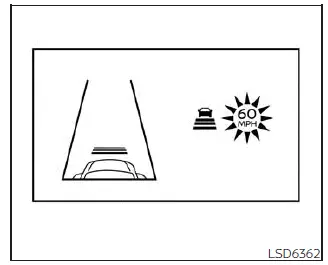
When passing another vehicle, the set speed indicator may flash if the vehicle speed rises above the selected set speed. The vehicle ahead detection indicator will turn off when the lane ahead becomes clear. Once the accelerator pedal is released, the Nissan Kicks will return to the previously selected cruising speed.
Even when a cruising speed is set in the ICC system, the driver can press the accelerator pedal whenever rapid acceleration is needed, such as during passing, merging, or adjusting to changing traffic flow.
How to change the set vehicle speed
To cancel the preset speed in the Nissan Kicks, use one of the following methods:
- Push the CANCEL switch. The set vehicle speed indicator will turn off.
Tap the brake pedal. The set vehicle speed indicator will turn off.
- Turn the ICC
 switch
off.
The ICC indicators
will go out.
switch
off.
The ICC indicators
will go out.
To reset the Nissan Kicks ICC system at a faster cruising speed, use one of the following methods:
- Press the accelerator pedal. When the vehicle reaches the desired speed, push and release the SET- switch.
- Push and hold the RES+ switch. The set vehicle speed will increase by approximately 5 mph (8 km/h for Canada).
- Push and quickly release the RES+ switch. Each time this is done, the set speed will increase by approximately 1 mph (1.6 km/h for Canada).
To reset the Nissan Kicks ICC system at a slower cruising speed, use one of the following methods:
- Lightly tap the brake pedal. When the vehicle reaches the desired lower speed, push and release the SET- switch.
- Push and hold the SET- switch. The set vehicle speed will decrease by approximately 5 mph (8 km/h for Canada).
- Push and quickly release the SET- switch. Each time this is done, the set speed will decrease by approximately 1 mph (1.6 km/h for Canada).
To resume the preset speed, push and release the RES+ switch. The Nissan Kicks will return to the last stored cruising speed when the vehicle speed is above 20 mph (32 km/h), provided the operating conditions for ICC are satisfied.
How to change the set distance to the vehicle ahead
The Nissan Kicks Intelligent Cruise Control system allows the following distance to be adjusted at any time to better suit current traffic conditions. By selecting the most appropriate gap to the vehicle ahead, drivers can tailor the system's response for greater comfort and confidence during highway travel and daily commuting.
Each time the distance
 switch A is
pressed, the selected following distance cycles through Long, Middle, Short, and then returns to Long. The newly
selected setting is immediately displayed, allowing the driver to confirm the chosen distance while driving.
switch A is
pressed, the selected following distance cycles through Long, Middle, Short, and then returns to Long. The newly
selected setting is immediately displayed, allowing the driver to confirm the chosen distance while driving.
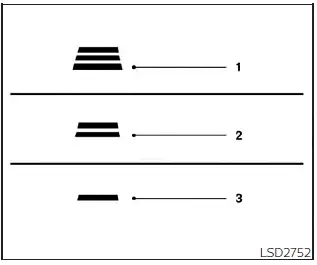
Distance / Approximate distance at 60 mph (100 km/h) [ft (m) ]
- Long 200 (60)
- Middle 150 (45)
- Short 90 (30)
- The distance maintained between the Nissan Kicks and the vehicle ahead changes automatically according to
vehicle speed.
As speed increases, the system provides a larger following gap to help maintain a comfortable and controlled driving experience.
- The selected distance setting remains stored in memory and will stay at the current setting even after the engine is restarted.
Approach warning
If the Nissan Kicks approaches a vehicle ahead too quickly because that vehicle suddenly slows down or because another vehicle moves into your lane, the ICC system provides a visual and audible warning. When this occurs, the driver should immediately assess the situation and apply the brakes as necessary to maintain a safe following distance.
Decelerate by depressing the brake pedal to maintain a safe vehicle distance if:
- The warning chime sounds.
- The vehicle ahead detection indicator blinks.
The warning chime may not sound in certain situations where the distance between vehicles remains short. Examples include:
- When both vehicles are traveling at approximately the same speed and the distance between them remains relatively constant.
- When the vehicle ahead is traveling faster and the gap between vehicles is increasing.
- When another vehicle merges into the lane very close to your Nissan Kicks.
The warning chime will not sound when:
- The Nissan Kicks approaches parked vehicles or vehicles traveling at very low speeds.
- The accelerator pedal is being pressed and the driver is overriding ICC system operation.
NOTE:
The approach warning chime may sound and the ICC display may flash when the radar sensor detects objects located near the side of the vehicle or alongside the roadway. Under certain circumstances, this may cause the Nissan Kicks ICC system to accelerate or decelerate unexpectedly. Such situations can occur while driving on winding roads, narrow roads, hilly terrain, or when entering and exiting curves. In these conditions, the driver must manually monitor traffic and maintain a safe distance from vehicles ahead.
Sensor performance may also be influenced by steering inputs, vehicle position within the lane, surrounding traffic patterns, weather conditions, or damage to the vehicle. As a result, detection characteristics may vary depending on the driving environment, particularly on roads with frequent elevation changes or complex traffic flow.
Automatic cancellation
A warning chime sounds and vehicle-to-vehicle distance control is automatically canceled under the following conditions:
- When no vehicle ahead is detected and the Nissan Kicks speed drops below approximately 15 mph (24 km/h)
- When the system determines that the vehicle has come to a complete stop
- When the shift lever is not in the D (Drive) position or B (Brake) range
- When the parking brake system is applied
- When the VDC system is switched off
- When the VDC system is actively operating
- When distance measurement becomes inaccurate because dirt, snow, ice, mud, or another obstruction is covering the sensor
- When wheel slip is detected
- When the radar signal is temporarily interrupted
After the condition causing the cancellation has been corrected, the Nissan Kicks ICC system can be activated again. Before resuming operation, make sure traffic conditions are suitable and verify that all system indicators are functioning normally.
Vehicle-to-vehicle distance control mode limitations Nissan Kicks Owner's Manual
WARNING
The following points describe important limitations of the Nissan Kicks ICC system. If the vehicle is not operated with these limitations in mind, the driver may lose proper control of the situation, which could result in a collision, serious injury, or death.
- The Nissan Kicks ICC system is designed mainly for use on straight, dry, open roads where traffic is light and moving smoothly. It should not be used as a substitute for careful driving in city traffic, dense traffic, or stop-and-go congestion.
- The ICC system does not automatically adjust its judgment to every road surface, curve, or weather condition. Use this system only when traffic is steady and predictable. Do not use the Nissan Kicks ICC system on roads with sharp curves, icy surfaces, heavy rain, fog, snow, or any situation where visibility and traction are reduced.
- The distance control function has performance limits, and the driver must never rely only on the ICC system. It cannot correct careless driving, lack of attention, poor judgment, or limited visibility caused by rain, fog, snow, spray, or other poor weather conditions. When needed, reduce vehicle speed by pressing the brake pedal according to the distance from the vehicle ahead and the surrounding traffic situation so that a safe following distance is maintained.
- If the vehicle ahead comes to a stop, the Nissan Kicks may decelerate to a standstill only within the
operating limits of the ICC system.
Once the system determines that the Nissan Kicks has reached a standstill, it will cancel vehicle-to-vehicle distance control and sound a warning chime. To prevent the vehicle from moving after cancellation, the driver must press and hold the brake pedal.
- Always pay attention to vehicle behavior and remain ready to manually control speed and following distance. Under certain conditions, the Nissan Kicks ICC system may not be able to maintain the selected distance from the vehicle ahead or keep the selected cruising speed.
- The system may fail to detect a vehicle ahead in some road, traffic, or weather conditions. To help avoid
accidents, never use the Nissan Kicks ICC system under the following conditions:
- On roads with heavy traffic, frequent lane changes, or sharp curves
- On slippery surfaces, including ice, snow, wet leaves, or similar low-traction conditions
- During poor weather, such as rain, fog, snow, heavy spray, or blowing dust
- When rain, snow, mud, dirt, ice, or other material is attached to the bumper area around the distance sensor
- On steep downhill roads, where the Nissan Kicks may exceed the set speed and repeated braking may overheat the brakes
- On roads with repeated uphill and downhill sections where speed control may become inconsistent
- When traffic flow requires frequent acceleration or deceleration, making it difficult to keep a stable and proper following distance
- When interference from other radar sources may affect sensor performance
- In certain road or traffic conditions, a vehicle or object may suddenly enter the sensor detection area and cause the system to brake automatically. The driver must remain alert, keep a safe distance, and avoid using the ICC system in any situation where this warning section advises against it.
The radar sensor in the Nissan Kicks will not reliably detect the following objects:
- Stationary vehicles and vehicles moving very slowly
- Pedestrians, animals, debris, or other objects in the roadway
- Oncoming vehicles traveling in the same lane
- Motorcycles traveling offset from the center of the travel lane
The ICC sensor generally works by detecting radar signals reflected from the vehicle ahead. If the Nissan Kicks sensor cannot receive a clear reflection from that vehicle, the ICC system may not maintain the selected following distance. This can happen when the vehicle ahead is small, narrow, positioned off-center, partially hidden, or moving in a way that makes radar detection less stable.
Below are several situations in which the forward radar sensor may be unable to accurately recognize a vehicle ahead, causing the Nissan Kicks Intelligent Cruise Control (ICC) system to operate with reduced effectiveness:
- When snowfall, slush, mist, or road spray generated by surrounding traffic partially blocks the radar sensor and limits its ability to detect vehicles ahead.
- When excessive cargo or heavy luggage is loaded in the rear seating area or cargo compartment, potentially affecting the vehicle’s posture and sensor performance.
The ICC system in the Nissan Kicks continuously performs automatic self-checks to verify sensor functionality within the operational limits of the system.
If the radar sensor becomes covered by dirt, mud, snow, or any other obstruction, the system may automatically deactivate for safety reasons. Likewise, if the sensor is covered by ice, transparent materials, translucent plastic, or similar objects, the ICC system may be unable to properly identify obstacles or vehicles ahead.
Under these conditions, the vehicle-to-vehicle distance control mode may remain active even though detection capability is reduced, which can prevent the system from consistently maintaining the selected following distance.
To help ensure reliable operation of the Nissan Kicks ICC system, inspect the radar sensor regularly and keep its surface clean and unobstructed.
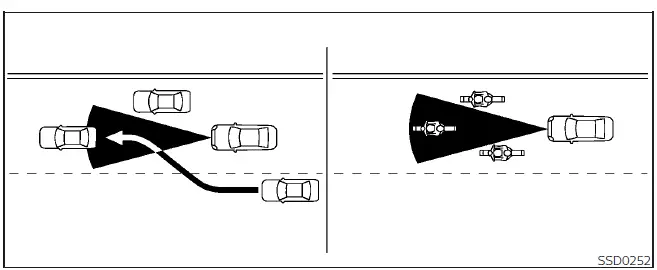
The radar sensor operates within a defined detection area. For the vehicle-to-vehicle distance control mode to function correctly, the vehicle ahead must remain within this detection zone so the system can accurately monitor and adjust the following distance.
A vehicle traveling ahead may temporarily move outside the radar detection area because of its position within the lane. Motorcycles, especially when riding away from the center of the lane, may not always be detected as expected. Likewise, a vehicle merging into your lane may not be recognized immediately until it has fully entered the lane and becomes clearly visible within the radar sensor’s coverage area.
If this occurs, the ICC system may alert you by flashing the system indicator and sounding an audible warning. In such situations, the driver of the Nissan Kicks must manually manage vehicle speed and maintain a safe following distance from traffic ahead.
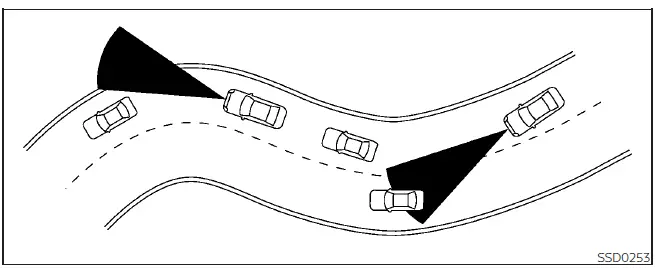
When driving on winding roads, steep grades, sharp curves, narrow roadways, or through construction zones, the radar sensor may temporarily detect vehicles traveling in adjacent lanes or lose sight of the vehicle directly ahead. As a result, the Nissan Kicks ICC system may unexpectedly accelerate or decelerate while responding to changing sensor input.
Vehicle detection performance can also be influenced by steering inputs, lane positioning, road geometry, and the operating condition of nearby vehicles. These factors may occasionally affect how accurately the radar system interprets traffic conditions.
If this occurs, the ICC system may unexpectedly flash the system indicator and sound a warning chime. The driver must immediately assume full control and maintain an appropriate distance from the vehicle ahead using manual driving inputs.
System temporarily unavailable
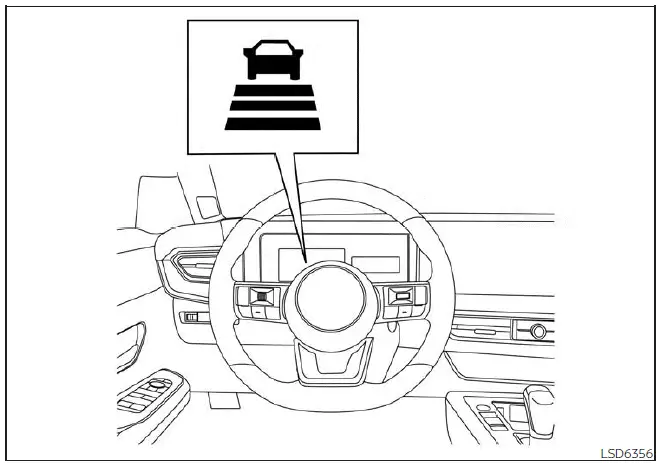
There are certain operating conditions under which the ICC system may become temporarily unavailable.
During these situations, the Nissan Kicks Intelligent Cruise Control system may not be capable of maintaining the selected following distance and its normal distance-control functions may be limited.
Condition A
Under any of the following circumstances, the ICC system will automatically cancel operation. An audible chime will sound, and the system cannot be activated until the condition is resolved:
- When the Vehicle Dynamic Control (VDC) system has been switched off.
- When the VDC system is actively intervening to help stabilize the vehicle.
- When no vehicle is detected ahead and your Nissan Kicks is traveling below 15 mph (24 km/h).
- When the system determines that the vehicle has come to a complete stop.
- When the shift selector is not positioned in the D (Drive) or B (Brake) range.
- When the parking brake is engaged.
- When wheel slip is detected due to reduced traction or slippery road conditions.
- When the radar signal is temporarily interrupted by environmental conditions or external interference.
Action to take:
Once the conditions described above are no longer present, switch the ICC system off using the ICC control switch. Afterward, reactivate the system to restore normal Intelligent Cruise Control operation. The Nissan Kicks ICC system is designed to resume functionality once the temporary restriction has been cleared and all operating requirements are satisfied.
Condition B
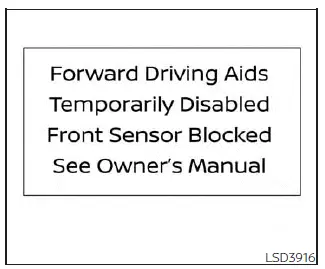
During adverse weather conditions such as heavy rain, dense fog, snowfall, or similar environmental situations that obstruct the front radar sensor, the ICC system will automatically cancel operation. An audible chime will sound, and the vehicle information display will show the warning message: "Forward Driving Aids Temporarily Disabled Front Sensor Blocked See Owner's Manual."
Action to take:
When weather conditions improve and the radar sensor is no longer obstructed, the warning message should disappear from the vehicle information display and the Nissan Kicks ICC system should return to normal operation. If the message remains visible after conditions have improved, the system should be inspected by a qualified technician. It is recommended that you visit a NISSAN dealer to have the radar sensor and related components checked.
Condition C
If the radar sensor area located in the front bumper becomes dirty, covered by debris, snow, mud, ice, or otherwise obstructed, the ICC system will automatically cancel operation to prevent inaccurate vehicle detection.
A warning chime will sound and the message "Forward Driving Aids Temporarily Disabled Front Sensor Blocked See Owner's Manual" will appear in the vehicle information display.
Action to take:
If this warning message appears, safely stop the Nissan Kicks, shift the transmission into the P (Park) position, and turn the engine off. Inspect and clean the radar sensor area on the front bumper if contamination or an obstruction is present. After cleaning the sensor area, restart the engine and verify whether the warning message has cleared. If the message continues to appear after the sensor area has been cleaned and the system restarted, have the vehicle inspected by a qualified service facility. NISSAN recommends visiting an authorized dealer for diagnosis and repair.
Condition D
While driving in areas with limited roadside structures or unusual surroundings—such as long bridges, open desert regions, expansive snow-covered terrain, or roads running alongside extended walls—the system may temporarily illuminate the warning indicator and display the message: "Forward Driving Aids Temporarily Disabled Front Sensor Blocked See Owner's Manual."
Under these circumstances, the radar sensor may experience reduced reference points within its operating environment, which can affect temporary system availability.
Action to take:
After leaving the affected driving environment and returning to normal road conditions, switch the system on again. The Nissan Kicks ICC system should resume normal operation once the temporary condition no longer exists.
Condition E
If the ICC system detects an internal malfunction or abnormal operating condition, an audible warning chime will sound and the orange ICC warning light will illuminate.
Action to take:
If the warning light comes on, move the vehicle to a safe location and park it securely. Turn the engine off, wait briefly, and then restart the engine. Resume driving and attempt to activate the ICC system again to determine whether normal operation has been restored.
If the system cannot be activated again, or if the warning indicator remains illuminated, the ICC system may be malfunctioning. Although the Nissan Kicks can generally continue to be driven under normal conditions, the Intelligent Cruise Control system may not function correctly. The vehicle should be inspected as soon as possible. It is recommended that you visit a NISSAN dealer for a complete system diagnosis.
NOTE:
If the ICC system is temporarily unavailable because of operating conditions, sensor blockage, or a detected system issue, the conventional cruise control mode may still remain available and can be used in accordance with its operating limitations.
System maintenance Nissan Kicks crossover
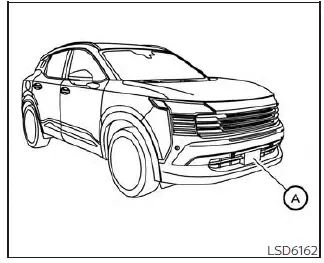
The radar sensor used by the Nissan Kicks Intelligent Cruise Control (ICC) system is located at the front of the vehicle and plays a critical role in monitoring traffic conditions ahead. Proper care of this sensor is essential for accurate vehicle detection and reliable ICC operation.
To help ensure that the Nissan Kicks ICC system continues to operate correctly and deliver consistent performance, follow these maintenance guidelines:
- Always keep the sensor area on the front bumper or front emblem clean and free of dirt, mud, snow, ice, insects, or other debris that could interfere with radar signals.
- Avoid striking, impacting, or damaging the area surrounding the sensor, as even minor damage may affect system performance and detection accuracy.
- Do not place stickers, decals, films, protective coverings, or accessories near the sensor area, including transparent materials. Such items may interfere with radar operation and could result in system malfunctions.
- Do not install metallic accessories or objects near the sensor location, including brush guards, decorative trim pieces, or similar equipment. Metal components may obstruct or distort radar signals and negatively affect system operation.
- Do not modify, remove, repair, repaint, or refinish the front bumper without considering the sensor location. If front bumper repairs, restoration work, or customization are required on your Nissan Kicks, it is recommended that the work be performed or inspected by a NISSAN dealer.
Radio frequency statement
For USA
This device complies with Part 15 of the FCC Rules. Operation is subject to the following two conditions:
1. This device may not cause harmful interference, and
2. This device must accept any interference received, including interference that may cause undesired operation.
FCC Warning
Changes or modifications that have not been expressly approved by the party responsible for compliance may void the user's authority to operate this equipment.
For Canada
This device complies with Part 15 of the FCC Rules and with Industry Canada licence-exempt RSS standard(s). Operation is subject to the following two conditions:
1. This device may not cause harmful interference, and
2. This device must accept any interference received, including interference that may cause undesired operation.
Le présent appareil est conforme aux CNR d'Industrie Canada applicables aux appareils radio exempts de licence. L'exploitation est autorisée aux deux conditions suivantes:
1. L'appareil ne doit pas produire de brouillage, et
2. L'utilisateur de l'appareil doit accepter tout brouillage radioélectrique subi, même si le brouillage est susceptible d'en compromettre le fonctionnement.
Radio Frequency Radiation Exposure Information:
This equipment complies with FCC radiation exposure limits established for an uncontrolled environment.
The equipment should be installed and operated with a minimum separation distance of 30 cm between the radiator and the body of the user.
The transmitter must not be co-located with, or operated in conjunction with, any other antenna or transmitter.
Cet équipement est conforme aux limites d'exposition aux rayonnements IC établies pour un environnement non contrôlé. Cet équipement doit être installé et utilisé avec un minimum de 30 cm de distance entre la source de rayonnement et votre corps.
FCC Notice
Changes or modifications not expressly approved by the party responsible for compliance could void the user's authority to operate the equipment.
Conventional (fixed speed) cruise control mode
This operating mode allows the Nissan Kicks to maintain a selected speed between 25 and 90 mph (40 and 144 km/h) without requiring continuous pressure on the accelerator pedal. Unlike Intelligent Cruise Control, conventional cruise control maintains a fixed vehicle speed and does not monitor traffic ahead or automatically adjust the vehicle's speed based on surrounding traffic conditions.
WARNING
- In conventional (fixed speed) cruise control mode, no warning chime will sound if your Nissan Kicks approaches another vehicle too closely. The system does not detect vehicles ahead and does not monitor following distance.
- Always pay close attention to the distance between your vehicle and surrounding traffic. Failure to maintain a safe following distance could increase the risk of a collision.
- Always verify the selected operating mode and confirm the displayed settings in the ICC system display before driving.
-
Do not use conventional (fixed speed) cruise control under any of the following driving conditions:
- When it is difficult or impossible to maintain a constant vehicle speed.
- In heavy traffic or in traffic conditions where vehicle speeds frequently change.
- On winding, curving, or hilly roads where frequent speed adjustments may be required.
- On slippery road surfaces caused by rain, snow, ice, gravel, or similar conditions that may reduce tire traction.
- In areas subject to strong crosswinds or persistent high winds that may affect vehicle stability.
- Using conventional cruise control in unsuitable driving conditions may lead to reduced vehicle control and could result in an accident.
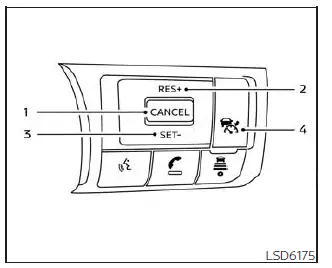
Conventional (fixed speed) cruise control switches
1. CANCEL switch:
Temporarily deactivates the cruise control function without deleting the previously stored cruising speed. This
allows the driver to interrupt cruise control operation and later resume the selected speed when road and
traffic conditions permit.
2. RES+ switch:
Restores the previously stored cruising speed after cancellation or gradually increases the set speed in small
increments while the system is active.
3. SET- switch:
Stores the current vehicle speed as the desired cruising speed or decreases the selected speed incrementally
while conventional cruise control is engaged.
4. ICC switch:
Serves as the primary control switch for activating the Nissan Kicks cruise control system and selecting the
desired operating mode.
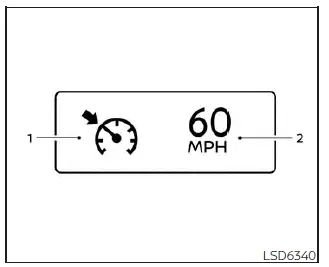
Conventional (fixed speed) cruise control mode display and indicators
All cruise control information is shown within the vehicle information display, allowing the driver to quickly verify the current operating status of the Nissan Kicks cruise control system.
1. Cruise indicator:
This indicator changes color to communicate the current condition of the system.
- Cruise control ON indicator (gray): Indicates that the ICC switch has been activated and the system is standing by for operation.
- Cruise control SET indicator (green): Confirms that a cruising speed has been successfully stored and the Nissan Kicks is maintaining the selected speed.
- Cruise control warning indicator (yellow): Indicates that a malfunction or system-related issue has been detected within the ICC or cruise control system.
2. Set vehicle speed indicator:
Displays the currently selected cruising speed. On Canadian Nissan Kicks models, the displayed value is shown in
kilometers per hour (km/h).
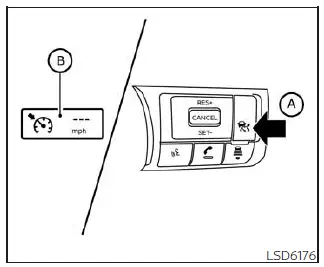
Operating conventional (fixed speed) cruise control mode
To activate conventional (fixed speed) cruise control mode, press and hold the ICC switch A for more than approximately 1.5 seconds.
When the ICC switch is initially pressed, the Nissan Kicks displays the conventional cruise control indicators and status information B in the vehicle information display. After the switch has been held for approximately 1.5 seconds or longer, the standard ICC distance-control display is turned off and the conventional cruise control indicator appears.
Once this occurs, the system is ready for the driver to select a desired cruising speed. Pressing the ICC switch again will completely deactivate the cruise control system. In addition, the system automatically turns off whenever the ignition switch is moved to the OFF position.
To return to Intelligent Cruise Control operation, press and release the ICC switch briefly to activate vehicle-to-vehicle distance control mode, or press and hold the switch again to reactivate conventional cruise control mode. This allows Nissan Kicks drivers to select the operating mode that best suits current driving conditions.
CAUTION
To prevent unintended cruise control activation, always switch the ICC system off whenever it is not being used.
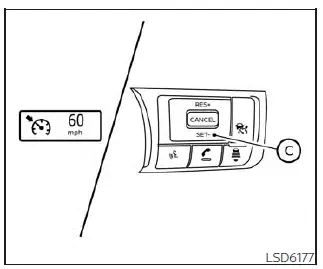
To establish a cruising speed, accelerate the Nissan Kicks to the desired speed and then press and release the SET- C switch. When the speed has been stored successfully, the cruise indicator changes from gray to green and the set vehicle speed indicator appears in the display.
After the desired speed has been set, remove your foot from the accelerator pedal. The cruise control system will automatically maintain the selected vehicle speed under normal driving conditions.
- When overtaking another vehicle, simply depress the accelerator pedal. The Nissan Kicks will accelerate as needed while the pedal is pressed. Once the accelerator is released, the vehicle automatically returns to the previously stored cruising speed.
- On steep uphill or downhill grades, the vehicle may not always be able to maintain the exact set speed because of changing road conditions, vehicle load, or terrain. Under such circumstances, driver intervention may be required to maintain the desired speed and vehicle control.
If this occurs, the driver should manually control and maintain the vehicle's speed until normal operating conditions return. The conventional cruise control system in the Nissan Kicks is designed to assist with speed management, but it cannot compensate for all driving situations and road conditions.
To cancel the currently stored cruising speed, use any of the following methods:
1. Push the CANCEL switch. The set vehicle speed indicator will turn off, confirming that cruise control operation has been suspended while retaining the previously stored speed.
2. Lightly press the brake pedal. Doing so immediately cancels cruise control operation, and the vehicle speed indicator will switch off.
3. Turn the ICC switch off. Both the cruise indicator and the vehicle speed indicator will be extinguished, completely deactivating the Nissan Kicks cruise control system.
To establish a higher cruising speed after a speed has already been set, use one of the following methods:
1. Press the accelerator pedal and allow the vehicle to reach the desired speed. Once the preferred speed is reached, press and release the SET- switch to store the new cruising speed.
2. Press and hold the RES+ switch. The Nissan Kicks will gradually increase speed while the switch remains depressed. Release the switch once the desired cruising speed has been reached.
3. Press and quickly release the RES+ switch. Each brief press increases the stored cruising speed by approximately 1 mph (1.6 km/h), allowing precise speed adjustments without using the accelerator pedal.
To reset the cruise control system to a lower cruising speed, use one of the following methods:
1. Lightly tap the brake pedal to reduce vehicle speed. When the Nissan Kicks reaches the desired speed, press and release the SET- switch to store the new value.
2. Press and hold the SET- switch. The vehicle will gradually slow down while the switch remains pressed. Release the switch when the desired cruising speed is reached.
3. Press and quickly release the SET- switch.
Each brief press decreases the stored cruising speed by approximately 1 mph (1.6 km/h), making it easy to fine-tune the selected speed during highway driving.
To resume a previously stored cruising speed, press and release the RES+ switch. The Nissan Kicks will automatically accelerate or decelerate as necessary to return to the last stored cruising speed, provided the vehicle is traveling faster than 25 mph (40 km/h).
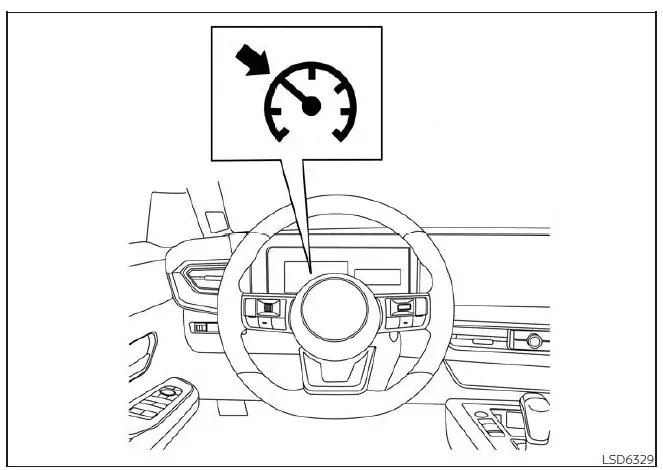
System temporarily unavailable
Under certain operating conditions, an audible warning chime will sound and cruise control operation will be automatically canceled to help maintain safe vehicle operation.
- When the vehicle speed decreases by more than 8 mph (13 km/h) below the selected cruising speed.
- When the shift lever is moved out of the D (Drive) position or manual shift mode is not available for operation.
- When the parking brake is applied.
- When the Vehicle Dynamic Control (VDC) system intervenes, including activation of the traction control system.
- When wheel slip is detected because of reduced traction or slippery road conditions.
If the system detects an operating issue or abnormal condition, an audible warning chime will sound and the cruise indicator will change color to orange.
Action to take
If the cruise indicator changes to orange, safely move the Nissan Kicks to an appropriate location and bring the vehicle to a stop. Shift the transmission into the P (Park) position before proceeding.
Turn the engine off and then restart it. After resuming driving, attempt to activate and set the cruise control system again to determine whether normal operation has been restored.
If the system cannot be set again or the orange indicator remains illuminated, this may indicate a malfunction within the cruise control or ICC system. Although the Nissan Kicks can generally continue to be driven under normal conditions, the system should be inspected by a qualified technician. It is recommended that you visit a NISSAN dealer for diagnosis and service.