



- Tire Pressure Monitoring System (TPMS)
- Changing a flat tire (models with spare tire)
- Repairing a flat tire (models with emergency tire puncture repair kit)
Tire Pressure Monitoring System (TPMS) Nissan Kicks 2025
The Nissan Kicks is equipped with a Tire Pressure Monitoring System (TPMS) designed to monitor the air pressure in all road tires, excluding the spare tire. If one or more tires become significantly underinflated, the low tire pressure warning light will illuminate and a warning message will appear. Vehicles without a vehicle information display will show the message "CHECK TIRE PRES," while vehicles equipped with a display will show "Tire Pressure Low - Add Air."
When the Nissan Kicks is driven with insufficient tire pressure, the TPMS continuously monitors the condition and alerts the driver. The system becomes active when vehicle speed exceeds approximately 16 mph (25 km/h).
WARNING
- Radio frequency signals generated by the TPMS may affect certain types of electronic medical devices. Individuals using pacemakers or similar medical equipment should consult the device manufacturer regarding possible interference before operating the vehicle.
- If the low tire pressure warning light illuminates while driving, avoid sudden steering inputs and harsh
braking maneuvers. Gradually reduce speed, move to a safe location, and stop the vehicle as soon as
conditions allow.
Driving with underinflated tires can cause permanent tire damage, excessive heat buildup, and an increased risk of tire failure.
Continued operation under these conditions may lead to vehicle damage, loss of control, or an accident that could result in serious injury.
Inspect the pressure of all four tires and adjust them to the recommended COLD tire pressures listed on the Tire and Loading Information label. Once the correct pressure is restored, the warning light should turn off.
If the warning remains illuminated after tire pressure has been corrected, a tire may be flat or the TPMS may require service.
If a flat tire is found, replace it with the spare tire as soon as possible. If all tires are properly inflated and no puncture is present, have the Nissan Kicks inspected. It is recommended that you visit a NISSAN dealer for diagnosis and service.
- When a wheel without a TPMS sensor is installed, such as the spare tire, the system cannot monitor tire pressure. In this situation, the low tire pressure warning light will flash for approximately one minute and then remain illuminated. Have the tire repaired or replaced and the TPMS restored as soon as possible. It is recommended that you visit a NISSAN dealer for these services.
- Installing tires other than those specified for the Nissan Kicks may negatively affect TPMS operation and system accuracy.
- Do not inject liquid tire sealants or aerosol tire repair products into the tires unless specifically approved, as these materials may damage the tire pressure sensors and cause system malfunctions.
- If the warning light remains illuminated while driving after proper tire inflation, a flat tire or TPMS malfunction may be present. Replace a damaged tire with the spare tire as soon as possible. If no tire damage is found and pressures are correct, it is recommended that you visit a NISSAN dealer for inspection and repair.
Changing a flat tire (models with spare tire) Nissan Kicks 2026
If your Nissan Kicks experiences a flat tire, carefully follow the procedure below to replace the damaged wheel safely and efficiently.
NOTE:
On models equipped with an emergency tire puncture repair kit, a spare tire, jack, and jacking rod may not be included as standard equipment.
Stopping the vehicle
1. Carefully move the Nissan Kicks to a safe location away from moving traffic and park on firm, level ground whenever possible.
2. Switch on the hazard warning flashers to alert other road users.
3. Apply the parking brake securely and move the shift lever into the P (Park) position.
4. Turn the engine off completely.
5. Open the hood to increase vehicle visibility and help indicate to roadside assistance personnel that help may be required.
6. Ask all passengers to exit the vehicle and remain in a safe area away from traffic and clear of the vehicle.
WARNING
- Always make sure the parking brake is fully applied and the Continuously Variable Transmission (CVT) is securely placed in the P (Park) position before attempting any tire replacement procedure.
- Never attempt to change a tire while the vehicle is parked on a slope, icy surface, or any slippery
area.
Such conditions can make the vehicle unstable and significantly increase the risk of injury.
- Do not attempt to replace a tire when traffic is passing close to the vehicle. If conditions are unsafe, wait for professional roadside assistance.
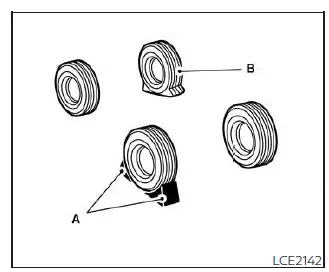
- Blocks
- Flat tire
Blocking wheels
Place suitable wheel blocks in front of and behind the wheel diagonally opposite the flat tire. This helps prevent the Nissan Kicks from moving while it is being lifted with the jack.
WARNING
Always block the appropriate wheel before raising the vehicle. Failure to do so may allow the vehicle to move unexpectedly and could result in serious personal injury.
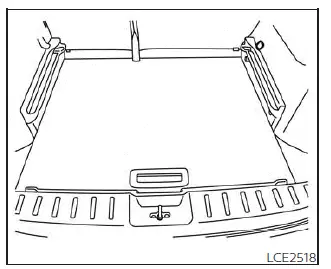
Getting the spare tire and tools
1. Open the liftgate.
2. Lift the luggage floor board to gain access to the spare tire compartment.
3. Carefully remove the wheel cover panel while avoiding damage to surrounding trim components.
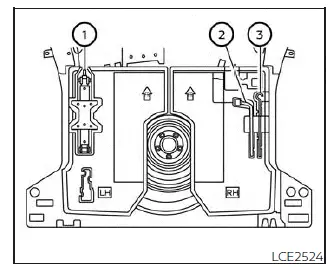
Type A (if so equipped)
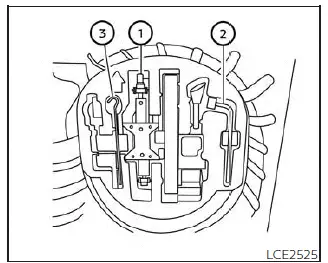
Type B (if so equipped)
4. Remove the jack 1, wheel nut wrench 2, and jacking rod 3 from their storage locations.
5. Remove the storage cover to expose the spare tire.
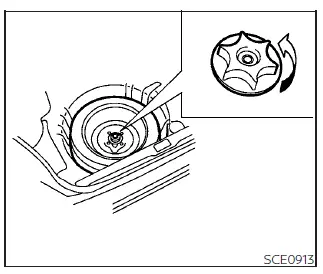
6. Rotate the retaining bolt counterclockwise to loosen it.
7. Once the bolt has been completely loosened, remove it and carefully lift out the spare tire.
CAUTION
Avoid touching exposed floor metal directly, as certain surfaces may become hot enough to cause burns.
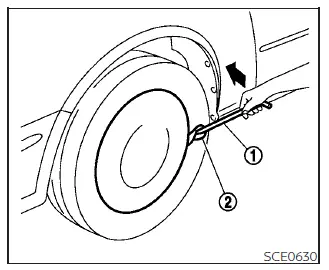
Removing wheel cover (if so equipped)
CAUTION
Do not attempt to pry off wheel covers or wheel caps with your hands. Doing so may result in injury.
Use the jack rod 1 as shown in the illustration to remove the wheel cover.
Place a cloth 2 between the wheel and the jack rod to help protect the wheel finish and wheel cover from scratches or other damage.
Work carefully to avoid marking the wheel surface or damaging the wheel cover during removal.
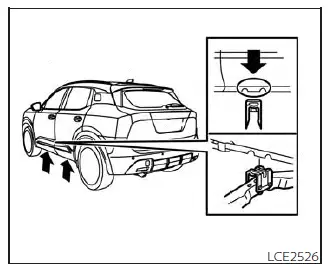
Jacking up vehicle and removing the damaged tire
WARNING
- Never place any part of your body beneath a vehicle supported only by a jack. If work underneath the vehicle is necessary, proper safety stands must be used.
- Use only the jack supplied with your Nissan Kicks. It is specifically designed for emergency tire replacement on this vehicle.
- Always position the jack at the designated jack-up points shown in the owner's information. Never support the vehicle using any other component.
- Raise the vehicle only as much as necessary to remove and install the wheel.
- Never place blocks on top of or underneath the jack.
- Do not start or run the engine while the vehicle is supported by the jack, as unexpected vehicle movement may occur.
- Passengers must not remain inside the vehicle while it is being raised.
- Never run the engine when one or more wheels are off the ground.
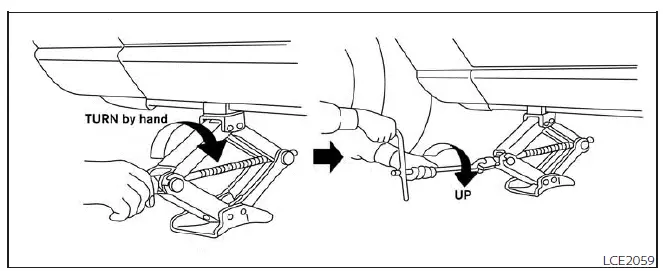
Always use the illustration appropriate for your Nissan Kicks model to identify the correct lifting points and jack placement locations.
Carefully read the warning and caution labels attached to the jack before beginning the lifting procedure.
1. Loosen each wheel nut by one or two turns using the wheel nut wrench. Turn the nuts counterclockwise, but do not remove them completely until the wheel is raised off the ground.
2. Position the jack directly beneath the specified jack-up point as illustrated so the jack head contacts the vehicle correctly.
Align the jack head between the front or rear notches and ensure the groove in the jack head fits securely into the designated lifting area.
Always place the jack on firm, stable, and level ground.
3. Hold the jack lever and rod firmly with both hands and raise the vehicle carefully until the tire clears the ground. Remove the wheel nuts completely and remove the damaged wheel.
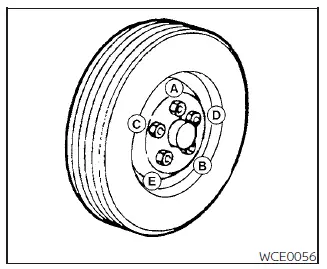
Installing the spare tire
1. Remove any dirt, mud, rust, or debris from the mounting surfaces of the wheel and hub.
2. Position the spare tire on the hub and install the wheel nuts finger-tight.
3. Using the wheel nut wrench, tighten the wheel nuts evenly and alternately in the illustrated sequence (A, B, C, D, E) until snug.
4. Carefully lower the Nissan Kicks until the tire contacts the ground. Then tighten the wheel nuts securely in the specified sequence (A, B, C, D, E) before lowering the vehicle completely.
WARNING
- Incorrect wheel nuts or improperly tightened wheel nuts can cause the wheel to loosen or separate from
the vehicle.
This may result in loss of vehicle control and a serious accident.
- Never apply oil or grease to wheel studs or wheel nuts, as this may cause incorrect tightening and wheel loosening.
- Wheel nuts should be rechecked and retightened after approximately 600 miles (1,000 km) of driving, including after a flat tire repair.
As soon as possible, use a torque wrench to tighten the wheel nuts to the specified torque value.
Wheel nut tightening torque: 83 ft-lb (113 N·m)
Wheel nuts should always be maintained at the specified torque. It is recommended that torque be checked at regular service intervals.
Adjust tire pressure to the recommended COLD tire pressure specification.
COLD pressure refers to tire pressure measured after the vehicle has been parked for at least three hours or driven less than 1 mile (1.6 km).
The recommended COLD tire pressures for your Nissan Kicks are listed on the Tire and Loading Information label.
5. Return the jack and all tools to their designated storage locations.
6. Reinstall the spare tire cover and cargo floor panel.
7. Securely store the damaged tire inside the vehicle.
8. Close the liftgate securely.
WARNING
- Always ensure that the spare tire, jack, and all related tools are properly secured after use. In a collision or sudden stop, unsecured items may become dangerous projectiles.
- The spare tire supplied with the Nissan Kicks is intended for temporary emergency use only.
Repairing a flat tire (models with emergency tire puncture repair kit) Nissan Kicks crossover
WARNING
- After using Genuine NISSAN Emergency Tire Sealant to temporarily repair a minor puncture, do not operate the Nissan Kicks at speeds exceeding 50 mph (80 km/h). Driving faster may compromise vehicle safety and tire performance.
- Immediately after using Genuine NISSAN Emergency Tire Sealant, arrange for the tire to be professionally inspected and permanently repaired or replaced. The sealant is intended only as a temporary solution and cannot provide a long-term repair. Continuing to drive without proper tire service may increase the risk of tire failure and an accident.
- If Genuine NISSAN Emergency Tire Sealant has been used to repair a puncture, it is recommended that a NISSAN dealer inspect the tire and replace the Tire Pressure Monitoring System (TPMS) sensor if necessary when repairing or replacing the tire.
- NISSAN recommends using only the Genuine NISSAN Emergency Tire Sealant supplied with your Nissan
Kicks.
Using other sealant products may damage the valve stem seal, potentially causing air leakage and improper tire operation.
The Nissan Kicks is not equipped with a conventional spare tire. Instead, it includes an emergency tire puncture repair kit containing Genuine NISSAN Emergency Tire Sealant for temporary roadside repairs.
The kit is designed to provide a temporary repair for small punctures, allowing you to continue driving for a limited distance until professional tire service can be obtained.
Whenever possible, have the vehicle transported to a qualified repair facility where the damaged tire can be properly repaired or replaced.
Be aware that using the emergency tire puncture repair kit may affect the operation of the tire pressure monitoring system and could cause the low tire pressure warning light to illuminate.
CAUTION
- To prevent damage to the emergency tire puncture repair kit during storage or operation:
- Use the emergency tire puncture repair kit only with your Nissan Kicks. It is not intended for use on other vehicles.
- Use the kit solely for inflating the tires on your vehicle and checking tire pressure.
- Connect the compressor only to a 12-volt DC power outlet.
- Keep all kit components clean and protected from water, moisture, and excessive dirt.
- Do not disassemble, alter, or modify any part of the repair kit.
- Avoid dropping the kit or exposing it to severe impacts, which may affect its performance.
- Do not attempt to use the emergency tire puncture repair kit under the following conditions. In these
situations, contact a NISSAN dealer or professional roadside assistance service.
- When the sealant has exceeded its expiration date as indicated on the bottle label.
- When the puncture, cut, or damage is approximately 0.25 in (6 mm) or larger.
- When the tire sidewall has been damaged.
- When the vehicle has been driven for an extended period with extremely low tire pressure.
- When the tire has become separated from the wheel rim.
- When the wheel itself is bent, cracked, or otherwise damaged.
- When two or more tires are flat or damaged.
If a flat tire occurs, follow the procedure below to safely use the emergency repair kit and protect your Nissan Kicks from further damage.
Stopping the vehicle
1. Carefully move the vehicle off the roadway and away from traffic to a safe location.
2. Activate the hazard warning flashers to alert other drivers that the vehicle is stopped.
3. Park the Nissan Kicks on a firm, level surface whenever possible. Apply the parking brake securely and move the shift lever into the P (Park) position.
4. Turn the engine off completely.
5. Raise the hood to increase vehicle visibility and help indicate to passing motorists or roadside assistance personnel that assistance may be required.
6. Have all passengers leave the vehicle and move to a secure location away from traffic. Everyone should remain well clear of the Nissan Kicks and stand where they can be seen by other motorists while the repair procedure is being performed.
WARNING
- Always confirm that the parking brake is fully applied and that the Continuously Variable Transmission (CVT) is securely shifted into the P (Park) position before beginning any tire repair procedure.
- Never attempt to repair or service a tire when the vehicle is parked on an incline, icy surface, or any
slippery area.
This can create a dangerous situation and may cause the vehicle to move unexpectedly.
- Do not perform a tire repair if traffic is passing too close to the vehicle. In such situations, wait for professional roadside assistance to ensure your safety.
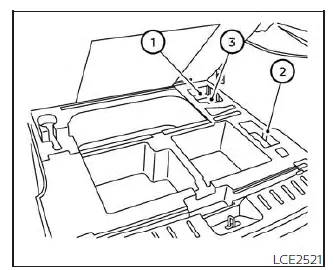
Type A (if so equipped)
Getting emergency tire puncture repair kit
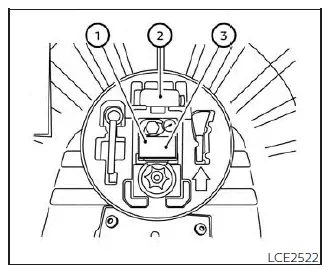
Type B(if so equipped)
Remove the emergency tire puncture repair kit from the cargo area of your Nissan Kicks. This compact repair system is designed to provide a temporary solution for minor tire punctures and includes the following components:
- Air compressor*
- Tire sealant bottle
- Speed restriction sticker
* The appearance and design of the compressor may vary depending on the Nissan Kicks model and equipment specification.
NOTE:
Models equipped with the emergency tire puncture repair kit are not supplied with a conventional spare tire, jack, or jacking rod as standard equipment.
Before using emergency tire puncture repair kit
- If a foreign object such as a screw, nail, or similar item is embedded in the tire, do not remove it before using the repair kit. Removing the object may increase air loss and make temporary repair more difficult.
- Check the expiration date printed on the tire sealant bottle label before use. Never use sealant that has passed its expiration date, as its effectiveness may be reduced.
Repairing tire
WARNING
Follow these precautions carefully when handling and using the tire repair compound supplied with the Nissan Kicks emergency tire puncture repair kit.
- Swallowing the repair compound can be dangerous.
If accidental ingestion occurs, immediately drink plenty of water and seek medical attention without delay.
- If the repair compound comes into contact with your skin or eyes, rinse thoroughly with large amounts of clean water. If irritation continues, obtain medical assistance as soon as possible.
- Store the repair compound out of reach of children at all times.
- The emergency tire repair compound may affect the operation of the tire pressure monitoring sensors and
cause the low tire pressure warning light to illuminate.
Have the tire pressure sensor inspected and replaced if necessary as soon as possible after the tire has been professionally repaired.
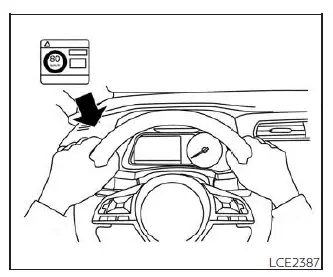
1. Remove the speed restriction sticker from the air compressor and place it in a clearly visible location where the driver can easily see it while operating the Nissan Kicks after the temporary repair has been completed.
CAUTION
Do not place the speed restriction sticker on the steering wheel pad, instrument cluster, speedometer, or over any warning indicators.
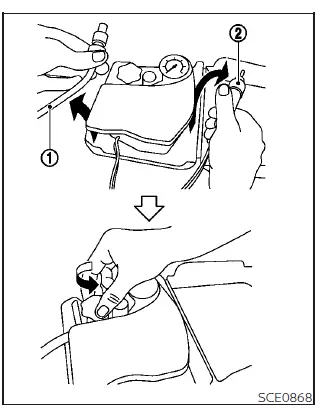
2. Remove hose 1 and power plug 2 from the air compressor. Then remove the cap from the compressor bottle holder in preparation for installing the tire sealant bottle.
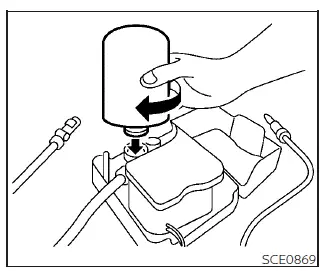
3. Remove the cap from the tire sealant bottle. Leave the bottle seal intact and do not pierce or remove it manually. The seal will be opened automatically during the repair process when the bottle is installed correctly into the compressor assembly.
Screw the bottle clockwise into the bottle holder until it is fully seated. This action will automatically pierce the seal inside the bottle, allowing the sealant to flow correctly through the system during the repair procedure.
4. Remove the valve cap from the flat tire.
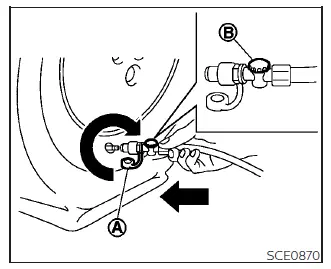
5. Remove the protective cap A from the hose and securely thread the hose onto the tire valve. Verify that the pressure release valve B is fully tightened before proceeding.
Confirm that the air compressor switch is in the OFF (O) position, then connect the power plug to the vehicle's power outlet.
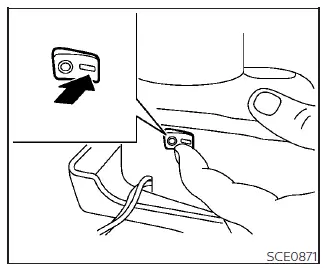
6. Place the power switch in the ACC position.
Next, switch the compressor to the ON (−) position and begin inflating the tire. Inflate the tire to the pressure specified on the Tire and Loading Information label located on the driver's side center pillar whenever possible, or at least to a minimum pressure of 26 psi (180 kPa). Periodically switch the compressor off briefly to verify the tire pressure using the built-in pressure gauge.
If the tire pressure exceeds the recommended value, carefully reduce the pressure by using the pressure release valve until the correct level is reached.
NOTE:
While the sealant is initially being injected, the compressor gauge may temporarily display a reading of approximately 87 psi (600 kPa) for up to 30 seconds. During this period, the gauge is indicating pressure inside the sealant container rather than actual tire pressure. Once the sealant has entered the tire, the reading will decrease and begin displaying the true tire pressure.
WARNING
To reduce the risk of serious personal injury while using the Nissan Kicks emergency tire puncture repair kit, observe the following precautions:
- Make sure the compressor hose is securely attached to the tire valve. An improperly connected hose may allow sealant to spray outward and come into contact with your skin or eyes.
- Do not stand directly beside the damaged tire while it is being inflated. Because a damaged tire may fail unexpectedly, monitor the tire from a safe position. If cracks, bulges, unusual deformation, or any other abnormal condition becomes visible, stop the compressor immediately.
If the tire pressure does not reach at least 26 psi (180 kPa) within 10 minutes, the tire may have sustained severe damage that cannot be repaired using the emergency repair kit. In this situation, discontinue the procedure and have the Nissan Kicks inspected by a NISSAN dealer or qualified roadside assistance provider.
7. Once the specified tire pressure has been reached, switch the compressor OFF. If the tire cannot be inflated to the recommended pressure, it may still be possible to stop the inflation process once the minimum pressure of 26 psi (180 kPa) has been achieved.
Disconnect the power plug from the vehicle power outlet and promptly remove the hose from the tire valve. Reinstall the protective cap and valve cap securely. Store the emergency tire puncture repair kit properly in the cargo area of the Nissan Kicks.
CAUTION
To avoid personal injury and prevent accidental sealant discharge while storing the emergency tire puncture repair kit:
- Leave the sealant bottle attached to the compressor after use. Removing it may cause residual sealant to spray out and come into contact with your eyes or skin.
8. Immediately drive the Nissan Kicks for approximately 10 minutes or 2 miles (3 km) at a speed below 50 mph (80 km/h). This allows the sealant to circulate throughout the tire and seal the puncture area as effectively as possible.
9. After driving the required distance, stop the vehicle in a safe location. Ensure the compressor switch is in the OFF position, then reconnect the hose securely to the tire valve and check the tire pressure using the pressure gauge.
The temporary repair procedure is considered successful if the tire pressure remains stable and does not show a noticeable drop during the inspection. Even after a successful temporary repair, have the tire professionally inspected and repaired as soon as possible to maintain the safety and reliability of your Nissan Kicks.
Before driving, verify that the tire pressure has been adjusted to the value specified on the Tire and Loading Information label. Operating the Nissan Kicks with incorrect tire pressure may affect handling, braking performance, and tire durability.
10. If the tire pressure decreases after the initial repair, repeat steps 5 through 9. If the pressure drops again, or falls below 19 psi (130 kPa), the damage is too severe to be repaired using the emergency tire puncture repair kit. In this situation, do not continue driving the Nissan Kicks. The vehicle should be transported to the nearest NISSAN dealer or qualified repair facility for professional assistance.
The sealant bottle and hose supplied with the emergency tire puncture repair kit are single-use components and cannot be reused for another punctured tire.
For future emergencies, it is recommended that replacement components be purchased from a NISSAN dealer.
After repairing tire
After performing a temporary tire repair, arrange for professional tire inspection and repair or replacement as soon as possible. The emergency repair procedure is intended only to help you reach a service location safely.
WARNING
- After using Genuine NISSAN Emergency Tire Sealant to temporarily repair a minor tire puncture, do not drive the Nissan Kicks at speeds exceeding 50 mph (80 km/h).
- Immediately after using Genuine NISSAN Emergency Tire Sealant, have the tire professionally inspected. The sealant provides only a temporary repair and is not intended to permanently seal a damaged tire. Continuing to operate the vehicle without a proper repair may increase the risk of tire failure and a potential accident.
- Do not inject additional tire liquids or aerosol tire sealants into the tire. Doing so may interfere with the operation of the tire pressure monitoring sensors and lead to system malfunctions.
- If Genuine NISSAN Emergency Tire Sealant has been used, it is recommended that a NISSAN dealer inspect the TPMS sensor and replace it if necessary when repairing or replacing the tire.
- NISSAN recommends using only Genuine NISSAN Emergency Tire Sealant supplied specifically for your Nissan
Kicks.
Using alternative sealant products may damage the valve stem seal and could result in gradual air loss or improper tire performance.
After tire repair
Even if the temporary repair appears successful and the tire maintains pressure, the Nissan Kicks should be taken to a NISSAN dealer or qualified tire service center as soon as practical for a permanent repair or tire replacement.
WARNING
- Following the use of Genuine NISSAN Emergency Tire Sealant, never exceed 50 mph (80 km/h) while driving. Reduced speed helps minimize stress on the temporarily repaired tire.
- A tire repaired with emergency sealant must be professionally serviced without delay. Genuine NISSAN Emergency Tire Sealant is designed to provide temporary mobility only and should not be considered a permanent repair solution.
- Avoid adding other liquid sealants or aerosol repair products to the tire, as they may adversely affect the Tire Pressure Monitoring System and other tire components.
- If the Nissan Kicks tire was repaired using Genuine NISSAN Emergency Tire Sealant, have the TPMS sensor inspected and replaced if required during the tire repair or replacement process.
- For reliable operation and compatibility, use only Genuine NISSAN Emergency Tire Sealant approved for
your Nissan Kicks.
Other sealant products may damage valve components, interfere with TPMS operation, and contribute to tire pressure loss.