



Continuously Variable Transmission (CVT)
WARNING
- Never press the accelerator pedal while shifting from P (Park) or N (Neutral) into R (Reverse), D
(Drive), or B (Brake). Always keep the brake pedal fully depressed until the shift operation has been
completed.
Failure to follow this procedure may cause unexpected vehicle movement, loss of control, or a serious accident involving your Nissan Kicks.
- Engine idle speed is higher during cold starts. Use extra caution when selecting a forward or reverse gear before the engine reaches normal operating temperature.
- Avoid abrupt downshifting or sudden changes in driving mode on slippery surfaces, as this may reduce traction and affect vehicle stability.
- Never move the shift lever to P (Park) or R (Reverse) while the Nissan Kicks is moving forward, and never select P (Park) or D (Drive) while the vehicle is moving backward. Doing so may result in transmission damage or loss of vehicle control.
CAUTION
- Except during an emergency, do not shift into N (Neutral) while driving.
Allowing the vehicle to coast with the CVT in N (Neutral) can reduce lubrication inside the transmission and may result in severe mechanical damage.
- When stopping on an uphill grade, do not use the accelerator pedal to hold the vehicle in place. Always use the brake pedal to prevent unnecessary transmission stress and overheating.
The Continuously Variable Transmission (CVT) used in the Nissan Kicks is electronically managed to provide smooth acceleration, efficient power delivery, and optimized fuel economy under a wide range of driving conditions.
The transmission control system continuously adjusts gear ratios to maintain efficient engine operation while delivering responsive performance and comfortable driving characteristics.
For the best driving experience and maximum reliability of your Nissan Kicks, follow the recommended operating procedures described below.
NOTE:
To help protect the Continuously Variable Transmission, engine output may be automatically limited if engine speed rises rapidly while driving on slippery roads or when the vehicle is being tested on certain dynamometer equipment.
Starting the vehicle
1. After starting the engine, fully depress the brake pedal before attempting to move the shift lever from the P (Park) position.
The Nissan Kicks CVT is designed with a shift interlock system that requires the brake pedal to be depressed before shifting from P (Park) into any driving range while the ignition switch is in the ON position.
The shift lever cannot be moved from P (Park) if the ignition switch is in the LOCK or OFF position.
2. Continue holding the brake pedal and move the shift lever to the desired driving position.
3. Release the parking brake and then gradually release the brake pedal while smoothly accelerating to begin driving.
WARNING
- Do not press the accelerator pedal while shifting from P (Park) or N (Neutral) into R (Reverse), D
(Drive), or B (Brake). Always keep the brake pedal applied until the shift operation has been completed.
Failure to do so may cause unintended vehicle movement and increase the risk of an accident.
- Because cold engine idle speed is elevated, exercise additional caution when engaging a drive range immediately after starting the engine.
- Avoid sudden downshifts on wet, icy, or otherwise slippery roads, as traction may be reduced and vehicle control could be affected.
- Never select P (Park) or R (Reverse) while the Nissan Kicks is moving forward, and never engage P (Park) or D (Drive) while reversing. Improper shifting can damage the transmission and create unsafe driving conditions.
CAUTION
- To help prevent transmission damage, never use the accelerator pedal to keep the Nissan Kicks stationary on an incline. Always use the brake pedal when stopped on a hill.
- Except in emergency situations, do not shift into N (Neutral) while the vehicle is in motion. The CVT relies on proper lubrication and operating conditions that may be affected when coasting in Neutral.
The advanced CVT system in the Nissan Kicks is engineered to balance efficiency, comfort, and everyday drivability. Smooth acceleration inputs and proper shifting habits can help maximize transmission life and overall vehicle performance.
For smoother operation and improved efficiency, allow the Nissan Kicks transmission and engine to reach normal operating temperature before demanding maximum performance, especially during cold-weather driving.
Coasting with the transmission in the N (Neutral) position may cause serious damage to the transmission.
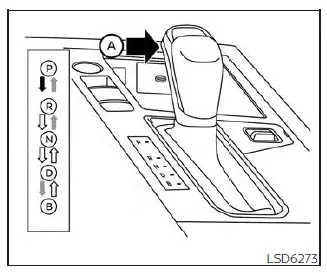
Shifting
To move the shift lever in the Nissan Kicks, follow the indicated shift pattern and use the shift lever button only when required.
 Press the button A while depressing
the brake pedal
Press the button A while depressing
the brake pedal
 Press the button A to shift
 Shift without pressing the
button A
Shift without pressing the
button A
After the engine has started, fully depress the brake pedal and move the shift lever from P (Park) to the desired shift position. Smooth and deliberate shifting helps the Nissan Kicks CVT operate correctly and reduces unnecessary stress on the transmission.
WARNING
Apply the parking brake whenever the shift lever is in any position and the engine is not running. If the vehicle is not properly secured, it may move unexpectedly or roll away, which could result in serious personal injury or property damage.
P (Park)
CAUTION
To help prevent transmission damage, use the P (Park) position only when the Nissan Kicks is completely stopped.
Use P (Park) when the vehicle is parked or when starting the engine. Before selecting this position, make sure the Nissan Kicks has come to a complete stop.
The brake pedal should be depressed to move the shift lever from N (Neutral) or any drive position to P (Park).
The P (Park) position is automatically engaged if you switch off the ignition.
Apply the parking brake before leaving the vehicle. When parking on a hill, apply the parking brake first, then move the shift lever into the P (Park) position to reduce load on the transmission parking mechanism.
R (Reverse)
CAUTION
To prevent transmission damage, use the R (Reverse) position only when the vehicle is completely stopped.
Use R (Reverse) only for backing up the Nissan Kicks.
Make sure the vehicle is fully stopped before selecting R (Reverse). The brake pedal must be depressed to move the shift lever from P (Park), and the shift lever button must be pressed when shifting from N (Neutral) or any drive position into R (Reverse).
N (Neutral)
In N (Neutral), neither forward nor reverse drive is engaged.
The engine can be started in this position. If the engine stalls while the Nissan Kicks is moving, you may shift to N (Neutral) and restart the engine when conditions allow.
D (Drive)
Use D (Drive) for normal forward driving. This is the main driving position for everyday operation of the Nissan Kicks.
B (Brake)
Use B (Brake) when additional engine braking is needed, such as when descending steep grades, climbing steep slopes, or approaching sharp bends where better speed control is useful. Do not use B (Brake) for normal driving situations where D (Drive) is appropriate.
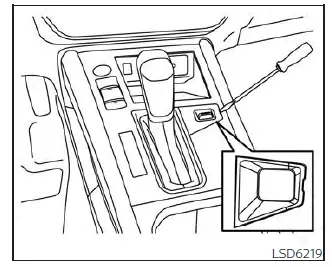
Shift lock release
If the battery charge is low or the battery is discharged, the shift lever may not move from the P (Park) position even when the brake pedal is depressed and the shift lever button is pressed.
The battery may need to be jump-started or charged before normal shifting is restored. For additional information, see "Jump starting". It is recommended that you contact a NISSAN dealer or a professional towing service for assistance.
To move the shift lever, complete the following procedure:
1. Push the ignition switch to the LOCK position.
2. Apply the parking brake securely.
3. Place a protective cloth over the tip of a small flat-head screwdriver, approximately 1/8 inch or 3 mm, and carefully remove the shift lock release cover.
- If a plastic trim tool is available, it may also be used to help reduce the chance of marking or damaging the surrounding trim.
4. Insert the rod from the spare tire tool kit into the shift lock release slot and push it in at an angle of about 45º. A small screwdriver or compact trim tool may also be used if handled carefully.
- For additional information, see "NISSAN Intelligent Key system".
5. Move the shift lever to the N (Neutral) position while continuing to hold the shift lock release down.
6. Push the ignition switch to the ON position.
The Nissan Kicks may now be moved to the desired location.
If the shift lever still cannot be moved out of P (Park), have the transmission inspected as soon as possible. It is recommended that you visit a NISSAN dealer for this service.
CAUTION
Use extra care when removing the shift lock cap, because this part can be damaged easily if too much force is applied.
WARNING
If the shift lever cannot be moved from the P (Park) position while the engine is running and the brake pedal is depressed, the stop lights may not operate correctly.
Malfunctioning stop lights can increase the risk of an accident and may cause injury to you and others.
Accelerator downshift - in D (Drive) position -
When additional power is needed for passing or climbing a hill, press the accelerator pedal fully to the floor. The Nissan Kicks CVT will automatically select a lower ratio, depending on vehicle speed and driving conditions, to provide stronger acceleration.
High fluid temperature protection mode
The transmission is equipped with a high fluid temperature protection mode. If the CVT fluid temperature becomes excessively high, such as when driving up steep grades in hot weather while carrying heavy loads, engine output and, in some situations, vehicle speed may be reduced automatically to help prevent transmission damage.
Vehicle speed can still be controlled with the accelerator pedal, but engine response and maximum vehicle speed may be limited until the transmission temperature returns to a safer operating range.
Fail-safe
If the Nissan Kicks is driven under extreme conditions, such as excessive wheel spinning followed by hard braking, the fail-safe system may activate.
The Malfunction Indicator Light (MIL) may illuminate to show that fail-safe mode has been activated.
This can occur even when all electrical circuits are operating correctly.
In this situation, place the ignition switch in the OFF position and wait for 10 seconds.
Then push the switch back to the ON position. The vehicle should return to normal operation. If normal operation does not return, have the transmission inspected and repaired if necessary. It is recommended that you visit a NISSAN dealer for this service.
WARNING
When high fluid temperature protection mode or fail-safe operation occurs, vehicle speed may be gradually reduced. The reduced speed may be lower than the speed of surrounding traffic, which can increase the risk of a collision. Drive with extra care. If necessary, move safely to the side of the road and allow the transmission to return to normal operation, or have the Nissan Kicks repaired if required.