



- Precautions on child restraints
- LATCH (Lower Anchors and Tethers for CHildren) system
- Rear-facing child restraint installation using LATCH
- Rear-facing child restraint installation using the seat belts
- Forward-facing child restraint installation using LATCH
- Forward-facing child restraint installation using the seat belts
- Booster seats
Precautions on child restraints Nissan Kicks 2026
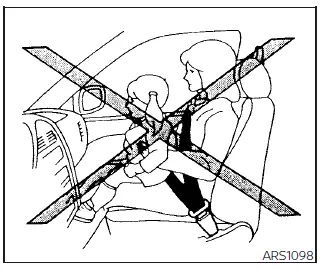
WARNING
- Failure to follow the warnings, recommendations, and installation instructions for child restraints in the Nissan Kicks may result in serious injury or death to a child or other vehicle occupants during a sudden stop, sharp maneuver, or collision.
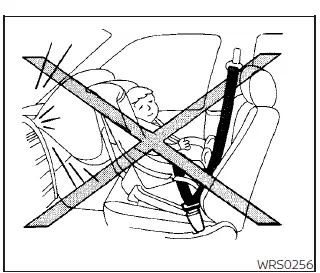
- The child restraint must always be installed and used correctly. Carefully follow all instructions provided by the child restraint manufacturer regarding installation, adjustment, and daily use.
- Never hold an infant or child on your lap while traveling in the Nissan Kicks. During a collision, even the strongest adult cannot safely restrain a child against crash forces.
- Never place a seat belt around both a child and another passenger at the same time.
- NISSAN strongly recommends installing child restraints in the rear seating area whenever possible. Safety studies consistently show that children are safer when properly restrained in the rear seat than in the front passenger seat. If a forward-facing child restraint must be installed in the front seat, refer to the section "Forward-facing child restraint installation using the seat belts".
- Even when equipped with the NISSAN Advanced Air Bag System, never install a rear-facing child restraint in the front passenger seat. Deployment of the front air bag could seriously injure or kill a child.
A rear-facing child restraint should always be installed in a rear seating position of the Nissan Kicks.
- Select a child restraint that properly fits both the child and the Nissan Kicks. Not every child restraint is compatible with every vehicle.
- Child restraint anchor points are engineered only for the loads generated by properly installed child restraint systems. Under no circumstances should these anchor points be used for adult seat belts, luggage restraints, cargo straps, or other equipment.
Improper use may damage the anchorages. A damaged anchorage may prevent correct child restraint installation and could increase the risk of serious injury or death in a collision.
- Never use child restraint anchor points for adult seat belts or unrelated equipment.
- A child restraint that uses a top tether strap should not be installed in the front passenger seating position.
- After installing a child restraint, keep the seatback as upright as possible while maintaining proper installation.
- Infants and children should always ride in an appropriate child restraint whenever traveling in the Nissan Kicks.
- When a child restraint is not being used, secure it with the LATCH system or a seat belt. In a sudden stop or collision, an unsecured child restraint can become a dangerous projectile capable of injuring occupants or damaging the vehicle interior.
CAUTION
A child restraint left inside a closed Nissan Kicks on a warm day may become extremely hot. Always check the seating surfaces, harness components, and buckles before placing a child into the restraint.
The Nissan Kicks is equipped with a universal child restraint anchoring system known as LATCH (Lower Anchors and Tethers for CHildren). Many modern child restraints include rigid connectors or webbing-mounted attachments designed specifically to connect directly to these anchors.
For additional information, see the section titled "LATCH (Lower Anchors and Tethers for CHildren) system".
If a LATCH-compatible child restraint is not available, the Nissan Kicks seat belt system may be used to secure an approved child restraint.
Manufacturers offer a wide range of child restraints designed for infants, toddlers, and older children. When selecting a child restraint for your Nissan Kicks, keep the following recommendations in mind:
- Choose only a child restraint carrying certification that it complies with Federal Motor Vehicle Safety Standard 213 or Canadian Motor Vehicle Safety Standard 213.
- Verify that the child restraint is compatible with the Nissan Kicks seat design, seating position, and restraint system.
- If the child restraint appears compatible, place the child in the restraint and confirm that all harnesses, supports, and adjustment features fit properly. Select a restraint designed specifically for the child's height, weight, and developmental stage.
- If the combined weight of the child and child restraint is less than 65 lbs. (29.5 kg), the LATCH lower anchors may be used for installation. Follow the child restraint manufacturer's instructions carefully.
- If the combined weight of the child and child restraint exceeds 65 lbs. (29.5 kg), install the child restraint using the Nissan Kicks seat belt system instead of the lower anchors.
- Always follow every installation and adjustment procedure provided by the child restraint manufacturer.
Before every trip, check that the child restraint is securely attached and does not move excessively from side to side or front to back. A properly installed child restraint is a critical part of the overall Nissan Kicks occupant protection system.
As children grow, periodically review whether the current restraint remains appropriate. Transitioning to the next restraint type should only occur when the child exceeds the height or weight limits specified by the manufacturer.
All U.S. states and Canadian provinces or territories require infants and young children to be secured in an approved child restraint whenever a vehicle is being operated. Canadian regulations also require the top tether strap of a forward-facing child restraint to be attached to the designated tether anchor point provided by the vehicle manufacturer.
Proper child restraint selection and installation are among the most important safety responsibilities for Nissan Kicks owners. Taking the time to install the restraint correctly can significantly improve protection for young passengers in everyday driving situations as well as during unexpected emergencies.
LATCH (Lower Anchors and Tethers for CHildren) system Nissan Kicks P16
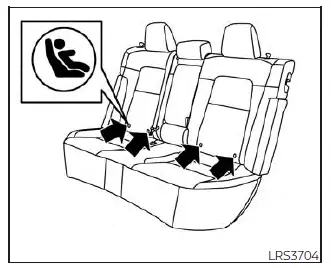
LATCH system lower anchor locations
The Nissan Kicks is equipped with dedicated anchor points designed for use with LATCH-compatible child restraint systems. This attachment method may also be referred to as ISOFIX or an ISOFIX-compatible system in some markets. When using a compatible child restraint, the LATCH system allows installation without using the vehicle seat belt, provided the combined weight of the child and child restraint does not exceed 65 lbs. (29.5 kg).
If the combined weight of the child and child restraint exceeds 65 lbs. (29.5 kg), the child restraint must be secured using the Nissan Kicks seat belt system rather than the lower anchors. Always follow the installation instructions supplied by the child restraint manufacturer.
The LATCH anchor points in the Nissan Kicks can be used to install compatible child restraints in either rear outboard seating position or, under specific conditions, in the center rear seating position. Refer to the following sections for detailed information regarding center-seat LATCH installation requirements.
LATCH lower anchor
WARNING
Failure to follow all warnings and installation instructions for child restraints may result in serious injury or death to a child or other occupants during a sudden stop or collision.
- Only install LATCH-compatible child restraints using the designated lower anchors shown in the illustrations. Refer to the appropriate installation procedures in this Nissan Kicks manual before beginning installation.
- Before attaching a child restraint, inspect the lower anchor area with your fingers. Verify that no seat
belt webbing, seat cushion material, or other objects are covering the anchors. A child restraint cannot
be installed correctly if the lower anchors are obstructed.
Child restraint anchorages are engineered exclusively for the forces generated by properly installed child restraint systems.
They must never be used to secure adult seat belts, cargo straps, harnesses, or any other equipment. Misuse may damage the anchorages, preventing proper child restraint installation and increasing the risk of serious injury or death in a collision.
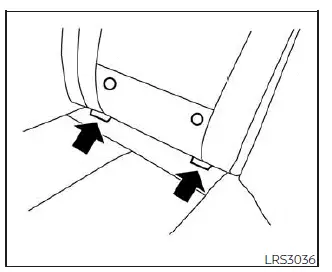
LATCH lower anchor location
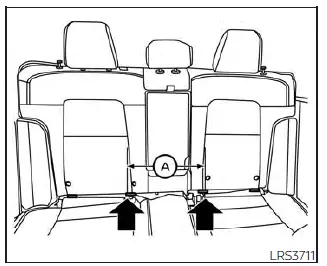
The LATCH lower anchors are positioned as illustrated. Labels attached to the seatback help identify the anchor locations and make installation easier when securing a child restraint in the Nissan Kicks.
LATCH in the center rear seating position
The Nissan Kicks does not provide dedicated LATCH anchors specifically for the center rear seating position. However, the inner LATCH anchors from the two outboard rear seating positions may be used together to install certain child restraint systems in the center seating location.
These anchors are separated by a distance A of 13 in (330 mm). Before attempting installation, confirm that the child restraint manufacturer specifically permits use of LATCH anchors spaced at this distance.
Child restraint systems equipped with rigid lower attachments cannot be installed in the center rear seating position. These restraint systems should only be installed in the rear outboard seating positions of the Nissan Kicks.
WARNING
Never attach two child restraint attachments to the same LATCH anchor. Doing so may overload the anchor during a collision and increase the risk of serious injury or death.
When installing a child restraint in the center rear seating position using the inboard LATCH anchors, make sure any passenger or child restraint in the outboard seating positions remains properly secured using the vehicle seat belt system and does not interfere with the center installation.
If proper restraint of outboard occupants cannot be achieved, consider securing the child restraint in the center position using the vehicle seat belt or relocating the child restraint to another approved seating location within the Nissan Kicks.
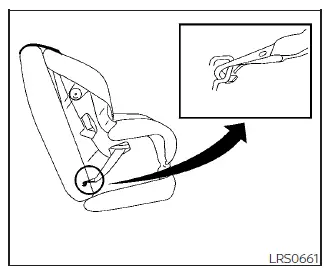
LATCH webbing-mounted attachment
Installing child restraint LATCH lower anchor attachments
LATCH-compatible child restraints include either rigid connectors or webbing-mounted attachments that connect directly to the vehicle's lower anchors. This design eliminates the need to use the seat belt for installation when weight limitations allow.
Check the child restraint for a label confirming LATCH compatibility. Installation details may also be found in the child restraint manufacturer's documentation.
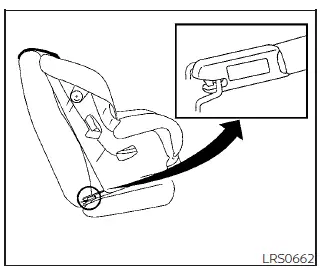
LATCH rigid-mounted attachment
Before installing a child restraint in the Nissan Kicks, carefully read and follow both the vehicle instructions and the instructions supplied with the child restraint. Correct installation is essential for maximizing occupant protection.
After installation, test the child restraint by pulling firmly in different directions. Excessive movement may indicate incorrect attachment or adjustment.
Top tether anchor
WARNING
- Do not allow cargo or other objects to contact the top tether strap while it is attached to the top tether anchor. Secure all cargo properly so it cannot interfere with the tether. Unsecured cargo may damage the tether strap during a collision. A damaged tether may fail to properly restrain the child restraint, increasing the risk of serious injury or death.
- The child restraint top tether strap may be damaged by contact with the tonneau cover or loose cargo. Remove the tonneau cover (if equipped) or secure it properly in the cargo area. All cargo should also be secured before driving. Damage to the tether strap may compromise child restraint performance during a collision.
- Child restraint anchorages are designed only for loads generated by properly installed child restraints.
These anchorages must never be used for adult seat belts, harnesses, luggage restraints, or any other equipment.
Improper use may damage the anchorage system. A damaged anchor point may prevent proper child restraint installation and could result in serious injury or death during a crash.
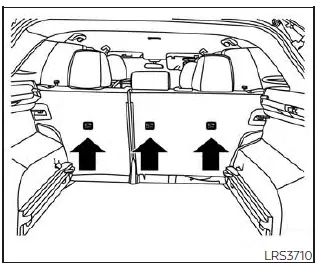
Top tether anchor point locations
The top tether anchor points in the Nissan Kicks are located on the rear side of the rear seatbacks as shown in the illustration. These anchor points provide an additional attachment location for compatible forward-facing child restraints and help reduce forward movement of the restraint during a collision.
For maximum safety, always verify that the top tether strap is routed correctly, attached securely to the designated anchor point, and tightened according to the child restraint manufacturer's recommendations before driving the Nissan Kicks.
Rear-facing child restraint installation using LATCH Nissan Kicks Owner's Manual
Before installing a rear-facing child restraint in the Nissan Kicks, carefully review all warnings, cautions, and child safety information provided in the "Child safety" and "Child restraints" sections of this manual.
Do not use the LATCH lower anchors if the combined weight of the child and the child restraint exceeds 65 lbs. (29.5 kg). When the combined weight is greater than this limit, the child restraint must be installed using the Nissan Kicks seat belt system instead of the lower anchors. Always follow the child restraint manufacturer's installation instructions in addition to the procedures outlined in this manual.
Use the following procedure to install a rear-facing child restraint using the Nissan Kicks LATCH system:
1. Place the rear-facing child restraint in the desired seating position.
Always position the child restraint according to the manufacturer's recommendations and verify that it sits securely on the vehicle seat.
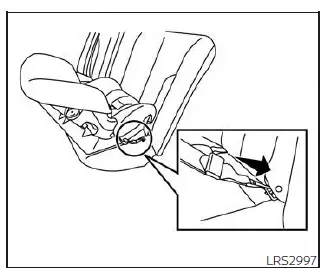
Rear-facing webbing-mounted - step 2
2. Attach the child restraint connectors to the Nissan Kicks LATCH lower anchors.
Carefully inspect each attachment point and verify that the connectors are fully engaged with the lower anchors. Improperly connected attachments may reduce the effectiveness of the child restraint during a collision.
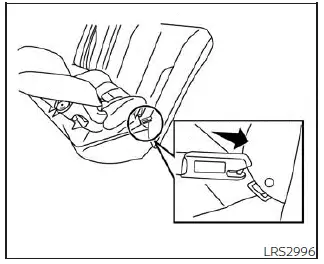
Rear-facing rigid-mounted - step 2
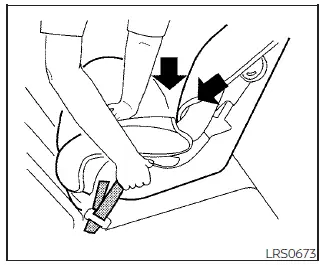
Rear-facing - step 3
3. For child restraints equipped with webbing-mounted attachments, remove all unnecessary slack from the attachment straps. Press firmly downward and toward the seatback in the center of the child restraint while tightening the webbing. This action compresses the Nissan Kicks seat cushion and seatback, helping create a tighter and more secure installation.
Continue tightening until the child restraint feels stable and properly secured against the vehicle seat. A properly installed rear-facing child restraint should fit snugly without excessive movement.
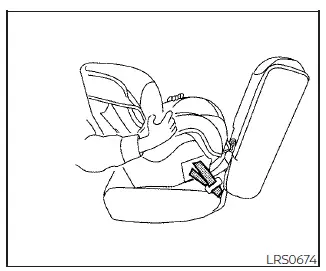
Rear-facing - step 4
4. After installation is complete, test the child restraint before placing a child inside it. Hold the child restraint near the LATCH attachment path and push it from side to side. The restraint should not move more than 1 inch (25 mm) in either direction.
Next, pull the restraint forward and verify that the Nissan Kicks LATCH attachments hold it securely in position. If excessive movement is detected, tighten the attachment straps further and repeat the inspection.
If the child restraint still does not fit securely, try installing it in a different seating position or install it using the Nissan Kicks seat belt system if permitted by the child restraint manufacturer. Keep in mind that not all child restraints fit every vehicle equally well.
Choosing a child restraint that is compatible with the Nissan Kicks seating design can improve installation quality and overall safety performance.
5. Before every trip, verify that the child restraint remains properly secured. If the restraint becomes loose or shifts from its installed position, repeat steps 1 through 4 until a secure installation is achieved.
Regular inspection of the installation is important because daily use, seat movement, or repeated loading and unloading of a child can gradually affect attachment tension. Properly securing a rear-facing child restraint in the Nissan Kicks helps provide the highest level of protection for infants and young children during everyday driving and emergency situations.
Rear-facing child restraint installation using the seat belts Nissan Kicks 2025
WARNING
When installing a rear-facing child restraint in the Nissan Kicks using the vehicle seat belt system, the three-point seat belt must be placed into Automatic Locking Retractor (ALR) mode.
Failure to activate ALR mode may prevent the child restraint from being secured correctly. An improperly installed restraint could tip, shift, or loosen during a sudden stop or collision, increasing the risk of injury to the child. Incorrect installation may also affect the operation of the front passenger air bag system. For additional information, refer to "Front passenger air bag and status light".
Before beginning installation, review all warnings, cautions, and child restraint information provided in the "Child safety" and "Child restraints" sections of this Nissan Kicks manual.
Do not use the lower anchors when the combined weight of the child and child restraint exceeds 65 lbs. (29.5 kg). If the combined weight is greater than this limit, install the child restraint using the Nissan Kicks seat belt system rather than the LATCH lower anchors. Always follow the child restraint manufacturer's instructions in addition to the procedures described here.
Follow the steps below to install a rear-facing child restraint using the rear seat belts of the Nissan Kicks:
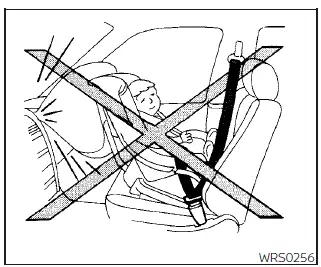
Rear-facing - step 1
1. Rear-facing child restraints designed for infants must always be installed facing the rear of the vehicle and should never be used in the front passenger seat. Position the child restraint securely on the rear seat of the Nissan Kicks and follow all manufacturer installation instructions.
Ensure the child restraint rests flat against the vehicle seat and is positioned according to the manufacturer's recommendations.
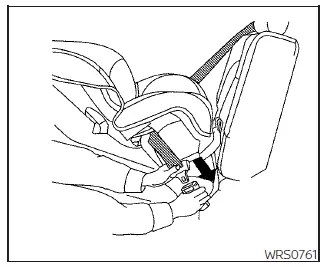
Rear-facing - step 2
2. Route the seat belt through the designated belt path on the child restraint and insert the belt tongue into the buckle until a distinct click is heard and felt.
Carefully verify that the belt follows the correct routing path specified by the child restraint manufacturer. Incorrect routing may reduce the effectiveness of the installation.
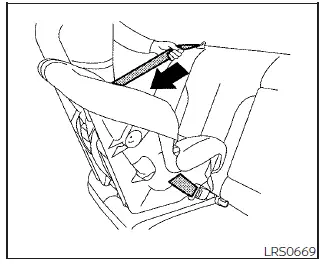
Rear-facing - step 3
3. Pull the shoulder belt completely out of the retractor until it reaches full extension. This action activates the Automatic Locking Retractor (ALR) mode, which is specifically intended for child restraint installation.
The seat belt will return to normal Emergency Locking Retractor (ELR) operation after it has been completely retracted following removal of the child restraint.
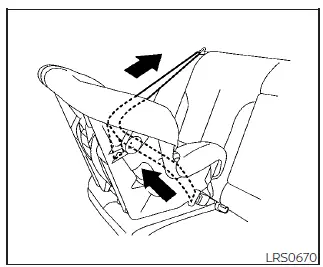
Rear-facing - step 4
4. Allow the seat belt to retract slowly while guiding it back into the retractor. Pull upward on the shoulder belt to remove slack and begin tightening the restraint against the seat.
During this process, listen for the characteristic clicking sound that confirms the Nissan Kicks seat belt remains in ALR mode.
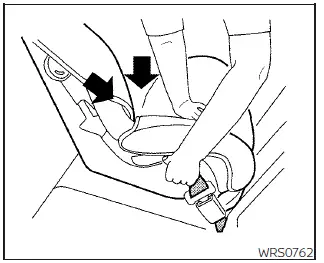
Rear-facing - step 5
5. Remove any remaining slack from the seat belt. While pulling upward on the belt, press firmly downward and toward the seatback in the center of the child restraint. This helps compress the Nissan Kicks seat cushion and seatback, creating a tighter and more secure installation.
A properly tightened child restraint should fit snugly against the vehicle seat without excessive movement.
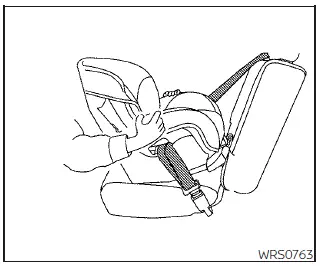
Rear-facing - step 6
6. After installation is complete, test the child restraint before placing the child inside. Hold the restraint near the seat belt path and push it side to side.
The child restraint should not move more than 1 inch (25 mm) from side to side. Next, pull the restraint forward and verify that the seat belt holds it firmly in place.
If excessive movement is detected, tighten the seat belt further and repeat the inspection. If a secure installation still cannot be achieved, try another seating position or consider a different child restraint model that may fit the Nissan Kicks more effectively.
Not all child restraints are compatible with every vehicle seating configuration, so installation results may vary.
7. Before every trip, verify that the child restraint remains properly secured. If the seat belt is not locked or the restraint has loosened, repeat steps 2 through 6 to restore a secure installation.
Regular inspection is important because normal vehicle use, seat adjustments, or repeated loading and unloading of the child may affect installation tightness over time.
After the child restraint is removed and the Nissan Kicks seat belt is allowed to fully retract, ALR mode (child restraint mode) is automatically canceled and the belt returns to normal ELR operation.
Correct installation of a rear-facing child restraint is one of the most important steps in protecting infants and young children. Taking the time to verify a secure fit in the Nissan Kicks helps maximize child passenger safety during everyday travel as well as emergency situations.
Forward-facing child restraint installation using LATCH Nissan Kicks 2026
Before installing a forward-facing child restraint in the Nissan Kicks, carefully review all warnings, cautions, and child safety information provided in the "Child safety" and "Child restraints" sections of this manual.
Do not use the Nissan Kicks LATCH lower anchors if the combined weight of the child and the child restraint exceeds 65 lbs. (29.5 kg). When the combined weight is greater than this limit, the child restraint must be secured using the vehicle's seat belt system rather than the lower anchors. Always follow the child restraint manufacturer's installation instructions for proper fit and safety.
Use the following procedure to install a forward-facing child restraint using the Nissan Kicks LATCH system:
1. Position the forward-facing child restraint in the desired seating location.
Place the child restraint firmly against the vehicle seat and carefully follow all instructions supplied by the child restraint manufacturer.
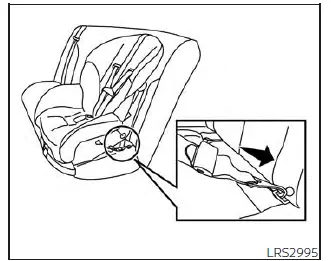
Forward-facing webbing-mounted -
step 2
2. Attach the child restraint connectors securely to the Nissan Kicks LATCH lower anchors.
After connecting the attachments, verify that each connector is fully engaged and locked onto the lower anchors. Proper attachment is essential for safe child restraint performance.
If the child restraint includes a top tether strap, route the tether according to the manufacturer's instructions and attach it securely to the designated Nissan Kicks top tether anchor point. For additional information, refer to "Installing top tether strap". Never install a child restraint requiring a top tether in a seating position that does not provide a suitable tether anchor.
The top tether helps reduce forward movement of the child restraint during a collision and can significantly improve overall restraint performance when installed correctly.
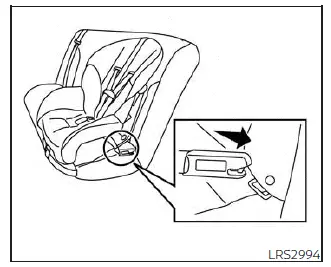
Forward-facing rigid-mounted - step 2
3. Make sure the rear surface of the child restraint rests firmly against the Nissan Kicks seatback.
If necessary, adjust or temporarily remove the head restraint/headrest to achieve the best possible fit. When a head restraint/headrest is removed, store it in a secure location where it cannot become a hazard during driving.
After the child restraint is removed, reinstall and properly adjust the head restraint/headrest before the seating position is used by a passenger. For additional information, see "Head restraints/headrests".
If the seating position is equipped with a non-adjustable head restraint/headrest that interferes with correct installation, consider using a different seating position or selecting another child restraint model that is more compatible with the Nissan Kicks interior configuration.
A proper fit between the child restraint and the seatback is important because gaps between the restraint and seatback can reduce installation stability.
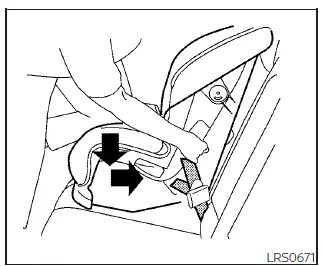
Forward-facing - step 4
4. For child restraints equipped with webbing-mounted LATCH attachments, remove all excess slack from the attachment straps. Press firmly downward and rearward into the center of the child restraint with your knee while tightening the attachment webbing.
This process compresses the Nissan Kicks seat cushion and seatback, helping create a tighter and more secure installation. Continue tightening until the child restraint feels firmly attached and movement is minimized.
A properly installed forward-facing child restraint should sit securely against the vehicle seat with minimal side-to-side or front-to-back movement. Taking extra time during installation can significantly improve safety and stability for child passengers traveling in the Nissan Kicks.
After installation is complete, always inspect all attachment points, verify proper top tether tension if equipped, and confirm that the child restraint remains securely fastened before every trip. Regular inspection helps ensure that the Nissan Kicks child restraint system continues to provide reliable protection during everyday driving and emergency situations.
5. Tighten the top tether strap exactly as described in the child restraint manufacturer's instructions until all slack is removed. In the Nissan Kicks, a properly tightened tether strap helps limit forward movement of the child restraint during a sudden stop or collision.
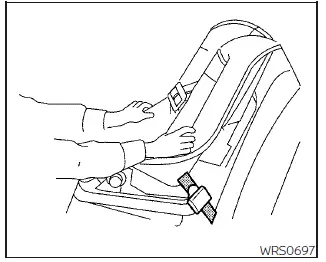
Forward-facing - step 6
6. After the child restraint has been attached, test the installation before placing the child in it. Hold the child restraint near the LATCH attachment path and push it from side to side. The restraint should not move more than 1 inch (25 mm) in either direction. Then pull it forward to confirm that the LATCH attachments hold it firmly in place.
If the restraint is not secure, tighten the LATCH attachments again as needed, or move the child restraint to another approved seating position in the Nissan Kicks and test it again.
A different child restraint may be required. Not all child restraints fit every vehicle seat design, so compatibility should always be checked carefully.
7. Before every trip, confirm that the child restraint remains properly secured. If the child restraint is loose, repeat steps 1 through 6 until the installation is stable and secure.
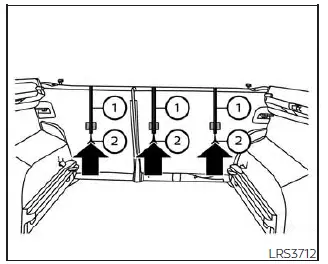
Rear seats
- Top tether strap
- Anchor point
Installing top tether strap
The child restraint top tether strap must be used when installing a compatible child restraint with the LATCH lower anchor attachments in the Nissan Kicks.
First, secure the child restraint to the LATCH lower anchors. This applies to the rear outboard seating positions only.
Rear bench seat
OUTBOARD SEATING POSITIONS
1. Remove the head restraint/headrest and store it in a safe place where it cannot move around inside the Nissan Kicks. Reinstall the head restraint/headrest after the child restraint is removed.
For additional information, see "Head restraints/headrests".
2. Route the top tether strap as shown in the illustration, making sure it is not twisted and does not interfere with nearby trim, cargo, or seat components.
3. Attach the tether strap securely to the designated tether anchor point as shown.
4. Tighten the tether strap according to the child restraint manufacturer's instructions until all slack is removed.
If you have any questions while installing a top tether strap in the Nissan Kicks, it is recommended that you visit a NISSAN dealer for assistance.
WARNING
Child restraint anchorages are designed to withstand only the loads produced by correctly installed child restraints.
Under no circumstances should these anchorages be used to attach adult seat belts, cargo straps, harnesses, or any other items or equipment to the Nissan Kicks. Misuse can damage the child restraint anchorages. If the anchorage is damaged, the child restraint may not be installed correctly, and a child could be seriously injured or killed in a collision.
After the top tether strap is installed, always check that the child restraint is firmly secured and that the tether remains properly tightened. A secure top tether connection is an important part of forward-facing child restraint safety in the Nissan Kicks.
Forward-facing child restraint installation using the seat belts Nissan Kicks P16
WARNING
When installing a child restraint in the Nissan Kicks with the vehicle seat belt, the three-point seat belt with Automatic Locking Retractor (ALR) mode must be used.
If ALR mode is not activated, the child restraint may not be held securely. The restraint could loosen, tip, or shift during a sudden stop or collision, increasing the risk of injury to the child. Improper installation may also affect operation of the front passenger air bag system. For additional information, see "Front passenger air bag and status light".
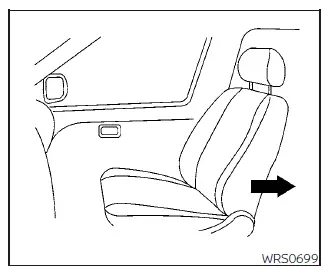
Forward-facing (front passenger seat) -
step 1
Before installing a forward-facing child restraint in the Nissan Kicks, review all warnings and cautions in the "Child safety" and "Child restraints" sections.
Do not use the lower anchors if the combined weight of the child and child restraint exceeds 65 lbs. (29.5 kg). If the combined weight is greater than 65 lbs. (29.5 kg), install the child restraint with the Nissan Kicks seat belt system instead of the lower anchors. Always follow the child restraint manufacturer's instructions.
Follow these steps to install a forward-facing child restraint using the vehicle seat belt in the rear seats or, only when necessary, in the front passenger seat:
1. If a child restraint must be installed in the front passenger seat, it must be forward-facing only. Move the front passenger seat to the rearmost position before installation.
Infant restraints are designed for rear-facing use and must not be installed in the front passenger seat.
2. Position the child restraint on the selected seat.
Always follow the child restraint manufacturer's installation instructions.
The back of the child restraint should rest firmly against the Nissan Kicks seatback.
If needed, adjust or remove the head restraint/headrest to obtain a proper child restraint fit. If the head restraint/headrest is removed, store it securely so it cannot move around inside the vehicle. Reinstall the head restraint/headrest after the child restraint is removed. For additional information about adjustment, removal, and installation, see "Head restraints/headrests".
If the seating position does not have an adjustable head restraint/headrest and it prevents a secure child restraint fit, use another approved seating position or choose a different child restraint that fits the Nissan Kicks more correctly.
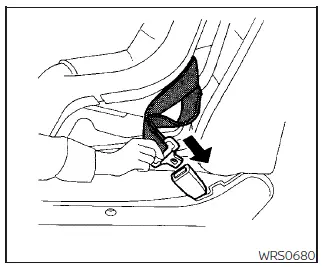
Forward-facing - step 3
3. Route the seat belt tongue through the correct belt path on the child restraint and insert it into the buckle until you hear and feel the latch engage. Make sure the belt follows the routing path specified by the child restraint manufacturer.
If the child restraint is equipped with a top tether strap, route the top tether strap and secure it to the designated tether anchor point for rear seat installation only. For additional information, see "Installing top tether strap".
Do not install a child restraint that requires a top tether strap in any seating position that does not have a top tether anchor.
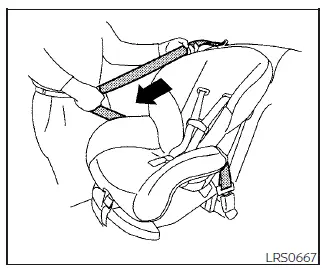
Forward-facing - step 4
4. Pull the shoulder belt completely out of the retractor. At this point, the Nissan Kicks seat belt retractor enters Automatic Locking Retractor (ALR) mode, also called child restraint mode. The belt will return to Emergency Locking Retractor (ELR) mode after it is fully retracted.
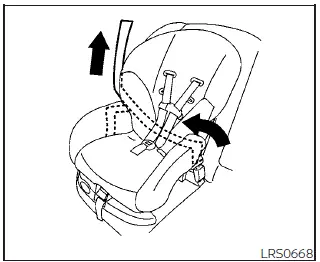
Forward-facing - step 5
5. Allow the seat belt to retract. Pull upward on the shoulder belt to remove slack and begin tightening the child restraint against the vehicle seat.
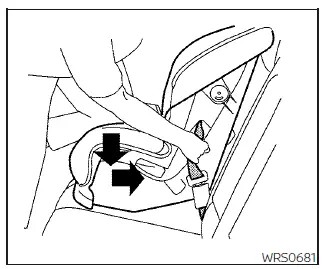
Forward-facing - step 6
6. Remove any remaining slack from the seat belt. Press firmly downward and rearward in the center of the child restraint with your knee to compress the Nissan Kicks seat cushion and seatback while pulling up on the seat belt.
7. Tighten the top tether strap, if equipped, according to the child restraint manufacturer's instructions until all slack is removed.
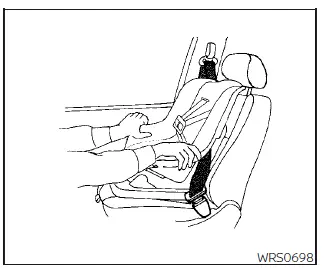
Forward-facing - step 8
8. After the child restraint is attached, test the installation before placing the child in it. Hold the restraint near the seat belt path and push it from side to side. The child restraint should not move more than 1 inch (25 mm) in either direction. Pull it forward to confirm that the seat belt holds it firmly in place.
If the child restraint is not secure, tighten the seat belt again or move the restraint to another suitable seating position in the Nissan Kicks and test it again. A different child restraint may be required if a stable installation cannot be achieved.
Not all child restraints fit every vehicle seat design, so compatibility should always be confirmed during installation.
9. Before each trip, check that the child restraint is still properly secured. If the seat belt is not locked or the restraint has loosened, repeat steps 2 through 8.
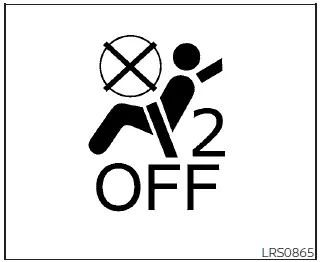
Forward-facing - step 10
10. If the child restraint is installed in the front passenger seat, place the ignition switch in the ON
position. The front passenger air bag status light
 should illuminate. If this light does not illuminate, see "Front passenger air bag and status light". Move the
child restraint to another seating position.
should illuminate. If this light does not illuminate, see "Front passenger air bag and status light". Move the
child restraint to another seating position.
Have the system inspected. It is recommended that you visit a NISSAN dealer for this service.
After the child restraint is removed and the Nissan Kicks seat belt is fully retracted, ALR mode is canceled and the belt returns to normal ELR operation.
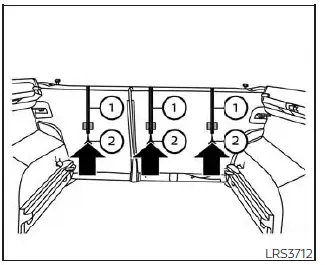
Rear seats
- Top tether strap
- Anchor point
Installing top tether strap
The child restraint top tether strap must be used when installing a compatible forward-facing child restraint with the Nissan Kicks seat belt system.
First, secure the child restraint with the seat belt, then attach and tighten the tether strap according to the child restraint manufacturer's instructions.
Rear bench seat
OUTBOARD SEATING POSITIONS
1. Remove the head restraint/headrest and store it in a secure place where it cannot become a loose object inside the Nissan Kicks. Reinstall the head restraint/headrest when the child restraint is removed.
For additional information, see "Head restraints/headrests".
2. Route the top tether strap as shown, making sure it is not twisted.
3. Attach the tether strap securely to the tether anchor point as shown.
4. Tighten the tether strap according to the child restraint manufacturer's instructions to remove all slack.
CENTER SEATING POSITION
1. Route the top tether strap as shown in the illustration.
2. Secure the tether strap to the designated tether anchor point.
3. Tighten the tether strap according to the manufacturer's instructions until no slack remains.
If you have any questions when installing a top tether strap in the Nissan Kicks, it is recommended that you visit a NISSAN dealer for assistance.
WARNING
Child restraint anchorages are designed to withstand only the loads applied by correctly installed child restraints.
They must never be used to attach adult seat belts, cargo straps, harnesses, or other equipment to the Nissan Kicks. Misuse can damage the anchorages. If an anchorage is damaged, the child restraint may not be installed correctly, and a child could be seriously injured or killed in a collision.
After installation, always confirm that the seat belt is locked, the tether strap is tight, and the child restraint is stable. A careful installation check helps the Nissan Kicks provide better protection for young passengers during daily driving and emergency situations.
Booster seats Nissan Kicks crossover
For additional information about installing a booster seat in the Nissan Kicks, follow the instructions and safety guidance provided in this section.
Precautions on booster seats
WARNING
If a booster seat and seat belt are not used correctly, the risk of a child being seriously injured or killed in a sudden stop or collision is greatly increased:
- Make sure the shoulder belt stays away from the child's face and neck, and that the lap belt does not cross the stomach.
- Never place the shoulder belt behind the child or under the child's arm.
- A booster seat must only be used in a Nissan Kicks seating position equipped with a lap/shoulder belt.
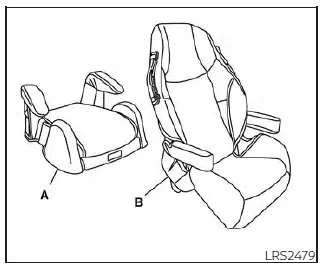
- Low back booster seat
- High back booster seat
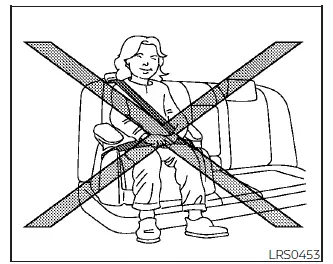
Booster seats are available in different sizes and designs from several manufacturers. When choosing a booster seat for the Nissan Kicks, keep the following points in mind:
- Select only a booster seat with a certification label showing that it complies with Federal Motor Vehicle Safety Standard 213 or Canadian Motor Vehicle Safety Standard 213.
- Test the booster seat in the Nissan Kicks to confirm that it fits the vehicle seat properly and works correctly with the lap/shoulder belt system.
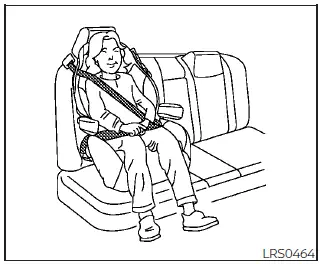
- Confirm that the child's head is properly supported by either the booster seat or the vehicle seatback. The seatback should reach at least the center of the child's ears. If a low back booster seat is used, the Nissan Kicks seatback must be high enough to support the child's head. If it is not, use a high back booster seat.
- If the booster seat is compatible with the Nissan Kicks, place the child in it and check all adjustments. Make sure the booster seat fits the child's height and weight, and always follow the manufacturer's recommended procedures.
All U.S. states and Canadian provinces or territories require that infants and small children be restrained in an approved child restraint at all times while the vehicle is being operated.
The instructions in this section apply to booster seat installation in the rear seats or, when necessary, in the front passenger seat of the Nissan Kicks.
Booster seat installation
WARNING
To help avoid injury to the child, do not use the lap/shoulder belt in Automatic Locking Retractor (ALR) mode when using a booster seat with the seat belts.
Before installing a booster seat, review all warnings, cautions, and instructions in "Child safety", "Child restraints", and "Booster seats".
Follow these steps to install a booster seat in the rear seat or in the front passenger seat:
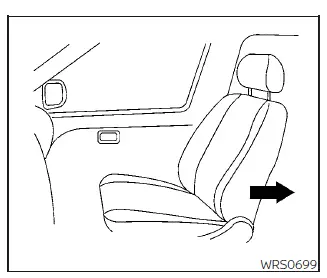
1. If a booster seat must be installed in the front passenger seat, move the seat to the rearmost position.
2. Place the booster seat on the selected seat.
Install the booster seat only in a forward-facing direction.
Always follow the booster seat manufacturer's installation and adjustment instructions.
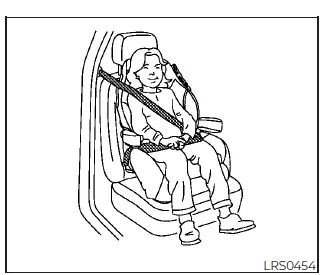
Front passenger position
3. The booster seat should sit flat and stable on the Nissan Kicks vehicle seat.
If necessary, adjust or remove the head restraint/headrest to achieve the correct booster seat fit. If the head restraint/headrest is removed, store it securely so it cannot move around inside the vehicle. Reinstall the head restraint/headrest after the booster seat is removed. For additional information, see "Head restraints/headrests".
If the seating position does not have an adjustable head restraint/headrest and it interferes with proper booster seat placement, try another seating position or use a different booster seat that fits the Nissan Kicks more securely.
4. Position the lap portion of the seat belt low and snug across the child's hips. Always follow the booster seat manufacturer's instructions for correct belt routing.
5. Pull the shoulder belt toward the retractor to remove extra slack. Make sure the shoulder belt crosses the upper middle part of the child's shoulder and chest. It should not touch the face or neck and should not slip off the shoulder.
6. Follow all warnings, cautions, and instructions for proper seat belt use shown in "Three-point type seat belt with retractor".
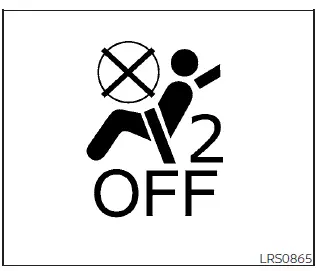
7. If the booster seat is installed in the front passenger seat, place the ignition switch in the ON position.
The front passenger air bag status light
 may or may not illuminate, depending on the child's size and the type of booster seat being used.
Before driving the Nissan Kicks, always confirm that the child is seated correctly, the lap belt is low on the hips, the shoulder belt is centered across the chest and shoulder, and the child can remain properly positioned for the entire trip.